Real Fruit, Real Flowers, Real Roots: What Your Kombucha Ingredients Actually Do Inside Your Body
Walk down the kombucha aisle in any Singapore supermarket and you will see the same words repeated across every label. Elderberry. Turmeric. Hibiscus. Butterfly pea flower. These ingredients sound potent. Some of them genuinely are. But there is a question no front-of-pack claim will ever answer for you: does your body actually absorb any of it?
The answer depends on two things — whether the brand used the real ingredient, and what happens to that ingredient during fermentation. These are not minor details. They are the difference between a functional beverage and an expensive cup of flavoured tea.
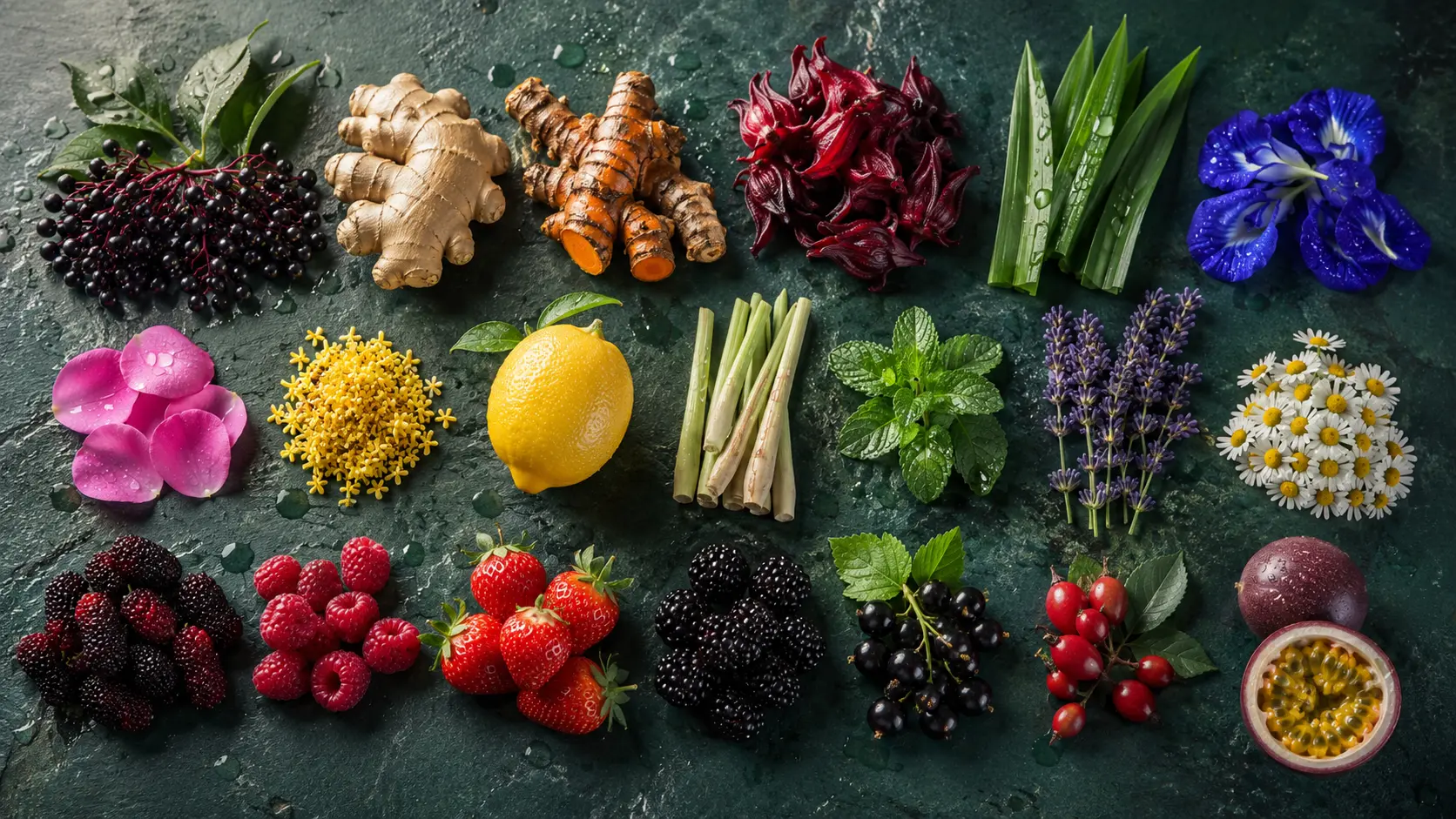
The question that matters: does it survive fermentation?
This is a guide to 20 ingredients commonly found in kombucha. For each one, we answer three questions: what compounds does it contain and what are they associated with? What does fermentation do to those compounds? And after brewing — is the benefit still there, still accessible, still worth anything to your body?
What is bioavailability? It is the proportion of a compound that actually enters your bloodstream and reaches the tissues where it can act. A food can be rich in beneficial compounds on paper — and still deliver very little to your body, because of how it was processed, what it was paired with, or how your gut handles it. This gap between label and body is where a lot of functional food marketing quietly lives.
Note throughout: compound presence is not the same as a proven health outcome. Where we say an ingredient “is associated with” a benefit, we mean the compounds it contains have been studied in that context — not that drinking kombucha will produce a guaranteed clinical effect.
Fermentation changes this equation in interesting ways. The acidic environment of well-brewed kombucha (pH 2.5–3.5) can stabilise compounds that would otherwise degrade. The live cultures produce enzymes and organic acids that break down plant cell walls, releasing compounds that were previously locked inside. Some ingredients are actually transformed during fermentation into metabolites that are more bioavailable than the original molecule.
None of this happens if the ingredient is added as a flavoring after fermentation. Or if the product is pasteurised. Or if what appears on the label is “natural flavoring” — a term that, in Singapore, carries no regulatory definition and no minimum quantity requirement. Keep that in mind as you read through what follows.
Part One — Herbs & Roots
Chamomile
Key compounds: Apigenin · Bisabolol · Chamazulene
Associated with: Apigenin, chamomile’s primary flavonoid, has been studied for its calming properties — it binds to the same receptors in the brain involved in anxiety regulation. Bisabolol has antimicrobial and anti-inflammatory properties studied in the context of gut lining health. Chamazulene contributes antioxidant activity.
After fermentation — still beneficial? Yes, and the acidic environment of kombucha actually works in apigenin’s favour. Bioavailability of apigenin increases in low-pH conditions, meaning authentic kombucha is a better delivery format than neutral water or tea. Bisabolol’s antimicrobial properties complement rather than compete with the live cultures in the brew. The benefit is largely intact — provided real chamomile was used.
On the label, look for: Chamomile flowers or dried chamomile. “Chamomile flavoring” delivers the aroma. None of the active compounds.
Ginger
Key compounds: Gingerols · Shogaols · Zingerone
Associated with: Gingerols are associated with anti-inflammatory activity, digestive support, and nausea relief — one of the most well-documented herb benefits across clinical research. Zingerone contributes antioxidant properties.
After fermentation — still beneficial? Better. This is one of the clearest positive fermentation stories in this list. Gingerols convert to shogaols in acidic, heated conditions — and shogaols are significantly more bioavailable and more potent in their anti-inflammatory activity than the raw form. Fermentation does not diminish ginger. It upgrades it. Ginger also actively stimulates yeast activity during second fermentation, contributing to natural carbonation. A brand using real ginger root is getting more out of the ingredient after brewing than before.
On the label, look for: Ginger root, fresh ginger, ginger juice. These are meaningfully different from ginger flavoring — which delivers none of the gingerol-to-shogaol conversion.
Lavender
Key compounds: Linalool · Linalyl acetate · Rosmarinic acid
Associated with: Linalool is associated with calming and anxiolytic effects in aromatherapy research. Rosmarinic acid is a polyphenol associated with antioxidant and anti-inflammatory activity. Linalyl acetate contributes to lavender’s relaxant properties.
After fermentation — still beneficial? Partially. Linalool is volatile — it partially dissipates during fermentation, so the aromatherapy benefit is reduced in a liquid kombucha compared to inhaled lavender. However, rosmarinic acid is acid-stable and survives fermentation at useful concentrations, preserving its antioxidant contribution. The honest verdict: lavender in kombucha retains its polyphenol benefit but loses some of the volatile compound activity it is most known for. Still worthwhile as a real botanical — just different from lavender essential oil.
On the label, look for: Lavender flowers, dried lavender. Real lavender contributes rosmarinic acid and genuine botanical complexity. Lavender flavoring contributes neither.
Lemongrass
Key compounds: Citral · Limonene · Geraniol
Associated with: Citral is associated with antimicrobial and antifungal activity — studies have shown activity against Candida species and certain pathogenic bacteria, directly relevant in a gut health context. Geraniol has shown activity against gut inflammation markers in preliminary research. Limonene is associated with digestive support.
After fermentation — still beneficial? Yes. Citral is notably stable in acidic environments — it survives the fermentation process at useful concentrations, which is unusual for aromatic compounds. This means the antimicrobial properties associated with lemongrass are largely preserved in a well-fermented kombucha. For a Southeast Asian ingredient in a Singapore-made product, the functional case is genuinely strong — and the compounds hold up through brewing.
On the label, look for: Lemongrass, fresh lemongrass. Citral’s acid stability means real lemongrass delivers its associated benefit through fermentation. Lemongrass flavoring does not.
Mint
Key compounds: Menthol · Rosmarinic acid · Luteolin
Associated with: Menthol is associated with digestive comfort and IBS symptom relief in clinical research. Rosmarinic acid is associated with antioxidant and anti-inflammatory activity. Luteolin is associated with antioxidant and neuroprotective properties.
After fermentation — still beneficial? Mixed. Menthol is highly volatile and significantly lost during fermentation — the digestive benefit mint is best known for is reduced compared to consuming fresh mint or peppermint tea. However, rosmarinic acid and luteolin are both acid-stable and survive fermentation at meaningful concentrations, preserving their antioxidant contribution. The verdict: real mint in kombucha still delivers polyphenol benefit, but the menthol-driven digestive effect is diminished. Worth using as a real ingredient — just with realistic expectations about which properties carry through.
On the label, look for: Mint leaves, peppermint, spearmint. Real mint delivers rosmarinic acid and luteolin through fermentation. Mint flavoring delivers taste only.
Turmeric
Key compounds: Curcumin · Turmerones · Polysaccharides
Associated with: Curcumin is one of the most studied anti-inflammatory compounds in nutritional science. Turmerones are associated with neuroprotective and anti-inflammatory activity. Turmeric’s polysaccharides are associated with immune modulation.
After fermentation — still beneficial? Complicated — but cautiously yes, more than you might expect. Curcumin has a well-documented bioavailability problem: it is fat-soluble, rapidly metabolised, and poorly absorbed on its own in water-based formats. However, fermentation research suggests live cultures may biotransform curcumin into tetrahydrocurcumin — a metabolite that is more water-soluble and potentially more bioavailable than the parent compound. This is not confirmed, but it is mechanistically plausible. Beyond curcumin, turmerones and polysaccharides from whole turmeric root are more stable in acidic conditions and likely survive fermentation better than curcumin itself. The honest verdict: whole turmeric root in authentic kombucha probably delivers more than most people assume — but less than a curcumin supplement with a bioavailability enhancer. Turmeric flavoring delivers none of it.
On the label, look for: Turmeric root, turmeric juice, fresh turmeric. Be sceptical of turmeric flavoring paired with any anti-inflammatory claim.
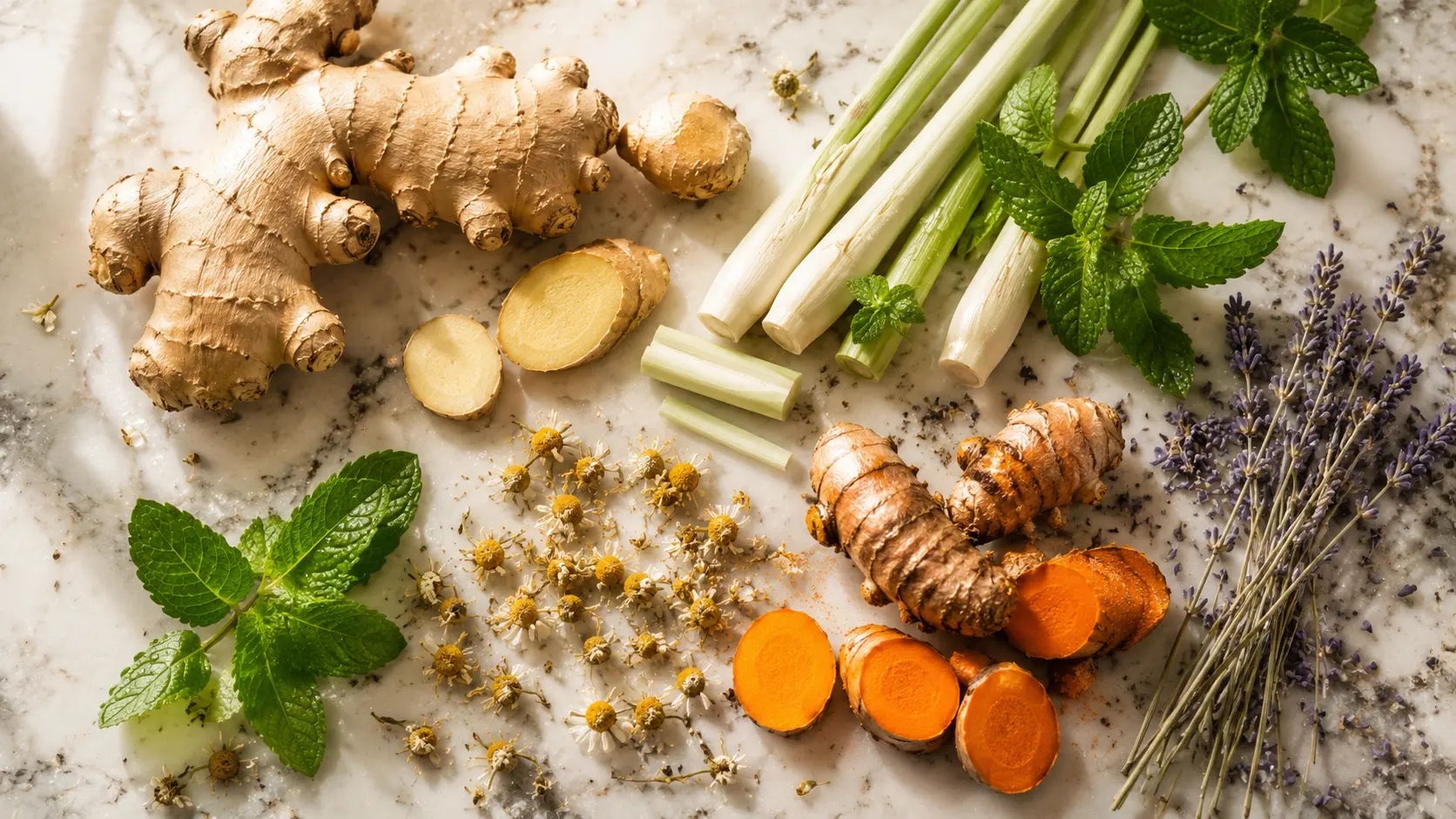
Part Two — Botanicals & Flowers
Butterfly Pea Flower
Key compounds: Anthocyanins (ternatins) · Flavonoids · Proanthocyanidins
Associated with: Ternatins and anthocyanins are associated with antioxidant, anti-inflammatory, and cardiovascular protective effects. Proanthocyanidins are associated with collagen support and vascular health. Butterfly pea flower has also been studied for potential neuroprotective and memory-supportive properties.
After fermentation — still beneficial? Yes — and visibly so. The acidic environment of authentic kombucha is one of the better-known stabilisers for anthocyanins. The colour shift from blue to purple to pink is not just beautiful — it is direct visual confirmation that the anthocyanins are intact and reacting to the fermentation-generated acidity. A pink or purple butterfly pea kombucha is showing you that the active compounds are present and that the fermentation environment is preserving them. The antioxidant and anti-inflammatory associations carry through fermentation well.
On the label, look for: Butterfly pea flower, Clitoria ternatea. The colour change in the bottle is your confirmation that the active anthocyanins are present and the fermentation pH is authentic.
Hibiscus
Key compounds: Anthocyanins · Organic acids · Vitamin C · Protocatechuic acid
Associated with: Hibiscus anthocyanins and protocatechuic acid have been studied for blood pressure regulation and LDL cholesterol reduction in multiple clinical trials — among the stronger human evidence bases for any botanical in this list. Vitamin C contributes antioxidant activity and enhances absorption of other polyphenols consumed alongside it.
After fermentation — still beneficial? Yes — hibiscus is one of the best functional matches for kombucha fermentation of any botanical. Its own organic acids complement the fermentation environment rather than competing with it. Critically, hibiscus anthocyanins are stabilised by acidity — heat and alkaline processing degrade them rapidly, but the low pH of authentic kombucha preserves them. The blood pressure and cholesterol associations are linked specifically to the anthocyanin and protocatechuic acid content, both of which survive fermentation well. The benefit carries through.
On the label, look for: Hibiscus flowers, Hibiscus sabdariffa, dried hibiscus. The deep red colour is a reasonable indicator — though it can be replicated, so the ingredient list remains the final check.
Magnolia
Key compounds: Honokiol · Magnolol · Polyphenols
Associated with: Honokiol and magnolol have been studied for antioxidant, anti-anxiety, and neuroprotective properties. Honokiol is one of the few polyphenols with meaningful blood-brain barrier permeability, which is relevant to the nervous system effects studied. Human clinical evidence remains limited — most research is cell and animal studies.
After fermentation — still beneficial? Unknown. The fermentation interaction for magnolia’s specific active compounds has not been meaningfully studied. Honokiol and magnolol are polyphenols with reasonable acid stability in general, suggesting they may partially survive fermentation — but this has not been confirmed for kombucha specifically. The honest verdict: the research on magnolia in fermented beverages simply does not exist yet. Its presence in a kombucha signals serious formulation intent. Whether the associated benefits survive brewing is an open question.
On the label, look for: Magnolia bark, magnolia flower, magnolia extract. Rarely seen in Singapore kombucha — its presence signals a serious formulator willing to work with frontier ingredients.
Osmanthus
Key compounds: Beta-ionone · Linalool · Polyphenols · Flavonoids
Associated with: Beta-ionone is associated with antioxidant activity and has been studied for potential anti-tumour properties in early research. Linalool is associated with calming effects. The flavonoid content contributes general antioxidant activity.
After fermentation — still beneficial? Partially. Beta-ionone and linalool are volatile aroma compounds — they partially dissipate during fermentation, reducing the aromatic intensity and some of the associated activity. The flavonoids are more stable in acidic conditions and survive better. The honest position: osmanthus in kombucha contributes genuine antioxidant activity from its flavonoid fraction after fermentation, but the volatile compound benefits are reduced. It is primarily a premium flavour and craft ingredient — the functional contribution is modest but real. A flavoring extract delivers none of it.
On the label, look for: Osmanthus flowers, dried osmanthus. A signal of genuine craft intent — the flavonoid benefit survives fermentation even where the volatile aroma compounds partially dissipate.
Pandan
Key compounds: 2-acetyl-1-pyrroline · Alkaloids · Flavonoids · Glycosides
Associated with: Pandan alkaloids and glycosides have been studied for blood sugar modulation, antimicrobial activity, and antioxidant effects in multiple in-vitro studies. Traditional use across Southeast Asia includes applications for headache relief, digestive support, and wound healing. The flavonoid content contributes antioxidant activity.
After fermentation — still beneficial? Likely yes. Alkaloids and glycosides are generally stable in acidic conditions — the fermentation environment does not appear to degrade the compounds most associated with pandan’s studied effects. The blood sugar modulation and antimicrobial associations are linked to compounds with reasonable acid stability. The honest caveat: pandan in kombucha fermentation has not been specifically studied, so this is an extrapolation from general compound chemistry rather than direct evidence. But the direction is positive — and among all the ingredients in this list, pandan in a Singapore-made kombucha is the most underexplored functional territory with the most genuine local relevance.
On the label, look for: Pandan leaves, fresh pandan, pandan extract. Virtually no English-language kombucha content covers pandan seriously. Its presence signals a producer thinking locally and rigorously.
Pink Rose
Key compounds: Anthocyanins · Geraniol · Vitamin C · Tannins · Flavonoids
Associated with: Tannins are associated with antimicrobial activity and gut health support. Anthocyanins are associated with antioxidant and cardiovascular protective effects. Vitamin C contributes immune support and enhances absorption of other polyphenols. Rose has documented use in traditional medicine for gut motility and digestive comfort.
After fermentation — still beneficial? Yes, with one partial exception. Tannins interact constructively with the fermentation environment — they contribute to the organic acid profile and their antimicrobial properties complement the live culture ecosystem. Anthocyanins and vitamin C are both preserved by the acidic conditions. The partial exception is geraniol, the primary aroma compound, which is volatile and partially lost during fermentation. The gut health and antioxidant associations carry through well. The aromatic intensity reduces. The functional benefit of real rose petals in kombucha is genuine and largely intact after brewing.
On the label, look for: Rose petals, rosa damascena, dried rose petals. Edible-grade rose is a different product to ornamental rose — a quality producer specifies the variety and source.
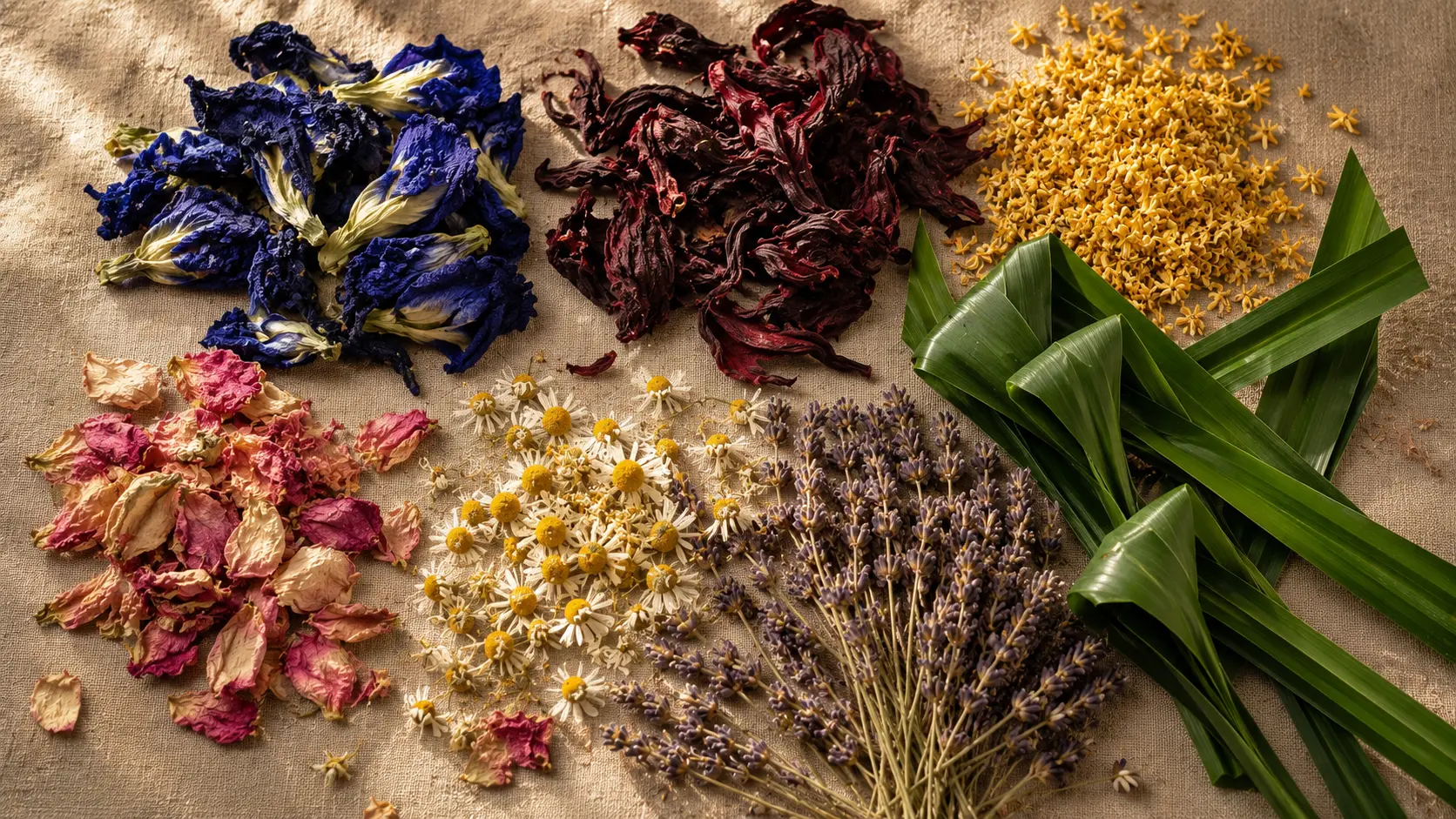
Part Three — Fruits & Berries
Blackberry
Key compounds: Anthocyanins · Ellagic acid · Vitamin C · Tannins
Associated with: Ellagic acid is associated with the urolithin pathway — gut bacteria convert it into urolithins, compounds with growing research interest in muscle health, mitochondrial function, and cellular renewal. Anthocyanins are associated with antioxidant and anti-inflammatory activity. Vitamin C supports immune function.
After fermentation — still beneficial? Yes — and the live culture environment of authentic kombucha actively enhances the most interesting benefit. The conversion of ellagic acid to urolithins depends on a diverse, active gut microbiome. The live cultures in unpasteurised kombucha support microbiome diversity — meaning the kombucha itself may be improving the conditions under which blackberry’s key compounds produce their associated effects. This is one of the clearest examples in this list of a real ingredient and authentic fermentation working together rather than one merely surviving the other.
On the label, look for: Blackberries, blackberry juice. The ellagic acid content of blackberry flavoring is unknown and unverifiable — and the urolithin pathway benefit disappears with it.
Blackcurrant
Key compounds: Anthocyanins · Vitamin C · GLA · Quercetin
Associated with: Blackcurrant has one of the highest anthocyanin densities of any commonly consumed fruit — associated with antioxidant, anti-inflammatory, and cardiovascular protective effects. GLA is associated with skin health and immune function. Quercetin is associated with antiviral activity and its bioavailability is enhanced by vitamin C — which blackcurrant provides in the same package, at approximately four times the concentration of orange by weight.
After fermentation — still beneficial? Yes — blackcurrant is one of the best functional fruits for kombucha specifically. Its anthocyanin density is preserved by the acidic fermentation environment rather than degraded by it. The vitamin C and quercetin combination means the quercetin benefit is enhanced by the accompanying vitamin C — and both are stable in acidic conditions. The GLA is fat-soluble and therefore less well-delivered in a water-based beverage, but the anthocyanin, vitamin C, and quercetin fractions carry through fermentation well. The associated benefits are largely intact.
On the label, look for: Blackcurrants, blackcurrant juice. Functionally one of the strongest fruit choices for kombucha — and underused in Singapore.
Cranberry
Key compounds: Proanthocyanidins (PACs) · Vitamin C · Quercetin · Organic acids
Associated with: PACs are the compounds behind cranberry’s most researched benefit — inhibiting certain bacteria from adhering to urinary tract tissue. This is among the better-evidenced functional food claims in this list, with multiple clinical trials behind it. Quercetin and vitamin C contribute antioxidant and immune-supportive activity.
After fermentation — still beneficial? Yes — and the delivery mechanism is well-suited to kombucha. PACs work locally in the gut and urinary tract rather than requiring systemic absorption, which makes a liquid format genuinely appropriate. The acidic fermentation environment supports the conditions under which PACs exert their effect. The natural tartness of cranberry also means a well-fermented kombucha does not need added sugar to balance it — the SCOBY has consumed the available sugars, and the flavour works. The associated urinary tract benefit carries through fermentation in a format that suits it.
On the label, look for: Cranberries, cranberry juice. The PAC content that drives cranberry’s key associated benefit is absent from cranberry flavoring.
Elderberry
Key compounds: Anthocyanins · Flavonoids · Vitamins B6 and C · Sambucol
Associated with: Elderberry has one of the stronger functional food evidence bases — its anthocyanin and flavonoid content has been studied for immune support and antiviral activity in multiple clinical trials. Vitamin C and B6 contribute immune and metabolic function.
After fermentation — still beneficial? Yes — and unpasteurised kombucha is actually one of the better delivery formats for elderberry specifically. Elderberry anthocyanins are heat-sensitive: studies show 30–80% degradation under pasteurisation depending on temperature and duration. A raw, unpasteurised kombucha preserves the anthocyanin content far better than a heat-processed juice or pasteurised beverage. Additionally, lactic acid fermentation has been shown to break down cell walls and modify anthocyanin structures into smaller, more easily absorbed forms. The immune-associated benefit is not just intact after fermentation — it may be more bioavailable than in many other formats.
On the label, look for: Elderberries, elderberry juice. The heat-sensitivity of elderberry’s key compounds makes elderberry flavoring — which requires processing that degrades anthocyanins — particularly questionable.
Lemon
Key compounds: Vitamin C · Hesperidin · Limonene · Flavonoids · Citric acid
Associated with: Vitamin C is associated with immune support, collagen synthesis, and antioxidant activity. Hesperidin is associated with cardiovascular and anti-inflammatory effects. Limonene is associated with digestive support and antimicrobial activity. The flavonoid fraction contributes antioxidant activity.
After fermentation — still beneficial? Yes — and lemon does something useful for everything else in the bottle too. Vitamin C is water-soluble and acid-stable — it survives fermentation well. Hesperidin and the flavonoid fraction are also reasonably stable in acidic conditions. Limonene, concentrated in the peel, is partially volatile but survives at residual concentrations. The key insight about lemon in a multi-ingredient kombucha: vitamin C enhances the bioavailability of polyphenols consumed alongside it. Lemon is not just contributing its own associated benefits — it is making other fruits and botanicals in the same bottle more absorbable.
On the label, look for: Lemon, lemon zest, lemon juice — in descending order of functional completeness. Lemon flavoring delivers taste and none of the vitamin C or polyphenol-enhancing benefit.
Mulberry
Key compounds: Anthocyanins · Resveratrol · Rutin · DNJ (1-deoxynojirimycin)
Associated with: DNJ is mulberry’s most distinctive compound — found in meaningful concentrations almost exclusively in mulberry, it has been studied as an alpha-glucosidase inhibitor that slows carbohydrate digestion and moderates post-meal blood sugar spikes. This is a well-characterised mechanism with clinical research behind it. Anthocyanins contribute antioxidant and anti-inflammatory associations. Resveratrol is associated with cardiovascular and longevity research.
After fermentation — still beneficial? Likely yes for DNJ, which has reasonable stability in acidic conditions. The anthocyanin content is well-preserved by the fermentation pH. Resveratrol bioavailability is variable, but there is emerging evidence that live cultures may produce more water-soluble resveratrol metabolites during fermentation — potentially making it more accessible than in non-fermented formats. The blood sugar modulation association linked to DNJ is the most distinctive functional claim here, and the compound appears to survive fermentation at useful levels.
On the label, look for: Mulberries, mulberry juice. DNJ — mulberry’s most distinctive compound — is not present in mulberry flavoring at functional levels.
Passion Fruit
Key compounds: Piceatannol · Vitamin C · Organic acids · Beta-carotene · Flavonoids
Associated with: Piceatannol is a direct metabolite of resveratrol with its own research profile — associated with metabolic health and insulin sensitivity. Unlike resveratrol, piceatannol has better natural water solubility. Beta-carotene is associated with antioxidant activity and vitamin A precursor function. Vitamin C contributes immune support.
After fermentation — still beneficial? Yes. Piceatannol’s water solubility makes it better suited to a liquid format than resveratrol, and it is reasonably stable in acidic conditions. Vitamin C survives fermentation well. The organic acid profile of passion fruit — citric, malic, and ascorbic acids — also reinforces the fermentation environment, contributing to the acidic conditions that preserve other polyphenols in a multi-ingredient bottle. One important note: the seeds contain polyphenols and fibre not present in the juice fraction — a brand using whole passion fruit delivers more than one using juice only.
On the label, look for: Passion fruit, passionfruit. Whole fruit delivers more than juice only. Passion fruit flavoring delivers neither piceatannol nor the organic acid reinforcement.
Raspberry
Key compounds: Ellagic acid · Anthocyanins · Vitamin C · Raspberry ketones
Associated with: Ellagic acid shares the urolithin pathway with blackberry and strawberry — associated with muscle health and cellular renewal via gut microbiome conversion. Anthocyanins are associated with antioxidant and anti-inflammatory activity. Raspberry ketones have been studied for metabolic effects, though human evidence is limited.
After fermentation — still beneficial? Yes. The ellagic acid to urolithin conversion is supported by the live culture environment — same mechanism as blackberry. Anthocyanins are well-stabilised in acidic conditions. The natural tartness of raspberry aligns with authentic kombucha’s flavour profile, meaning a brand using real raspberry does not need added sugar to balance it — the fermentation does the work. Raspberry is one of the most commonly faked flavors in commercial beverages, which makes the ingredient list especially important here.
On the label, look for: Raspberries, raspberry juice. Raspberry flavoring is ubiquitous in commercial beverages — its presence alongside health claims warrants scrutiny.
Rosehip
Key compounds: Vitamin C · Lycopene · Beta-carotene · Flavonoids · GOPO (galactolipid)
Associated with: GOPO is rosehip’s most distinctive compound — a galactolipid unique to rosehip studied in multiple human clinical trials for joint inflammation and osteoarthritis, with statistically significant results. This is a rare case in functional food science where a specific compound has genuine controlled human trial evidence. Vitamin C delivers the highest concentration of any common plant source — more than citrus by weight. Lycopene and beta-carotene contribute antioxidant activity.
After fermentation — still beneficial? Yes for the key compounds. Vitamin C is water-soluble and acid-stable — it survives fermentation very well. GOPO is a lipid-based compound; its behaviour in fermentation has not been specifically studied, but polyphenol-associated galactolipids generally show reasonable stability in acidic conditions. Lycopene and beta-carotene are fat-soluble and less well-delivered in a water-based format, but the vitamin C and GOPO fractions carry through fermentation in a way that justifies the ingredient. Rosehip is among the most credentialed fruits in this list — and among the most underused in Singapore kombucha.
On the label, look for: Rosehip, rosa canina, rosehip powder. The vitamin C and GOPO content that drives rosehip’s associations are not present in rosehip flavoring.
Strawberry
Key compounds: Anthocyanins · Ellagic acid · Fisetin · Vitamin C · Folate
Associated with: Fisetin is strawberry’s most distinctive compound — found at the highest concentration of any commonly consumed fruit. It has been studied for neuroprotective effects, cellular senescence, and memory function. Research is early-stage in humans but the mechanism is well-characterised. Ellagic acid shares the urolithin pathway with blackberry and raspberry. Anthocyanins contribute antioxidant activity.
After fermentation — still beneficial? Yes. Fisetin is reasonably stable in acidic conditions and survives fermentation at meaningful concentrations — making authentic kombucha a plausible delivery format for its associated neuroprotective effects. The ellagic acid to urolithin pathway is supported by the live culture environment. Anthocyanins are stabilised by the fermentation pH. Strawberry is one of the most commonly faked flavors in commercial beverages — if the label says strawberry flavoring, the fisetin content is effectively zero, and the neuroprotective and cellular health associations disappear entirely.
On the label, look for: Strawberries, strawberry juice. Strawberry flavoring on a functional product means the fisetin and ellagic acid content is effectively zero.

“The question is never just what the ingredient contains. It is whether those compounds are still there — still intact, still absorbable — after the brewing process is done. Real ingredients and authentic fermentation are both required. Neither is sufficient alone.”
All 20 Ingredients at a Glance
The verdict after fermentation — sorted by category, then A–Z.
| Ingredient | Associated with | After fermentation | Look for on label |
|---|---|---|---|
| Chamomile | Calming, gut lining support | Intact — acid improves apigenin bioavailability | Chamomile flowers |
| Ginger | Anti-inflammatory, digestive support | Better — gingerols convert to more potent shogaols | Ginger root, ginger juice |
| Lavender | Calming, antioxidant | Partial — rosmarinic acid intact, linalool reduced | Lavender flowers |
| Lemongrass | Antimicrobial, digestive support | Intact — citral stable in acidic environment | Lemongrass, fresh lemongrass |
| Mint | Digestive comfort, antioxidant | Partial — menthol reduced, rosmarinic acid intact | Mint leaves, peppermint |
| Turmeric | Anti-inflammatory, antioxidant | Possible improvement — curcumin may convert to more bioavailable form | Turmeric root, turmeric juice |
| Butterfly Pea Flower | Antioxidant, cardiovascular, neuroprotective | Intact — acid stabilises anthocyanins; colour confirms it | Butterfly pea flower |
| Hibiscus | Blood pressure, cholesterol, antioxidant | Intact — acid stabilises; organic acids reinforce fermentation | Hibiscus flowers, Hibiscus sabdariffa |
| Magnolia | Antioxidant, anti-anxiety, neuroprotective | Unknown — fermentation interaction unstudied | Magnolia bark, magnolia flower |
| Osmanthus | Antioxidant | Partial — flavonoids intact, volatile aromatics reduced | Osmanthus flowers |
| Pandan | Blood sugar modulation, antimicrobial, antioxidant | Likely intact — alkaloids and glycosides acid-stable | Pandan leaves, fresh pandan |
| Pink Rose | Antioxidant, gut motility, cardiovascular | Largely intact — tannins and anthocyanins preserved; geraniol partial | Rose petals, rosa damascena |
| Blackberry | Muscle health, cellular renewal, antioxidant | Enhanced — live cultures support ellagic acid → urolithin conversion | Blackberries, blackberry juice |
| Blackcurrant | Antioxidant, cardiovascular, immune support | Intact — highest anthocyanin density; acid-stable | Blackcurrants, blackcurrant juice |
| Cranberry | Urinary tract health, antioxidant | Intact — PACs act locally; liquid format suits delivery | Cranberries, cranberry juice |
| Elderberry | Immune support, antiviral activity | Better than pasteurised — anthocyanins preserved; cell walls broken down | Elderberries, elderberry juice |
| Lemon | Immune support, cardiovascular, antioxidant | Intact — vitamin C stable; enhances other polyphenols in bottle | Lemon, lemon zest, lemon juice |
| Mulberry | Blood sugar modulation, antioxidant, cardiovascular | Likely intact — DNJ acid-stable; resveratrol may improve | Mulberries, mulberry juice |
| Passion Fruit | Metabolic health, antioxidant | Intact — piceatannol water-soluble; organic acids reinforce fermentation | Passion fruit, passionfruit |
| Raspberry | Muscle health, cellular renewal, antioxidant | Enhanced — live cultures support urolithin conversion | Raspberries, raspberry juice |
| Rosehip | Joint health, immune support, antioxidant | Intact — vitamin C and GOPO survive fermentation well | Rosehip, rosa canina |
| Strawberry | Neuroprotective, cellular health, antioxidant | Intact — fisetin acid-stable; live cultures support urolithin pathway | Strawberries, strawberry juice |
What this all adds up to
The question running through this entire article is a simple one: after everything the fermentation process does to an ingredient, is the benefit still there? For most of the real ingredients in this list, the answer is yes — and in several cases, authentic kombucha fermentation actively preserves or enhances the compounds that matter, compared to pasteurised beverages or neutral-pH drinks.
Ginger gets more potent. Elderberry anthocyanins survive better than in heat-processed formats. The live culture environment supports the gut microbiome conversions that make blackberry, raspberry, and strawberry’s ellagic acid meaningful. Hibiscus and butterfly pea flower are stabilised rather than degraded. Lemon makes everything around it more absorbable.
But all of this is conditional on two things being true simultaneously: the real ingredient was used, and the fermentation was authentic. A brand using elderberry flavoring gets none of the anthocyanin preservation story. A pasteurised product with real fruit loses the live culture benefits. Both conditions are required. Neither is sufficient alone.
The ingredient list is the only document that tells you the truth
The front of the bottle tells you what the brand wants you to believe. The ingredient list tells you what is actually in it. Once you know what each real ingredient contains — and what fermentation does to it — the ingredient list becomes the most useful document on the packaging.
Every real fruit, every real flower, every real root represents a compound that fermentation can work with. Every instance of “natural flavoring” represents a compound that was never there to begin with.
- → How to read a kombucha label — and what red flags to look for
- → The Standard — the 7-criteria, 100-point authenticity scorecard explained
- → Real vs Fake Kombucha — the 5 shortcuts some brands take
- → Browse the full KombuchaSG brand review directory
KombuchaSG is an independent educational platform. This article draws on publicly available nutritional science and fermentation research and is intended for consumer education purposes only. It does not constitute medical or nutritional advice. Where this article states that an ingredient “is associated with” a benefit, this refers to compounds studied in that context — not a claim that consuming kombucha will produce a specific clinical outcome. Always consult a qualified healthcare professional for medical decisions.