
Powdered Kombucha Is Not Real Kombucha: What Is Actually Inside the Sachet
Walk through any Singapore supermarket health aisle or browse a wellness marketplace and you will find them: small, convenient sachets promising the benefits of kombucha in a stir-and-drink powder. Live cultures. Gut health. Probiotics. The word kombucha printed large on the front. The price a fraction of a bottled brew.
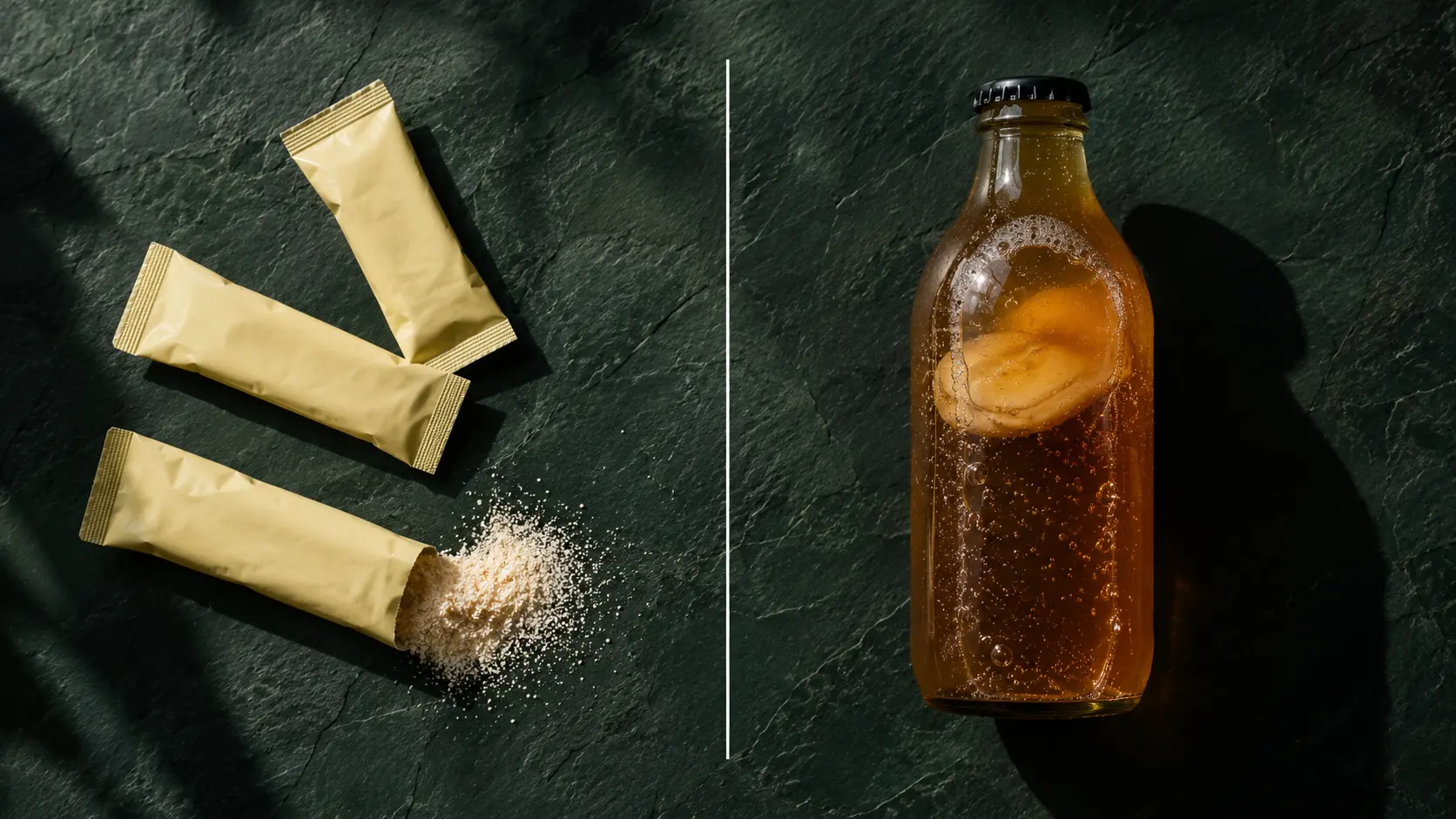
There is a problem. Authentic kombucha is a living fermented liquid. Creating it requires a SCOBY, brewed tea, time, and a controlled fermentation environment. Turning it into a powder requires removing everything that makes it alive. This article is about what that process destroys — and what is actually in the sachet that replaces it.
The fundamental problem: kombucha is a living liquid
Authentic kombucha is not a flavour. It is not a category. It is not a marketing term. It is the biological outcome of a specific fermentation process — a process that produces live cultures, organic acids, dissolved carbon dioxide, and bioactive compounds that exist in an aqueous, pH-sensitive environment. Every single one of those properties depends on the liquid being alive.
What authentic kombucha actually is: A living fermented tea made when a SCOBY (Symbiotic Culture of Bacteria and Yeast) ferments sweetened brewed tea over 7–14 days. The SCOBY consumes sugar and produces organic acids, live cultures, dissolved CO₂, B vitamins, and enzymes as metabolic by-products. The result is raw, unpasteurised, and biologically active at the point of consumption. This is what the word kombucha describes when used accurately.
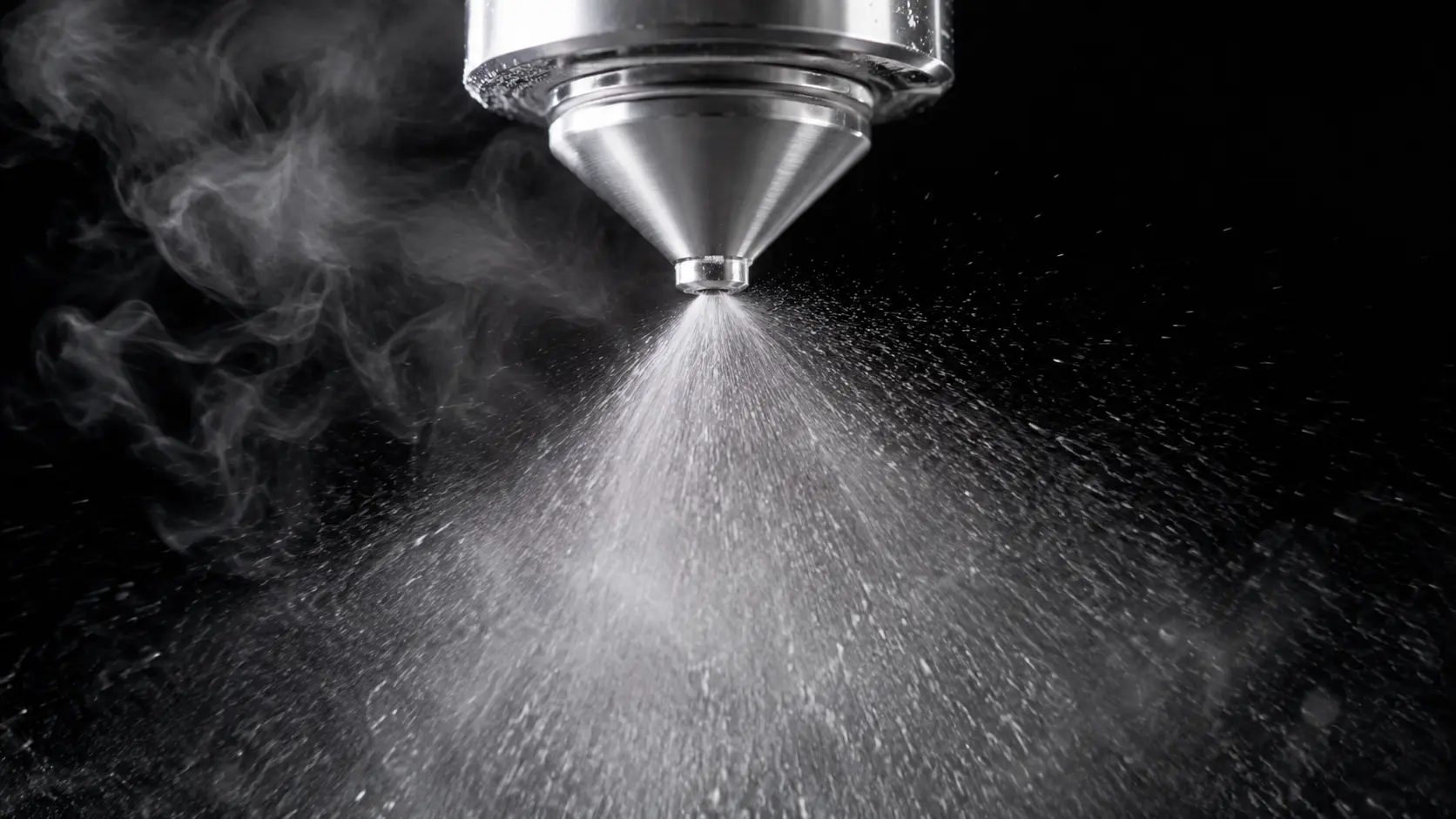
Powdering a living liquid requires removing all the water from it — typically through spray drying or freeze drying. The question is not whether this process changes the product. It clearly does. The question is whether anything meaningful survives — and whether what replaces the destroyed components is equivalent to the original. The answer to both is no. Here is why.
Part One — What Dehydration Does to Real Kombucha
Live Cultures
What authentic kombucha contains: A complex, co-evolved ecosystem of Lactobacillus bacteria and Saccharomyces yeast strains living in a mutually supportive environment. These cultures are protected by the organic acids and low pH the fermentation process creates around them. They are active, self-sustaining, and — in an unpasteurised bottle — still alive at the point of consumption.
What dehydration does: Spray drying — the most common dehydration method for powdered beverages — exposes liquid to inlet temperatures of 150–200°C. At these temperatures, Lactobacillus strains die within seconds. The cellulose matrix of the SCOBY, the organic acid environment that protects the cultures, the pH balance that maintains them — all of it is destroyed. Even freeze drying, which operates at far lower temperatures and is significantly more expensive, results in measurable culture death and unpredictable viability by the time the product reaches the consumer. There is no cold chain, no active fermentation, and no living ecosystem in a powder sachet at room temperature.
What this means for the label: A “live cultures” claim on a powdered kombucha product cannot refer to the cultures produced by fermentation. Any cultures present have been added back in after the fact — a manufactured supplement ingredient, not a fermentation outcome. The distinction matters and is covered in detail in Part Two.
Natural Carbonation
What authentic kombucha contains: Natural carbonation produced during second fermentation, when live yeast cultures in a sealed bottle continue producing dissolved CO₂. This is not injected carbonation and not sparkling water. It is biologically generated effervescence — softer, finer, and more integrated with the liquid than forced carbonation. It is also evidence that the fermentation process occurred correctly and that the bottle contains active cultures.
What dehydration does: Dissolved CO₂ cannot survive dehydration. It is gone entirely. Reconstituting a powder with still water produces a flat liquid. Any fizz in the final drink requires carbonated water to be added separately — which is precisely the carbonation shortcut that scores zero on the KombuchaSG Authenticity Scorecard. Powdered kombucha structurally requires the consumer to use the same method that disqualifies bottled products from an authentic carbonation score.
What this means for the label: No powdered kombucha product can claim natural carbonation. The carbonation in the final drink, if any, comes from the water the consumer adds. The fermentation-derived carbonation that characterises authentic kombucha has been destroyed in processing.
Organic Acids
What authentic kombucha contains: A complex profile of organic acids produced as metabolic by-products of fermentation — acetic acid (which gives kombucha its characteristic tang), glucuronic acid (associated with liver support and detoxification pathways), lactic acid (associated with gut health), and malic acid, among others. These acids also create the low pH environment (2.5–3.5) that protects live cultures, stabilises polyphenols from fruit and botanical ingredients, and defines the sensory and functional profile of real kombucha.
What dehydration does: Acetic acid is volatile — it partially evaporates during spray drying. Glucuronic acid degrades under high-temperature processing. The integrated acid profile that characterises authentic fermentation cannot be faithfully preserved through dehydration. What remains is a diminished, altered fraction of the original. The sourness in a reconstituted powder product comes not from fermentation-derived organic acids but from added acidulants — typically citric acid or malic acid, added to simulate the tartness of fermentation without fermentation having occurred.
What this means for the label: The tartness of powdered kombucha is almost always manufactured — citric acid mimicking what fermentation produces. Check the ingredient list for citric acid or malic acid in the first few positions. In authentic kombucha, these acids are by-products. In powdered products, they are ingredients.
SCOBY and the Fermentation Process
What authentic kombucha requires: A living SCOBY — a Symbiotic Culture of Bacteria and Yeast — that ferments sweetened brewed tea over 7–14 days in a controlled environment. The SCOBY is not an ingredient. It is the organism responsible for producing kombucha through its metabolic activity. Every batch of authentic kombucha grows a new SCOBY layer. The kombucha is the SCOBY’s output — a biological product, not a manufactured one.
What powdered products contain: The SCOBY plays no meaningful role at the consumer end of a powdered kombucha product. If a fermented tea extract appears in the ingredient list, it typically represents a small fraction of the total product — processed, concentrated, and dehydrated to the point where its biological integrity is not comparable to fresh fermentation output. In many formulations, the kombucha fraction is present in trace quantities included for labelling purposes, not functional ones.
What this means for the label: “Fermented tea extract” or “kombucha powder” in an ingredient list does not mean the product is kombucha. It means a processed, dehydrated fraction of something that was once fermented has been included as an ingredient. The quantity, biological integrity, and functional relevance of that fraction are unverifiable from the label.
Part Two — What Is Actually in the Sachet
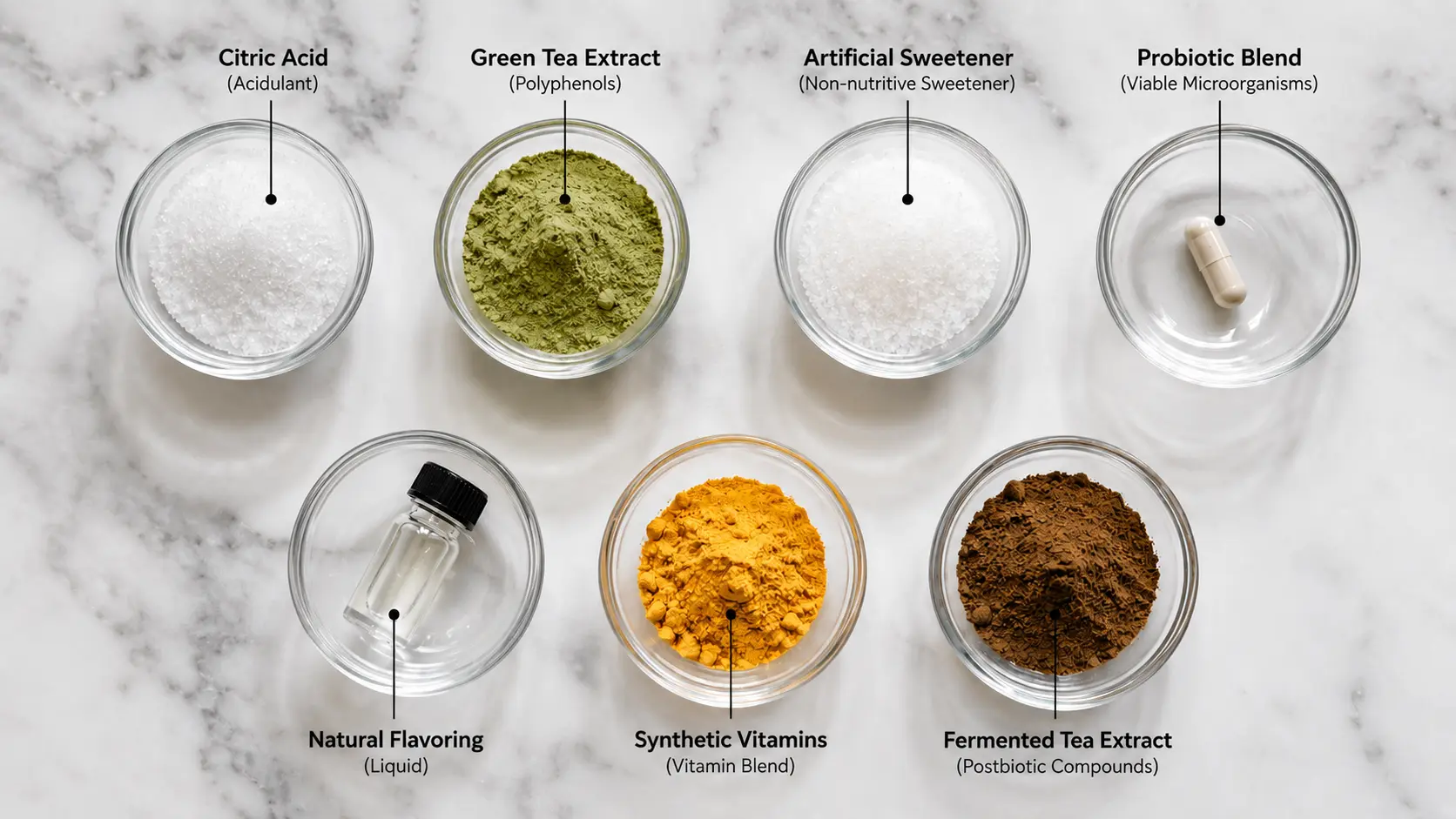
Reading the ingredient list of most powdered kombucha products removes ambiguity quickly. The ingredients are not fermentation outputs. They are assembled inputs — individual components combined to produce a drink that tastes like kombucha and carries kombucha’s marketing associations. Here is what each one is.
Dried Tea Extract or Green Tea Powder
What it is: Brewed tea that has been concentrated and dehydrated — or tea leaves ground to a fine powder. This provides the base flavour profile and some of the polyphenol content of tea, including catechins and L-theanine.
What it is not: Fermented tea. The dehydrated extract has not been through the SCOBY-driven fermentation process that produces kombucha’s organic acids, live cultures, and bioactive by-products. It is tea in dry form. There is nothing wrong with tea in dry form — it is simply not kombucha, and its polyphenol content, while real, is the content of tea rather than the fermentation-transformed profile of genuine kombucha.
Citric Acid or Malic Acid
What it is: An acidulant — a manufactured ingredient added to lower the pH of the reconstituted drink and create the tartness associated with fermentation. Citric acid is produced commercially through fermentation of sugars by Aspergillus niger mould. Malic acid is similarly manufactured or derived from fruit.
What it is not: A fermentation by-product of kombucha. In authentic kombucha, acidity develops over days as the SCOBY metabolises sugar and tea. In a powdered product, the acidity is dialled in by adding an acidulant during manufacturing. The taste result can be similar. The biological origin is entirely different. Check the ingredient list: if citric acid or malic acid appears in the first few ingredients of a powdered kombucha, the tartness you are tasting is manufactured, not fermented.
Sugar or Alternative Sweeteners
What it is: A palatability ingredient — added to balance the tartness of the acidulant and achieve an acceptable flavour profile. In authentic kombucha, sugar is added at the start of fermentation and substantially consumed by the SCOBY over the fermentation period. The residual sugar in a well-fermented authentic kombucha is typically 2–4g per 100ml — the remainder has been converted by the live cultures into organic acids and CO₂.
What it is not: Sugar that has been through fermentation. The sweetener in a powdered kombucha has not been consumed by a SCOBY. It has been added as a flavour-balancing ingredient after the fact. There is no fermentation-driven sugar reduction, because there is no fermentation.
“Kombucha Powder” or “Fermented Tea Extract”
What it is: A dehydrated extract of something that was at some point fermented — typically appearing mid-to-late in the ingredient list, which by weight means it is a minority component of the formulation. The term is vague by design. It does not specify the fermentation method, the SCOBY strain, the fermentation duration, the acid profile, or the quantity present.
What it is not: Meaningful evidence that the product is kombucha. Including a small fraction of fermented tea extract in a powder formulation does not make the product kombucha any more than adding a small fraction of chicken stock to a vegetable soup makes it chicken soup. The kombucha fraction is present in a quantity that serves a labelling function more reliably than a functional one. Treat it as a flavour note, not a fermentation claim.
“Natural Flavoring”
What it is: An undefined flavour ingredient. In Singapore, the term “natural flavoring” carries no regulatory definition and no minimum quantity requirement. It can refer to an extract, an isolate, a concentrate, or a chemical compound derived from a natural source — without specifying the source, the processing method, or the quantity used. It appears in powdered kombucha formulations to approximate the taste of fruit or botanical ingredients.
What it is not: Real fruit, real flowers, or real botanicals. The bioactive compounds covered in detail in our ingredients bioavailability guide — the anthocyanins in elderberry, the gingerols in ginger root, the fisetin in strawberries, the PACs in cranberry — are not present in natural flavoring at functional levels. The flavoring delivers the taste profile associated with the ingredient. Nothing more. In a powdered kombucha that lists “raspberry natural flavoring,” the ellagic acid, the vitamin C, and the anthocyanins that make raspberry functional are effectively absent.
Part Three — The Probiotic Question
Probiotic claims are where the distance between powdered kombucha and authentic kombucha is clearest — and where the marketing is most carefully constructed to obscure that distance.
Probiotics Added Back In After the Fact
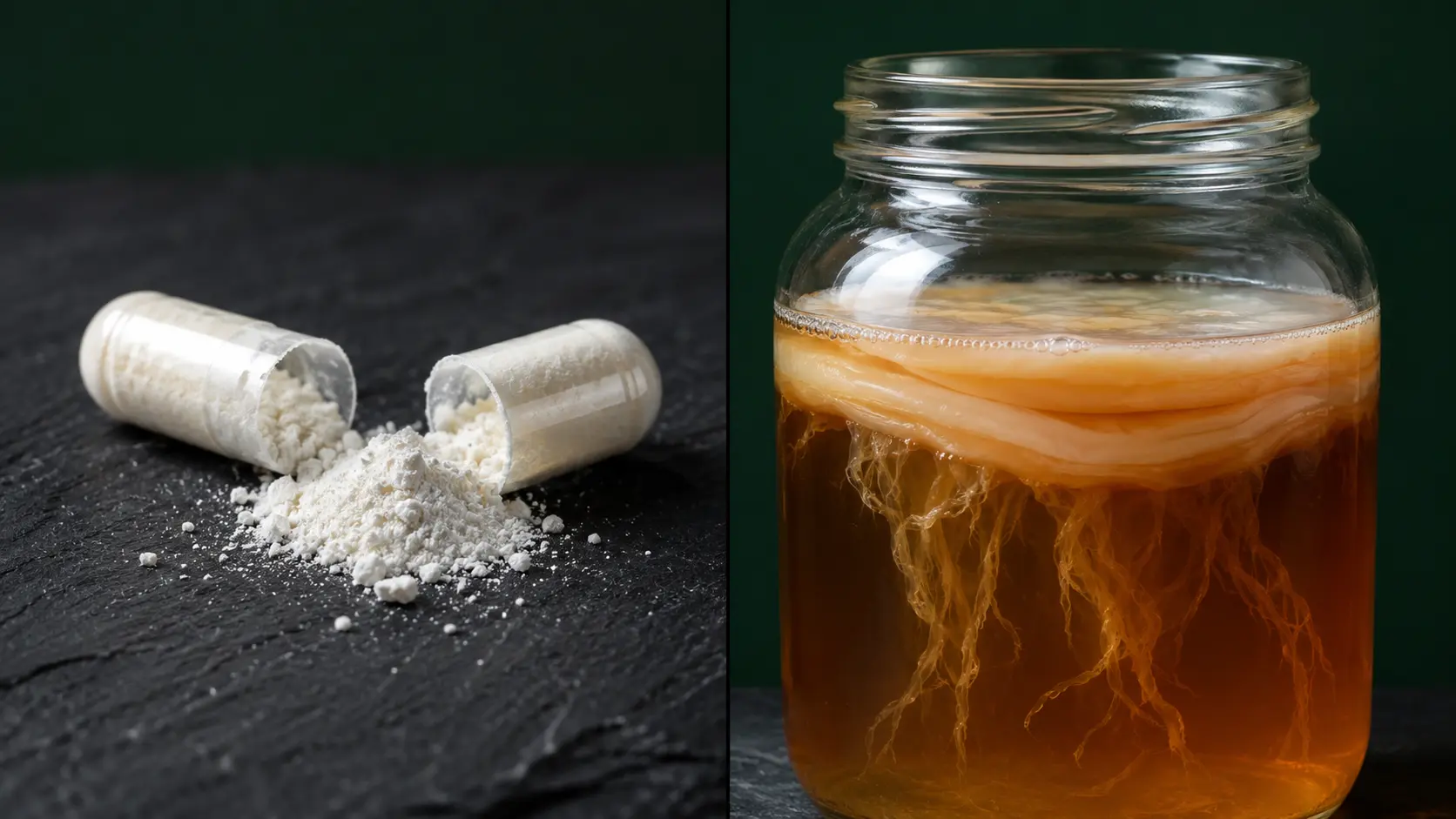
What powdered products do: Because dehydration destroys the live cultures that fermentation produces, powdered kombucha products that carry probiotic claims must add probiotic strains back in during manufacturing — as a separate ingredient, after the rest of the formulation is assembled. These are isolated strains manufactured in pharmaceutical or nutraceutical facilities, freeze-dried to a specific CFU count, and blended into the powder.
Why this is fundamentally different: In authentic kombucha, probiotics are a fermentation outcome. The bacteria that develop in a well-managed SCOBY ecosystem are co-evolved, mutually supportive, and protected by the organic acid environment the fermentation produces around them. They arrive in the gut alongside the acetic acid, lactic acid, and glucuronic acid that the same fermentation process created — compounds that may support their survival through the digestive environment.
A probiotic added to a powder arrives as an isolated strain in a neutral, manufactured environment. It has no protective organic acid matrix. It has no co-evolved bacterial community. It is a supplement ingredient blended into a drink mix. This does not make it without value — probiotic supplements are a legitimate product category. But it is not the same thing as the fermentation-derived probiotic community in authentic kombucha. Calling a product “kombucha” because it contains added probiotics is like calling a glass of water “wine” because a grape extract was stirred into it.
On the label, look for: Probiotic strains listed as named species — Lactobacillus acidophilus, Bifidobacterium lactis, and so on — appearing as discrete ingredients rather than as a natural outcome of the fermentation process. Their presence confirms that the cultures were manufactured and added, not produced by fermentation.
Viability at the Point of Consumption
The shelf-stability problem: Probiotic strains in powder form are subject to ongoing die-off during storage at room temperature. Unlike an unpasteurised kombucha bottle kept refrigerated — where cold temperature keeps the cultures dormant and largely intact — a sachet stored in a pantry or handbag offers no such protection. Moisture, heat, and oxygen all degrade viability over time. The CFU count on the label reflects the count at manufacture, not at consumption. Regulatory standards vary on whether a label CFU claim must be guaranteed at end of shelf life.
What this means in practice: The probiotic content of a powdered kombucha sachet — already a supplemented ingredient rather than a fermentation product — may be significantly lower by the time it is consumed than the label suggests. An authentic, unpasteurised, refrigerated kombucha contains live cultures that were active and viable moments before you opened the bottle. These are not comparable situations.
Synthetic Vitamins
What powdered products do: B vitamins and vitamin C are sometimes added to powdered kombucha formulations to support health claims. In authentic kombucha, B vitamins — particularly B1, B6, and B12 — form naturally during fermentation as metabolic by-products of SCOBY activity. Vitamin C is contributed by fruit or botanical ingredients used in second fermentation.
Why the distinction matters: Fermentation-derived B vitamins arrive in a complex matrix of organic acids, enzymes, and co-factors that may support their absorption. Synthetic vitamins added to a powder are fortification ingredients — the same approach used in breakfast cereals and energy drinks. This is not inherently harmful, but it is meaningfully different from the same vitamins appearing as natural fermentation by-products. The label claim “contains B vitamins” reads the same in both cases. The origin and delivery context are entirely different.
“A probiotic added to a powder is a supplement ingredient. A probiotic in real kombucha is a fermentation outcome. The word ‘kombucha’ on a sachet describes a flavour, not a process.”
Authentic Kombucha vs Powdered Kombucha: The Full Comparison
What each product actually contains — and what that means for the claims on the front of the pack.
| Property | Authentic Kombucha | Powdered Kombucha |
|---|---|---|
| SCOBY | Live, present, active throughout fermentation | Absent at consumer end. Not part of the product. |
| Fermentation process | 7–14 days of active SCOBY fermentation. The product is the fermentation output. | No fermentation occurs at consumer stage. A fraction of previously fermented extract may be present. |
| Live cultures | Fermentation-derived, co-evolved ecosystem of bacteria and yeast. Present and active at point of consumption. | Destroyed by dehydration. Replaced by separately manufactured probiotic strains added back as an ingredient. |
| Carbonation | Natural — dissolved CO₂ produced by yeast activity during second fermentation in a sealed bottle. | None from fermentation. Any fizz requires the consumer to add carbonated water. |
| Organic acids | Produced by fermentation: acetic, lactic, glucuronic, malic acids in a complex, integrated profile. | Destroyed or significantly degraded. Replaced by added citric acid or malic acid to simulate tartness. |
| Sourness / tartness | Produced by fermentation over days. A biological outcome. | Manufactured by adding an acidulant during formulation. |
| Fruit and botanical content | Real fruit, flowers, roots used in second fermentation. Bioactive compounds present and often enhanced by fermentation environment. | Typically “natural flavoring” — taste approximation without the bioactive compounds. |
| B vitamins | Produced naturally by SCOBY activity during fermentation. | Added as synthetic fortification ingredients. |
| Sugar reduction | Sugar consumed by SCOBY during fermentation. Residual sugar 2–4g per 100ml in a well-fermented batch. | No fermentation-driven sugar consumption. Sweetener added separately for palatability. |
| Refrigeration required | Yes — keeps live cultures dormant and viable. Cold chain essential. | No — shelf-stable at room temperature. No living biology to protect. |
| What “kombucha” means on the label | A description of the fermentation process and its biological output. | A flavour category and a marketing position. |
What this all adds up to
Powdered kombucha products are not without value as a product category. Some contain reasonable quantities of tea polyphenols. Some contain added probiotics at meaningful CFU counts. Some are a convenient and affordable way to consume a fermented-tea-flavoured drink with supplemented gut health ingredients.
What they are not is kombucha. The fermentation process that defines kombucha — the SCOBY, the organic acids, the natural carbonation, the live culture ecosystem, the transformation of raw ingredients into a biologically active liquid — is absent at the consumer end. What replaces each of those absent properties is a manufactured ingredient designed to approximate the result without replicating the process.
This matters because the health associations attributed to kombucha are specifically associated with the fermentation process and its biological outputs — not with tea extract, citric acid, or isolated probiotic strains in a powder. Consuming a powdered product in expectation of the benefits of authentic kombucha is consuming the wrong thing for the right reasons.
The ingredient list is the only document that tells you the truth
The front of a powdered kombucha sachet carries kombucha’s branding, kombucha’s health associations, and kombucha’s price premium relative to a standard powdered drink. The ingredient list tells you what is actually inside: tea extract, citric acid, sweetener, natural flavoring, added probiotics, and a small fraction of fermented tea extract included at an unspecified quantity.
These are the ingredients of a flavoured drink mix with supplemented gut health ingredients. That is a legitimate product. It is not kombucha. The standard for what kombucha actually is — and what it requires — is set out in full on The Standard. Read that first. Then read the sachet label. The distance between the two is the distance between the claim and the product.
- → The Standard — the 7-criteria, 100-point authenticity scorecard explained
- → Real vs Fake Kombucha — the 5 shortcuts some brands take
- → How to read a kombucha label — and what red flags to look for
- → Browse the full KombuchaSG brand review directory
KombuchaSG is an independent educational platform. This article draws on publicly available nutritional science and fermentation research and is intended for consumer education purposes only. It does not constitute medical or nutritional advice. References to ingredient properties are based on published research into those compounds and are not claims that consuming any specific product will produce a specific clinical outcome. Always consult a qualified healthcare professional for medical decisions.