
The Science Behind Authentic Kombucha — And Why Getting It Right Is So Hard
When you open a well-made kombucha, you are holding the result of a living biological process involving dozens of microbial species, carefully sequenced chemistry, and weeks of controlled fermentation. Understanding what actually happens inside that bottle changes how you read a label — and makes it far easier to spot the products that cut corners.
It Starts With a Living Culture
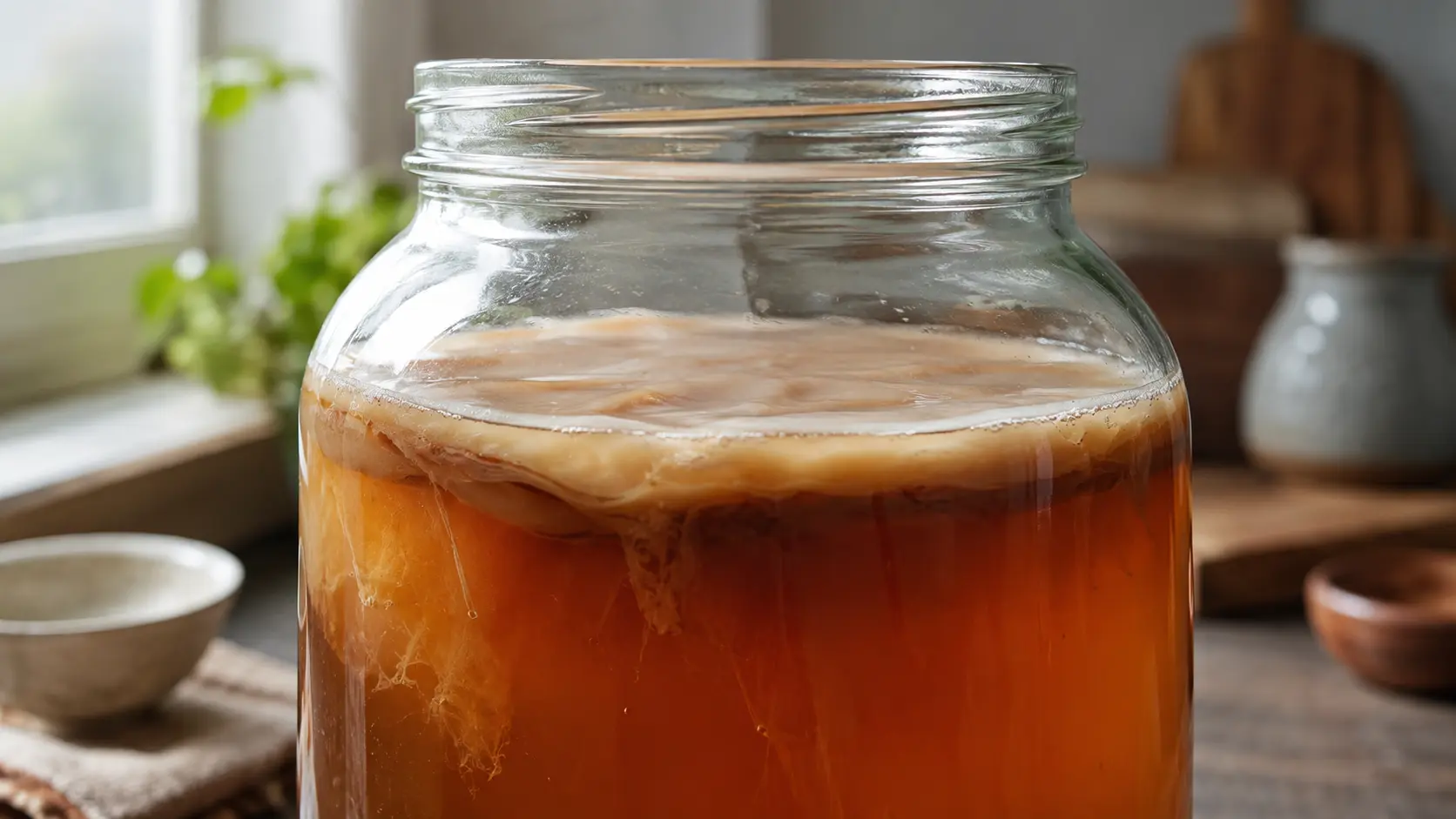
The foundation of every authentic kombucha is the SCOBY — Symbiotic Culture of Bacteria and Yeast. The name is precise. It is not a single organism but a community: yeasts and bacteria working in an interdependent cycle, each group consuming or producing compounds the other depends on.
Yeast in the SCOBY secrete an enzyme called invertase, which breaks sucrose down into its two component sugars — glucose and fructose. The yeast then ferment those simpler sugars, producing two key outputs: ethanol and carbon dioxide (CO₂). This is the same fundamental process behind wine and beer.
What distinguishes kombucha is what happens next. Acetic Acid Bacteria — the AAB — consume the ethanol the yeast produced and oxidise it into organic acids, primarily acetic acid (which gives kombucha its characteristic tang) and glucuronic acid. The pH drops. The liquid becomes inhospitable to most harmful microorganisms. The environment is self-protecting.
The entire cycle — sugar in, organic acids out — is what defines genuine fermented kombucha. Without a living SCOBY carrying out this process, you do not have kombucha. You have tea with additives.
Note that Acetic Acid Bacteria require oxygen to carry out their oxidation work. This is why a primary fermentation vessel must be covered with breathable cloth rather than sealed — a detail that has direct implications for production consistency and quality control.
Two Fermentations, Not One
Authentic kombucha production involves two separate fermentation stages. Both matter. Understanding the difference between them is the single most useful framework for reading a kombucha label.
From sweetened tea to finished bottle
The base is brewed from whole tea leaves — black, green, oolong, white, or blends. The tea variety is not decoration; it is the fermentation substrate and significantly influences the final flavour profile.
Cooled tea is combined with the SCOBY and a portion of acidified starter tea from the previous batch. The starter tea immediately lowers pH, protecting against contamination before the culture establishes itself. The vessel is covered with breathable cloth, not sealed. Fermentation is monitored by taste, pH, and visual assessment throughout.
Before sealing, the brewer verifies pH is within target range, residual sugar is controlled, the sensory profile is clean, and ABV meets compliance limits. This is the critical decision point. Skipping it is where batches fail.
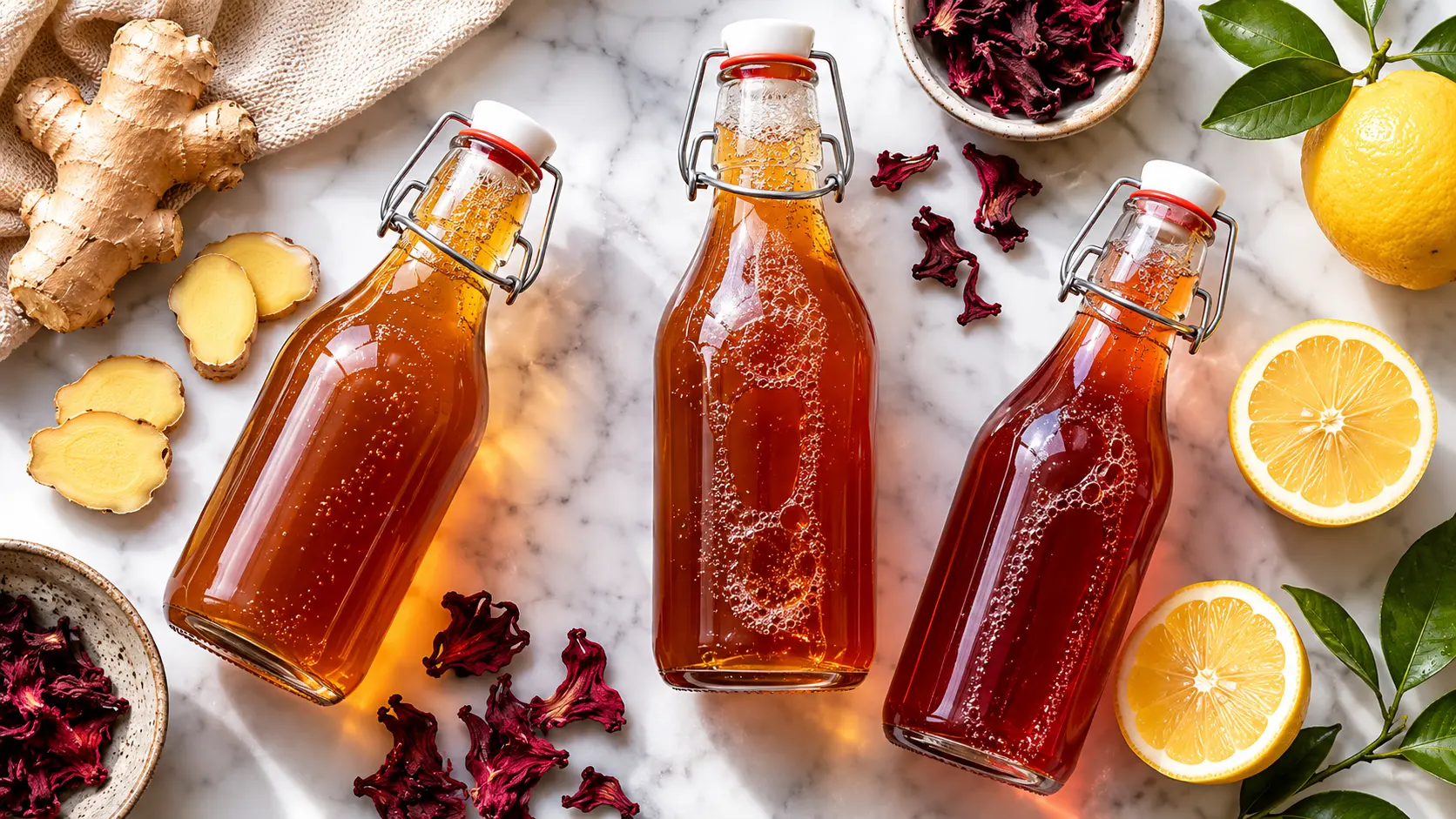
Kombucha is transferred into sealed bottles with natural flavouring additions — whole fruit, juice, dried flowers, roots, herbs. The sealed environment traps the CO₂ produced by the continuing fermentation. This is what builds natural carbonation from the inside out.
Bottles are refrigerated to slow the live cultures, halt further CO₂ build-up, lock in the flavour profile, and preserve carbonation. The cold chain must be maintained throughout distribution and retail storage.
Secondary fermentation is the only authentic source of carbonation in real kombucha. If a brand’s ingredient list includes carbonated water or sparkling water, that carbonation was added externally — not produced through the brewing process. The scorecard reflects this distinction directly.
The Parameters a Brewer Must Control Simultaneously
What makes this genuinely difficult is that none of these variables operate in isolation. Every change in one parameter ripples through all the others. A brewer who changes nothing except ambient temperature will produce a noticeably different-tasting batch.
| Parameter | What it measures | Why it matters for authenticity |
|---|---|---|
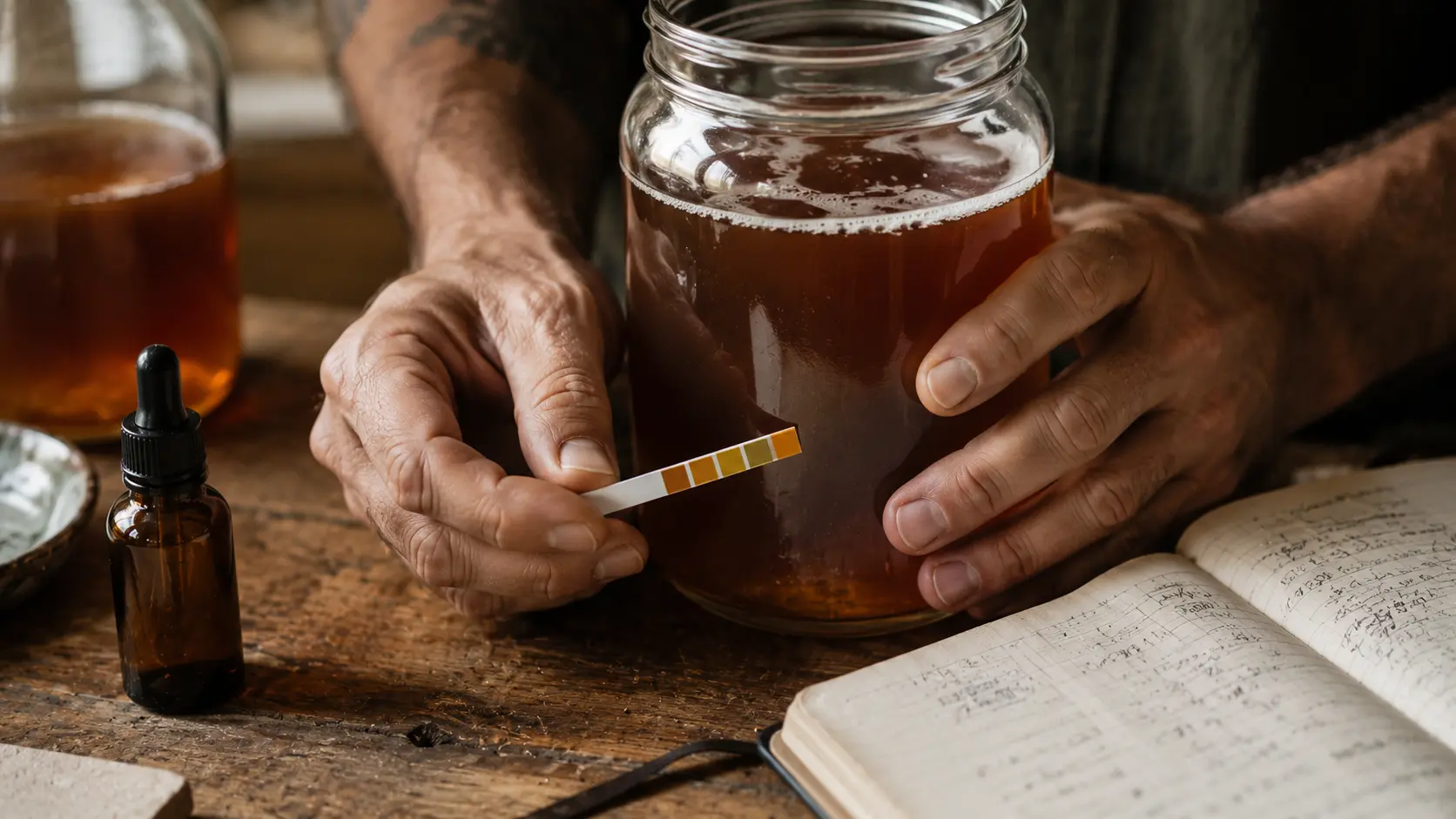
| pH | Accumulation of organic acids | Safety gate and taste indicator. Must hit target range before bottling. Drops from ~7 to 2.5–3.5 across a good primary fermentation. |
| Sugar (Brix) | Residual fermentable material | Too much at bottling means excessive CO₂ pressure and safety risk. Too little means flat kombucha and incomplete flavour. The scorecard target of under 4g per 100ml reflects well-fermented kombucha where the SCOBY has done its job. |
| ABV | Alcohol by volume | Rises with yeast activity, falls as AAB convert ethanol to acids. In Singapore, must stay under 0.5% v/v at 20°C to carry a non-alcoholic label. Must be verified — not assumed — especially across the cold chain. |
| Temperature | Rate of all microbial activity | The master variable. Governs how quickly every other parameter changes. In Singapore’s climate, ambient heat accelerates fermentation and can drive ABV drift during storage — a real compliance and quality concern. |
| Time | Duration of each fermentation stage | Cannot be standardised by the clock alone. Must be read in combination with pH, temperature, and Brix. Experienced producers assess by instrument and taste, not by days elapsed. |
Managing all of these simultaneously, across multiple batches, with Singapore’s climate introducing variability at every stage of the cold chain — and doing this reliably enough to produce a consistent product for retail — is not a casual operation.
“A change in temperature affects time, sugar consumption, and the final balance of ABV and pH. These parameters are not independent — they are a system. Active monitoring is the only path to consistency.”
The Bottling Gate — Where Inexperienced Producers Fail
The transition from primary to secondary fermentation is what experienced producers call the critical gate. Before a batch is sealed, every control point must be verified. Skip any of them and the failure modes are serious.
Mould or unwanted bacteria colonise a batch when pH is not low enough early in fermentation. The starter tea ratio and initial acidification are the primary safeguards — not optional refinements.
ABV can climb above the 0.5% non-alcoholic threshold during warm storage or distribution. In Singapore’s climate this is a live compliance concern that requires cold chain management and product testing.
Sealing an actively fermenting liquid traps CO₂. If residual sugar is too high or secondary fermentation runs too long at ambient temperature, pressure can exceed what the bottle is designed to hold.
A batch fermented too far past its target pH produces an unpleasantly vinegary product. pH monitoring and defined primary fermentation endpoints are the controls — not guesswork.
Each of these risks requires a specific, documented control: rigorous sanitation protocols, cold chain management throughout distribution, a defined bottling gate with verified criteria, and consistent pH monitoring. These are the minimum viable controls for a safe, consistent product — not boutique additions.
What This Means When You Read a Label
Once you understand the science, ingredient lists become readable in a different way. Every entry on a kombucha label is a data point about the production process — not just about flavour.
Authentic kombucha contains brewed tea, sugar as the fermentation substrate, a live SCOBY, and natural flavouring ingredients. The sugar content in the finished product will be low, because the culture has consumed most of it during fermentation. The carbonation comes from the sealed bottle, not an external gas source. There is no need to add vinegar, because a properly fermented kombucha produces acetic acid naturally.
The shortcuts become equally legible once you understand the process. Adding carbonated water replaces secondary fermentation with a tap. Adding vinegar mimics the acidity of fermentation without the biological process that creates it. Adding sugar after fermentation raises sweetness without the SCOBY having consumed and transformed it. None of these are illegal. But they are not the same product as the result of a controlled, two-stage live fermentation — and no amount of front-of-pack claims changes that.
The label tells the story
If a brand’s ingredient list includes carbonated water or sparkling water, the carbonation score on the KombuchaSG scorecard is zero. That is not an editorial judgment — it is the criteria. If the list includes “natural flavouring” without specifics, the ingredient transparency score is reduced. Again — criteria, not opinion.
The science of fermentation is what the scorecard is built on. Understanding the process is what makes the scores defensible, and what makes a high score meaningful.
- → The Standard — the 7-criteria, 100-point authenticity scorecard explained
- → How to read a kombucha label — and what red flags to look for
- → Real vs Fake Kombucha — the 5 shortcuts some brands take
- → Browse the full KombuchaSG brand review directory
KombuchaSG is an independent educational platform. This article draws on publicly available fermentation science and is intended for consumer education purposes only. It does not constitute medical or nutritional advice. Information about Singapore regulatory thresholds (ABV, Nutri-Grade) is provided as general reference — always confirm details against current SFA/MOH regulations.