How to Read a Kombucha Label
A practical guide to decoding any kombucha bottle on Singapore shelves
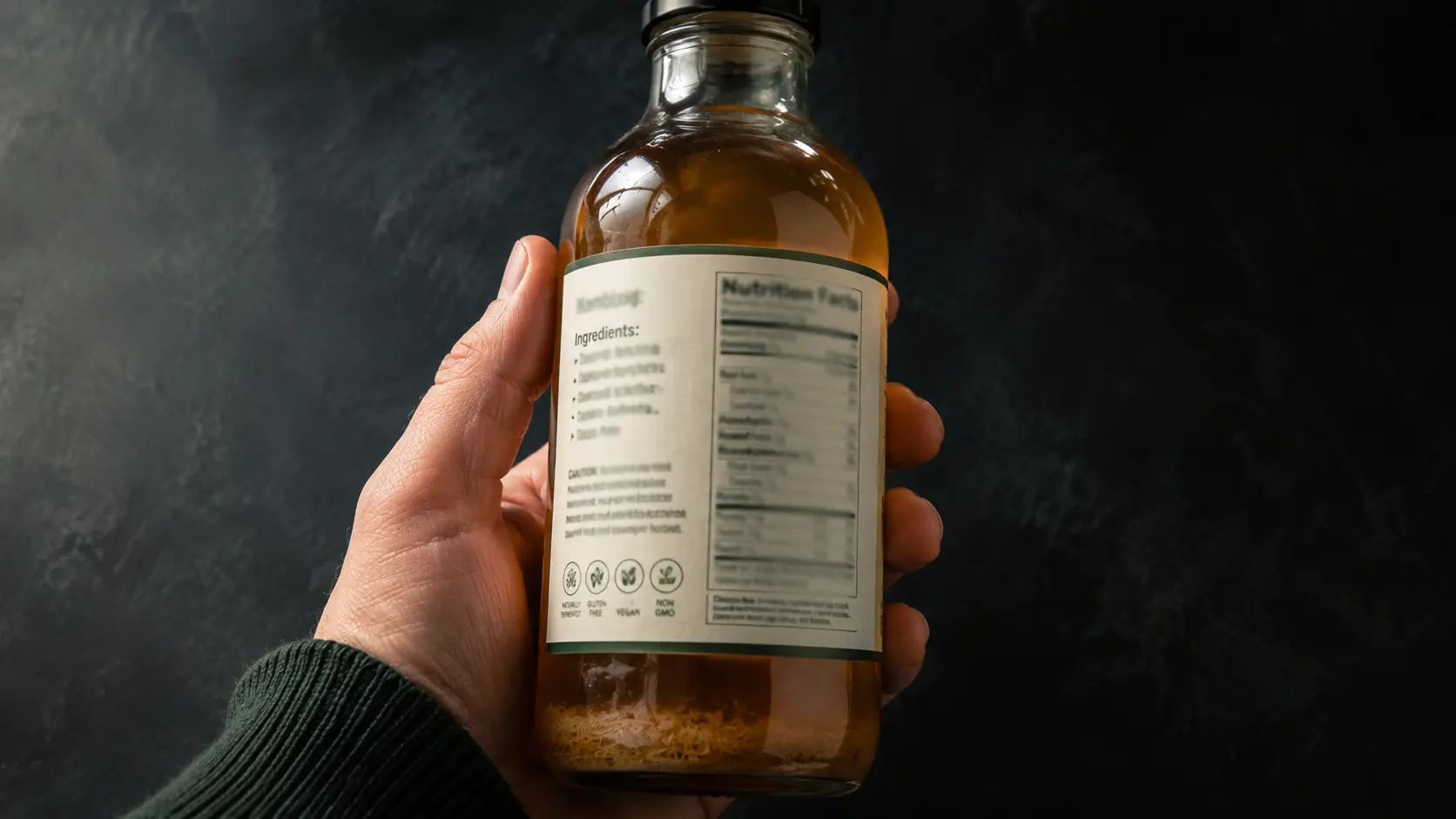
The back of a kombucha bottle contains everything you need to evaluate whether a product is genuinely fermented or commercially manufactured to resemble one. You do not need specialist knowledge. You need to know what to look for — and what each ingredient or claim actually signals.
This guide walks through every section of a kombucha label systematically. By the end, you will be able to pick up any bottle in a Singapore supermarket or health store and assess it in under a minute.
The two panels that matter
A kombucha label has several sections. Two of them contain objective, verifiable information. Everything else is marketing.
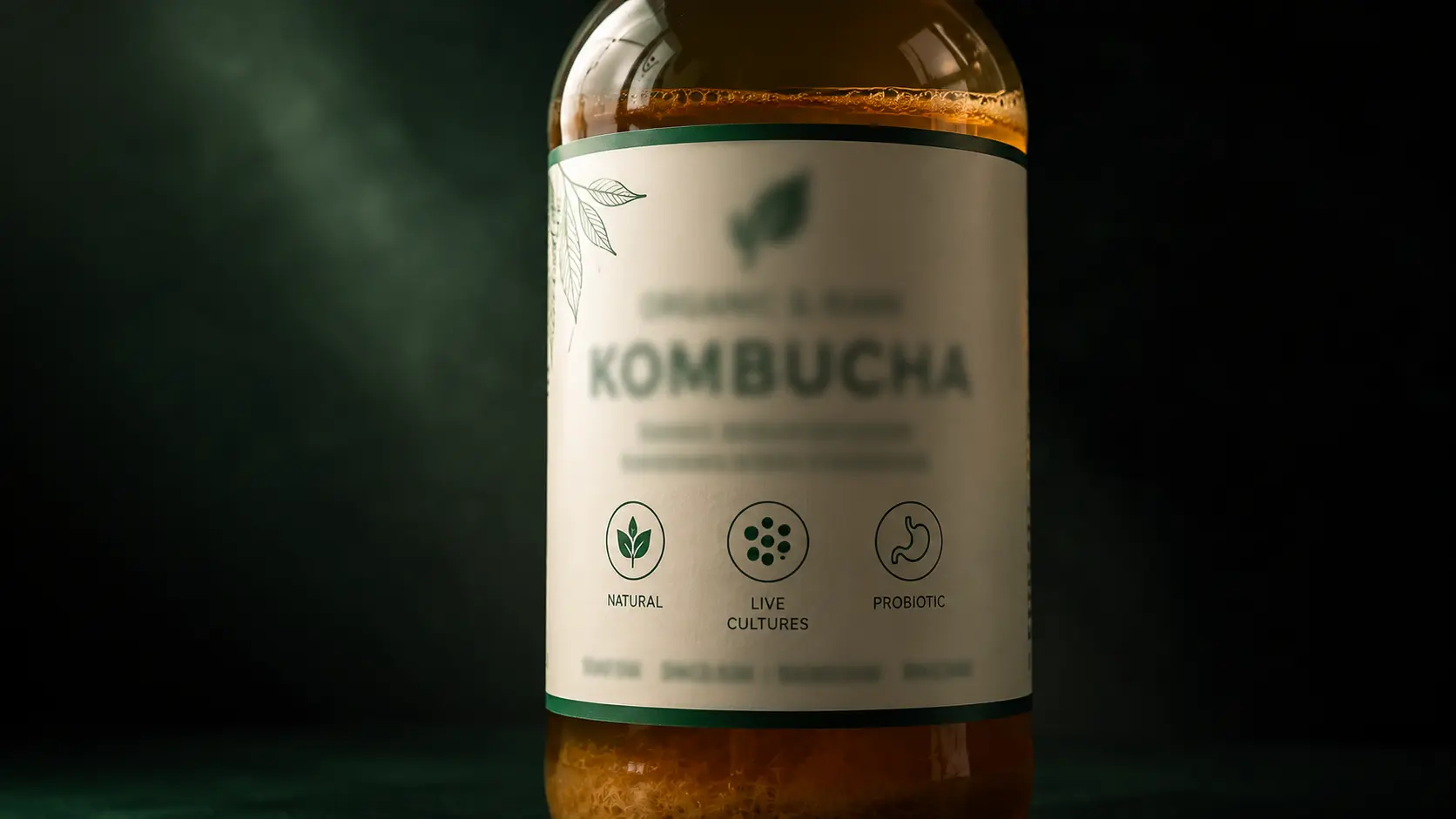
Front-of-pack claims — natural, probiotic, live cultures, gut health — are marketing declarations. In Singapore, most of these terms are unregulated. We cover them separately below. Always read the back label first.
Reading the ingredient list
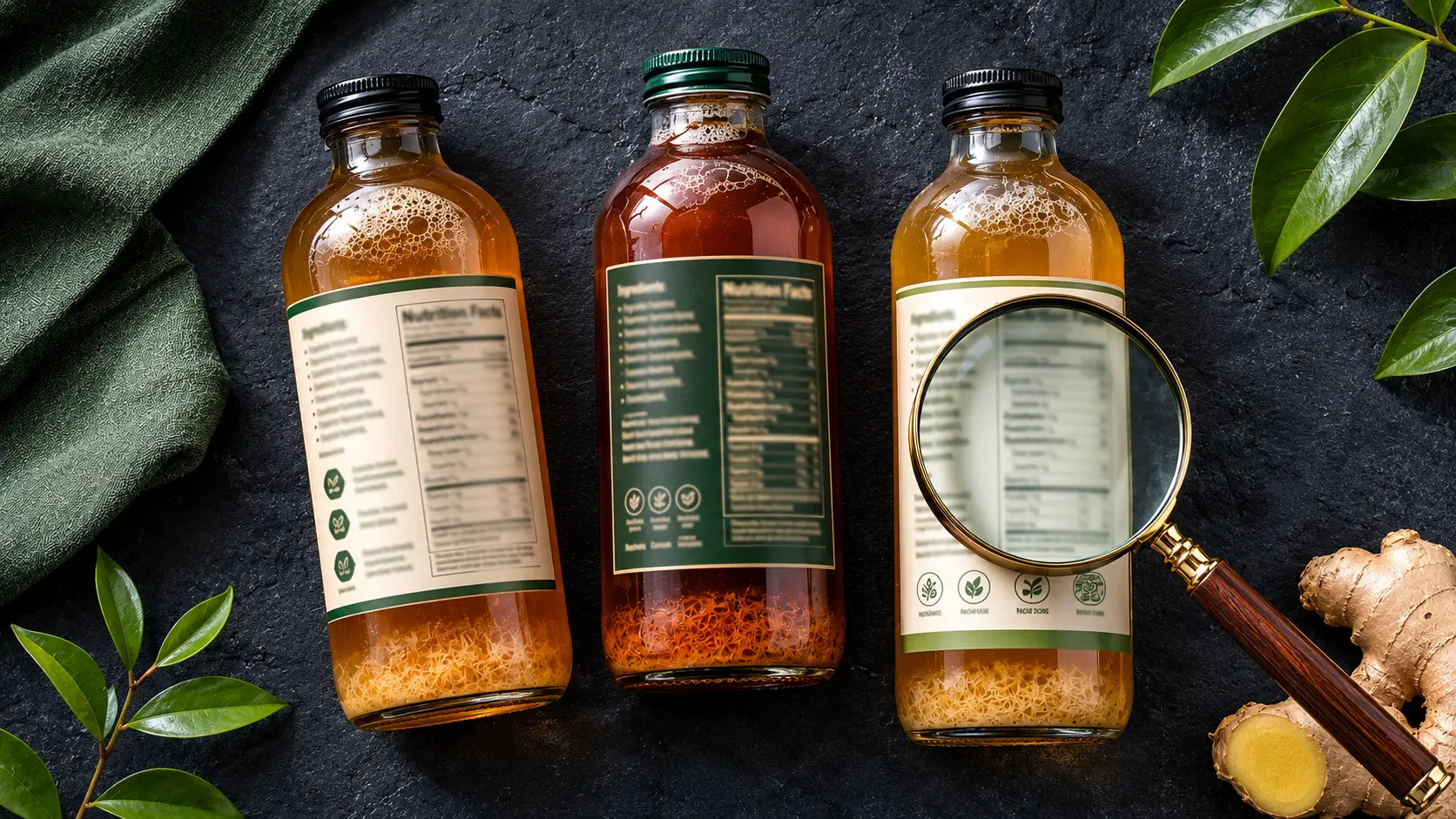
The ingredient list is the single most revealing section of any kombucha label. A brand that is confident in what it puts in the bottle will name every ingredient specifically. A brand that is not will hide behind vague declarations.
What should be in a genuine kombucha
✅ Green flags — what you want to see
- Brewed tea or fermented tea — as the first or second ingredient
- Water — filtered or purified
- Sugar or cane sugar — input for fermentation
- SCOBY or kombucha culture — the live culture
- Specifically named fruits — e.g. fresh mango, passion fruit, blueberry
- Specifically named botanicals — e.g. ginger root, hibiscus flowers, pandan leaf
- Specifically named teas — e.g. green tea, black tea, oolong
🚩 Red flags — what to question
- Carbonated water or sparkling water — added carbonation, no second fermentation
- Natural flavouring — unspecified, unverifiable
- Artificial flavouring or flavour — manufactured compound, not real ingredients
- Citric acid as primary acidulant — may signal shortcut fermentation
- Preservatives — incompatible with live cultures
- Caramel colour or colour (150d) — appearance is being engineered
- Kombucha flavour or kombucha extract — flavoured drink, not brewed kombucha
The order of ingredients matters
Ingredients are listed from highest to lowest by weight. In a genuine kombucha, brewed or fermented tea should appear first or second. If water appears first and tea appears fifth, the product is mostly water with tea added as a minor component — not a tea-forward fermented drink.
Similarly, if sugar appears before the tea or culture, the product may be more of a sweetened sparkling drink than a fermented one.
Specificity is a signal of honesty
A brand using real passion fruit, fresh ginger, and hibiscus flowers has every reason to say so — these are selling points. If a brand lists natural flavouring instead of naming the actual ingredient, ask why. The most likely explanation is that the flavour is not coming from a whole, real ingredient.
Reading the nutrition panel
For kombucha, one figure matters most: sugar per 100ml.
Sugar is added at the start of brewing as food for the SCOBY. During genuine fermentation, the SCOBY consumes most of this sugar — transforming it into organic acids, carbonation, and other by-products. The residual sugar in the finished drink is what appears on the nutrition panel.
⚠️ If there is no nutrition panel on the bottle or the brand’s website, the sugar content cannot be verified. Under the KombuchaSG scorecard, unverifiable criteria receive reduced marks — not because the brand is necessarily doing something wrong, but because transparency is itself a quality signal.
Front-of-pack claims — what they mean in Singapore
Front-of-pack claims are the words and phrases printed prominently on the front of the bottle to attract attention. In Singapore, most of the common kombucha claims are unregulated — meaning any brand can use them without meeting a defined standard of proof.
| Claim | Regulated in SG? | What it actually means |
|---|---|---|
| Natural | Not regulated | Any brand may use this word without meeting a defined standard. Check the ingredient list — if natural flavouring or artificial additives appear, the claim is not supported by the ingredients. |
| Probiotic | Not regulated | No verified CFU count or strain disclosure is required. Without lab data confirming live culture counts at point of sale, this claim is unverifiable. Check whether the product is unpasteurised — a pasteurised probiotic claim is contradictory. |
| Live cultures | Not regulated | No proof is required. An unpasteurised product with visible culture activity is more credible than a claim alone. Check the ingredient list for preservatives, which inhibit live cultures. |
| Raw | Not regulated | Typically means unpasteurised and unfiltered. Credible when supported by the ingredient list and absence of heat-treatment disclosure. Not legally defined. |
| Organic | Partially regulated | More credible when accompanied by a certification body reference. Without certification, treat as unverified. |
| Unpasteurised | Not regulated | One of the more meaningful claims — if true, it indicates live cultures may be present. Cross-reference with the ingredient list: preservatives in an unpasteurised product are contradictory. |
How to evaluate any kombucha bottle in 60 seconds
The next time you pick up a kombucha in a Singapore supermarket or health store, run through these six steps. The whole process takes under a minute.
Turn the bottle around — ignore the front label. The front label is marketing. The back label is information. Start there every time.
Check the first two ingredients. Brewed tea or fermented tea should appear here. If water is first and tea is fifth, the product is mostly water. If sugar is first, the fermentation did not consume it.
Look for carbonated water or sparkling water. If either appears anywhere in the ingredient list, the carbonation is not natural. This product did not undergo a genuine second fermentation.
Check how the flavouring is described. Are the flavouring ingredients specifically named — e.g. fresh mango, ginger root, hibiscus? Or does the list say natural flavouring without elaboration? Specificity is honesty.
Find the sugar per 100ml on the nutrition panel. Under 4g — well fermented. 4–6g — moderate. Above 6g — fermentation was likely shortened or sugar was added post-fermentation.
Note any front-of-pack claims — then check whether the ingredient list supports them. A live cultures claim on a product containing preservatives is contradictory. Let the ingredient list — not the claim — tell you what is in the bottle.
The label is only the starting point
Some information — SCOBY origin, CFU count, production batch size — does not always appear on the label. Our brand reviews dig into this additional information where available, contacting brands directly and cross-referencing with their websites.
Every brand reviewed on KombuchaSG is assessed using the same 7-criteria scorecard. Read The Standard to understand the full criteria before reading any brand review.
Frequently Asked Questions
- Why is “natural flavouring” a red flag on a kombucha label?
- In Singapore, natural flavouring is a legal catch-all declaration that does not require the brand to disclose what the flavour actually is, where it came from, or how it was processed. A brand using real passion fruit, genuine ginger root, or actual hibiscus flowers has every reason to name these specifically — they are selling points. The use of natural flavouring instead suggests the flavour source is either a manufactured extract or something the brand prefers not to name specifically.
- Is “unpasteurised” on the label a reliable claim?
- It is one of the more meaningful front-of-pack claims, but it is not regulated. Cross-reference it with the ingredient list. A genuinely unpasteurised product should not contain preservatives — preservatives inhibit the live cultures that unpasteurisation is meant to protect. If you see both unpasteurised and a preservative in the same product, that is worth questioning.
- What does it mean if there is no nutrition panel on the bottle?
- It means the sugar content — one of the key indicators of fermentation completeness — cannot be verified from the label alone. Some smaller brands may not include a full nutrition panel. In this case, check the brand’s website. If no information is available, the sugar criterion cannot be scored. Transparency about nutritional content is itself a quality signal.
- Can a kombucha be genuine if it contains citric acid?
- Possibly. Citric acid appears in some genuinely fermented kombucha products as a processing aid rather than as a primary acidulant. The question is whether the acidity of the product appears to come primarily from citric acid rather than from the organic acids produced during fermentation. If citric acid appears early in the ingredient list — particularly before the tea or SCOBY — that is a signal worth noting.
- Why does the ingredient order matter?
- Under Singapore food labelling regulations, ingredients must be listed in descending order by weight. The first ingredient is present in the largest quantity. For kombucha, this means brewed or fermented tea should appear prominently — ideally first or second. A product where water or sugar appears first and tea appears further down the list is making a statement about the composition of the product.
- What should I do if a brand’s ingredient list is incomplete or unclear?
- Contact the brand directly. A brand confident in its product and committed to transparency will respond to questions about ingredients, SCOBY origin, pasteurisation status, and CFU counts. A brand that deflects, provides vague answers, or does not respond is providing information too — just not the kind that earns trust.
- → Real vs Fake Kombucha — the 5 shortcuts brands take
- → The Standard — our 7-criteria authenticity scorecard
- → What is Kombucha — the complete guide
- → Browse all Singapore brand reviews
KombuchaSG is an independent educational platform. We are not affiliated with any kombucha brand. All brand reviews apply the same scorecard criteria without exception.