
Small-batch vs commercial kombucha: why it matters for your gut
Scale changes fermentation. A brew monitored by a person is a different product from a brew managed by a process. Here is what the difference actually means — and how to identify which you are buying.
The phrase ‘small-batch’ appears on many kombucha labels in Singapore. Like ‘natural’ and ‘live cultures’, it is used freely — sometimes meaningfully, sometimes as a branding choice that says little about how the product was actually made.
But production scale does genuinely affect the fermentation process, the product’s character, and what ends up in the finished bottle. Here is what you need to know.
What small-batch production actually means
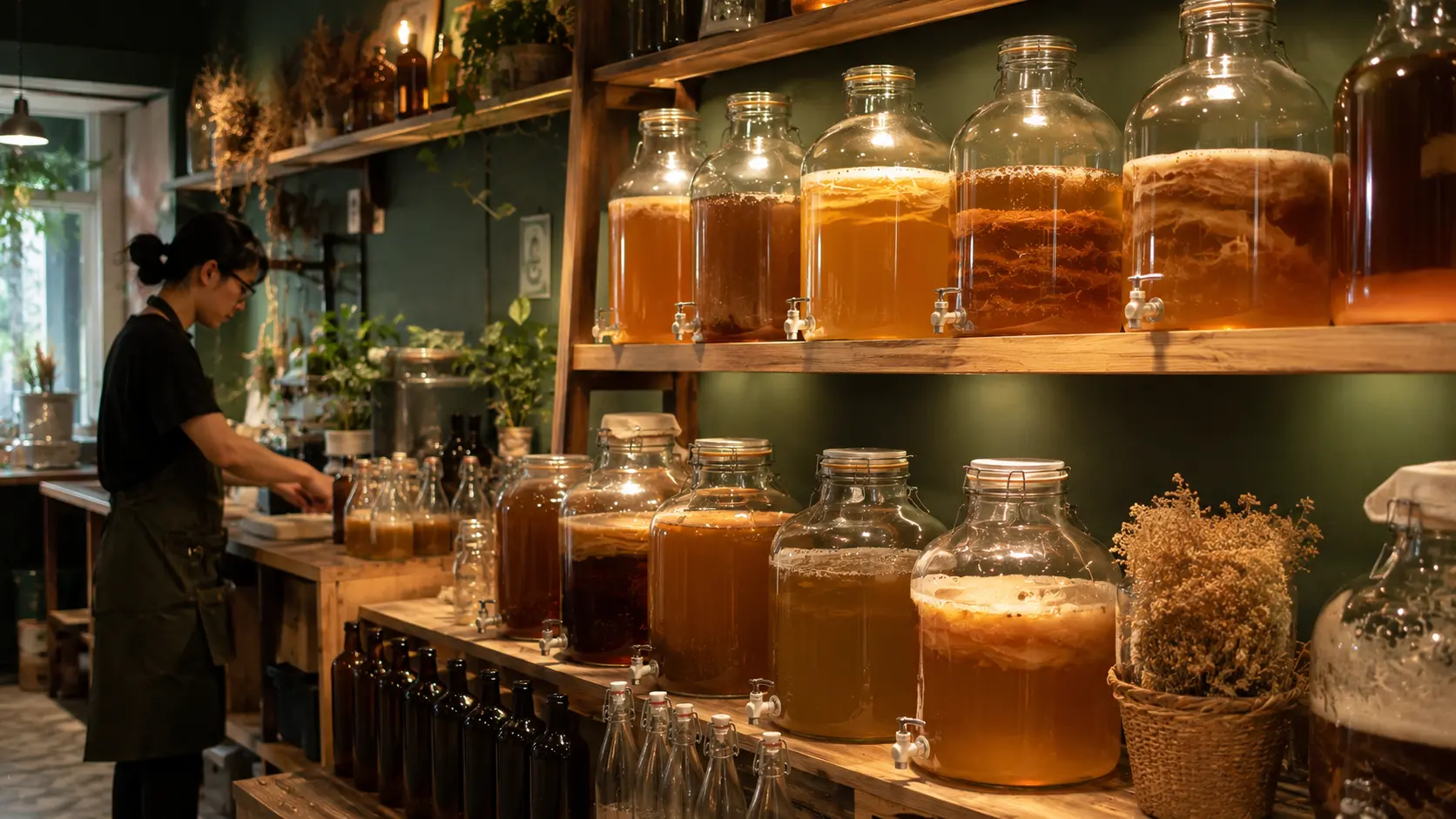
In kombucha brewing, small-batch refers to producing kombucha in limited quantities — typically in individual fermentation vessels ranging from a few litres to a few hundred litres — with close, hands-on monitoring of each batch through the fermentation process.
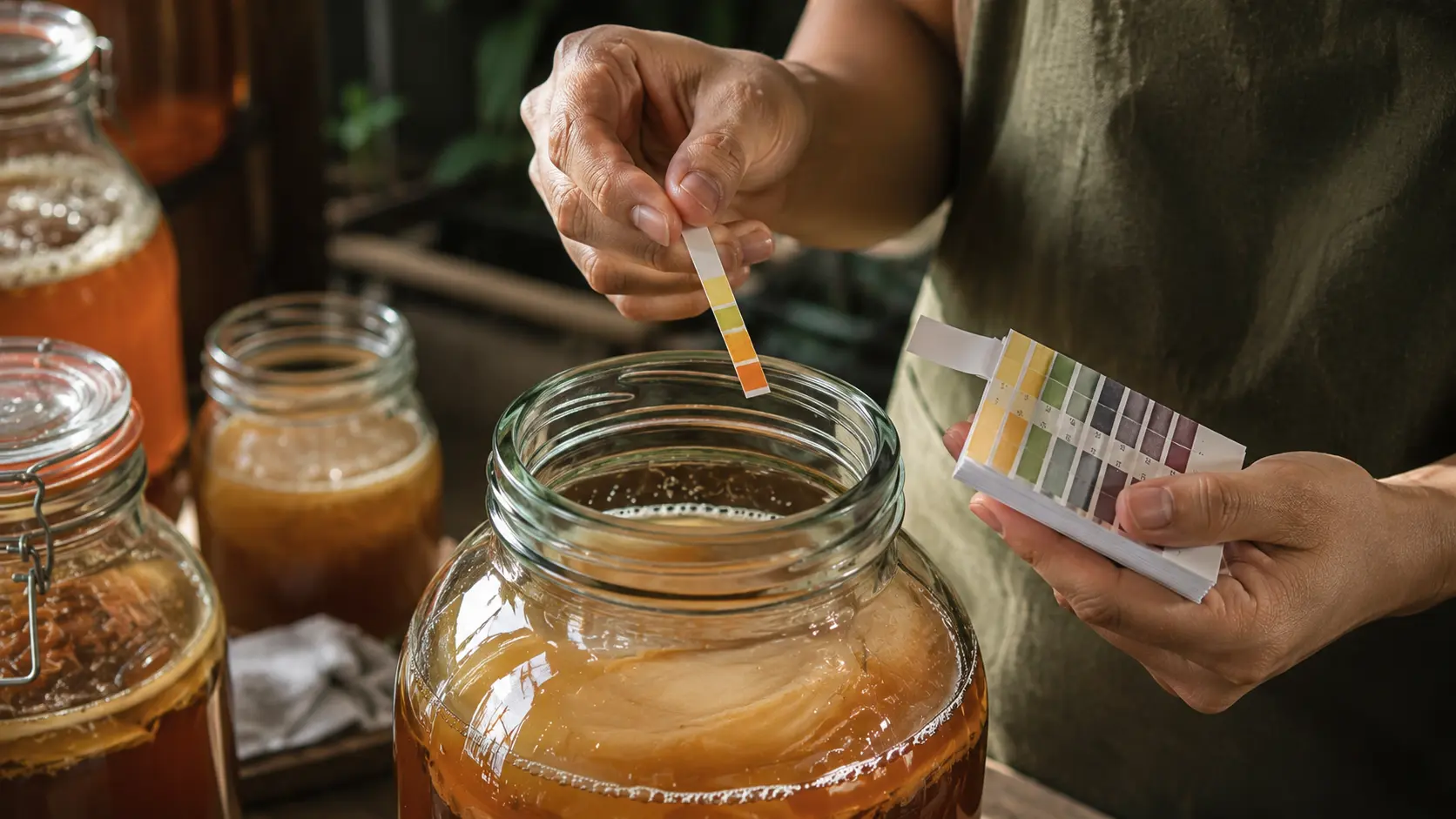
The key characteristic is human involvement at every stage. A small-batch brewer checks the pH, tastes the kombucha, monitors the SCOBY health, and makes adjustments based on observation — not just automated sensors. Each batch is assessed individually before moving to the next stage.
This stands in contrast to commercial-scale production, where fermentation happens in large tanks — sometimes tens of thousands of litres — with standardised inputs, automated monitoring, and processes designed to produce a consistent, predictable output efficiently.
- Fermentation monitored closely by the brewer
- Each batch assessed individually by taste and pH
- SCOBY health maintained through direct observation
- Natural variation between batches — expected and accepted
- Real ingredients — whole fruit, fresh botanicals
- Lower volume, higher per-unit cost
- Typically founder-led or hands-on craft operation
- Fermentation managed by standardised process
- Automated monitoring for consistency
- Designed for batch-to-batch uniformity
- Variation is a production problem to be eliminated
- Flavoring extracts more practical at scale
- Higher volume, lower per-unit cost
- Professional production and distribution infrastructure
How scale affects what ends up in the bottle
Production scale influences kombucha quality in several interconnected ways — none of which are obvious from the outside of the bottle.
Fermentation monitoring and SCOBY health
A small-batch brewer who checks their fermentation vessels daily will catch a struggling SCOBY, an off-pH batch, or a temperature deviation before it affects the product. At commercial scale, individual vessel monitoring is less practical — which is one reason why large-scale producers often use standardised starter cultures rather than maintaining a living SCOBY across production batches.
Fermentation duration and completeness
Commercial production has schedule pressures. A batch that ferments for exactly 10 days regardless of what the SCOBY is doing is more predictable than one that ferments until the brewer decides it is ready. Small-batch brewers have the flexibility to let a batch run longer if conditions warrant it — producing a more fully fermented, more complex product. That flexibility disappears at scale.
Ingredient choices
Fresh whole fruit and botanicals add variability to fermentation. Different batches of fresh ginger have different water content and sugar profiles. Fresh raspberries in season behave differently from out-of-season stock. Small-batch brewers embrace this variability as part of the craft. At commercial scale, it becomes a quality control problem — which is why extract-based natural flavoring, with its standardised concentration, becomes the more practical choice.
The honest tradeoffs
Small-batch is not automatically superior in every dimension. Here is a clear-eyed view of what each approach does well — and where it falls short.
| Factor | Small-batch advantage | Commercial advantage |
|---|---|---|
| Fermentation quality | More responsive to SCOBY and batch conditions | Consistent and predictable output |
| Ingredient authenticity | Real fruit and botanicals more practical | Extract-based flavoring more scalable |
| Batch variation | Natural — a sign of a living product | Minimised — a sign of process control |
| Availability | Limited — sells out, seasonal batches | Consistent supply chain and stocking |
| Price | Higher — reflects real ingredients and time | Lower — economies of scale |
| Traceability | Founder or brewer can speak to each batch | Harder to trace individual batch decisions |
The right choice depends on what you are looking for. If you want the most authentic, craft-fermented kombucha available — small-batch, from a founder who can speak to their process, is where to look. If you want consistent availability and predictable flavour at a lower price point — commercial production delivers that reliably.
The problem arises when a commercial-scale product is marketed with small-batch language that does not reflect how it was actually made.
“Batch variation is not a quality control failure. In genuine small-batch kombucha, it is evidence that a living process was allowed to run its course.”
How to identify small-batch production from the label
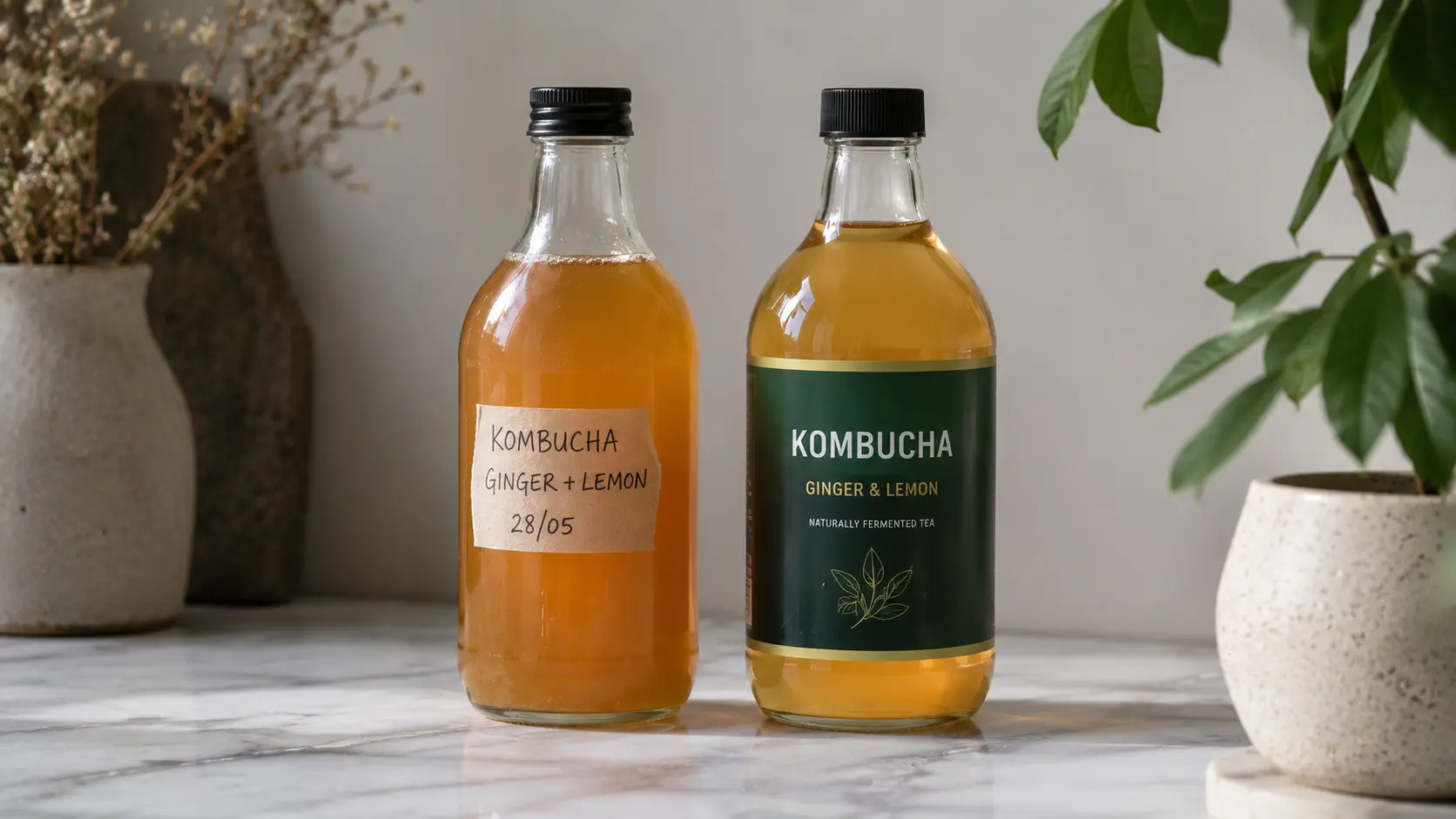
There is no regulated definition of ‘small-batch’ in Singapore. A brand can print it on any label regardless of production volume. But there are signals — beyond the words — that suggest genuine small-batch production.
✓ Signals that suggest genuine small-batch production
- Named founder or brewer — a person behind the product, not just a brand. Someone who can be asked about their process.
- Specific ingredients — whole fruit, named botanicals, real flavoring ingredients. Extract-based flavoring is a commercial shortcut that small-batch brewers rarely use.
- Limited availability — seasonal flavours, sold-out batches, a waiting list. Not signs of poor planning — signs of genuine production constraints.
- Batch notes or variation acknowledged — a brand that says “this batch may taste slightly different” understands fermentation. A brand that promises identical flavour every time is likely not small-batch.
- SCOBY mentioned or documented — its origin, its age, its lineage. A small-batch brewer who is proud of their culture talks about it.
- Refrigerated and locally distributed — small-batch Singapore kombucha is rarely shelf-stable and rarely available in every supermarket chain simultaneously.
Production integrity is one of seven criteria on the KombuchaSG Authenticity Scorecard — worth 10 points.
Every Singapore kombucha brand reviewed on this site is assessed on whether production is small-batch, traceable, and founder-led. See how local brands score on this criterion.
Frequently asked questions
Is small-batch kombucha always better than commercial kombucha?
Not always — it depends on what you value. Small-batch production is more likely to produce a genuinely fermented, complex product using real ingredients, because the brewer has the time and flexibility to manage the process properly. But small-batch does not automatically guarantee quality — a poorly managed small batch can produce inferior kombucha, and some commercial producers maintain high standards within their scaled process. The production method is one factor among several. The ingredient list, fermentation completeness, and carbonation source all matter too.
Why does small-batch kombucha taste different between batches?
Because it is a living product made with natural ingredients and a live culture. Seasonal temperature changes, the composition of fresh fruit, the activity level of the SCOBY, and minor variations in brewing conditions all influence the final flavour. A slightly more tart bottle from last month and a slightly sweeter bottle this month from the same brand is entirely normal — and is a hallmark of genuine artisanal fermentation. If your kombucha tastes identical every single time regardless of season or batch, it is more likely that the flavour has been standardised through extracts or additives.
Where can I find small-batch kombucha in Singapore?
Singapore has a growing number of local craft kombucha producers selling through farmers markets, pop-up events, independent health cafés, and their own online stores. Many do not stock major supermarket chains — not because they are hard to find, but because small-batch production volumes do not support mass retail distribution. The KombuchaSG brand directory covers the Singapore market, including which brands are locally brewed and founder-led.
Is more expensive kombucha always small-batch?
Not necessarily. Price reflects many factors — packaging, branding, distribution margins, and marketing spend — that are unrelated to how the kombucha was brewed. Some genuinely small-batch, founder-led Singapore brands price their product competitively. Some premium-priced brands use extract-based flavoring and commercial production methods. Price is not a reliable proxy for production integrity. The ingredient list and brand transparency are more informative than the price tag.
- → The Standard — our 7-criteria authenticity scorecard
- → Real vs Fake Kombucha — the shortcuts explained
- → How to read a kombucha label
- → Browse all Singapore kombucha brand reviews
KombuchaSG is an independent educational platform. We are not affiliated with any kombucha brand. Content is published for educational purposes only and does not constitute medical or nutritional advice.