
Lil Lixir Kombucha — Review & Authenticity Score
Reviewed using the KombuchaSG 7-criteria authenticity scorecard. Same format, same criteria as every other brand on this site. All data confirmed from physical 300ml glass jars purchased at a Singapore pop-up market.
Brand Overview
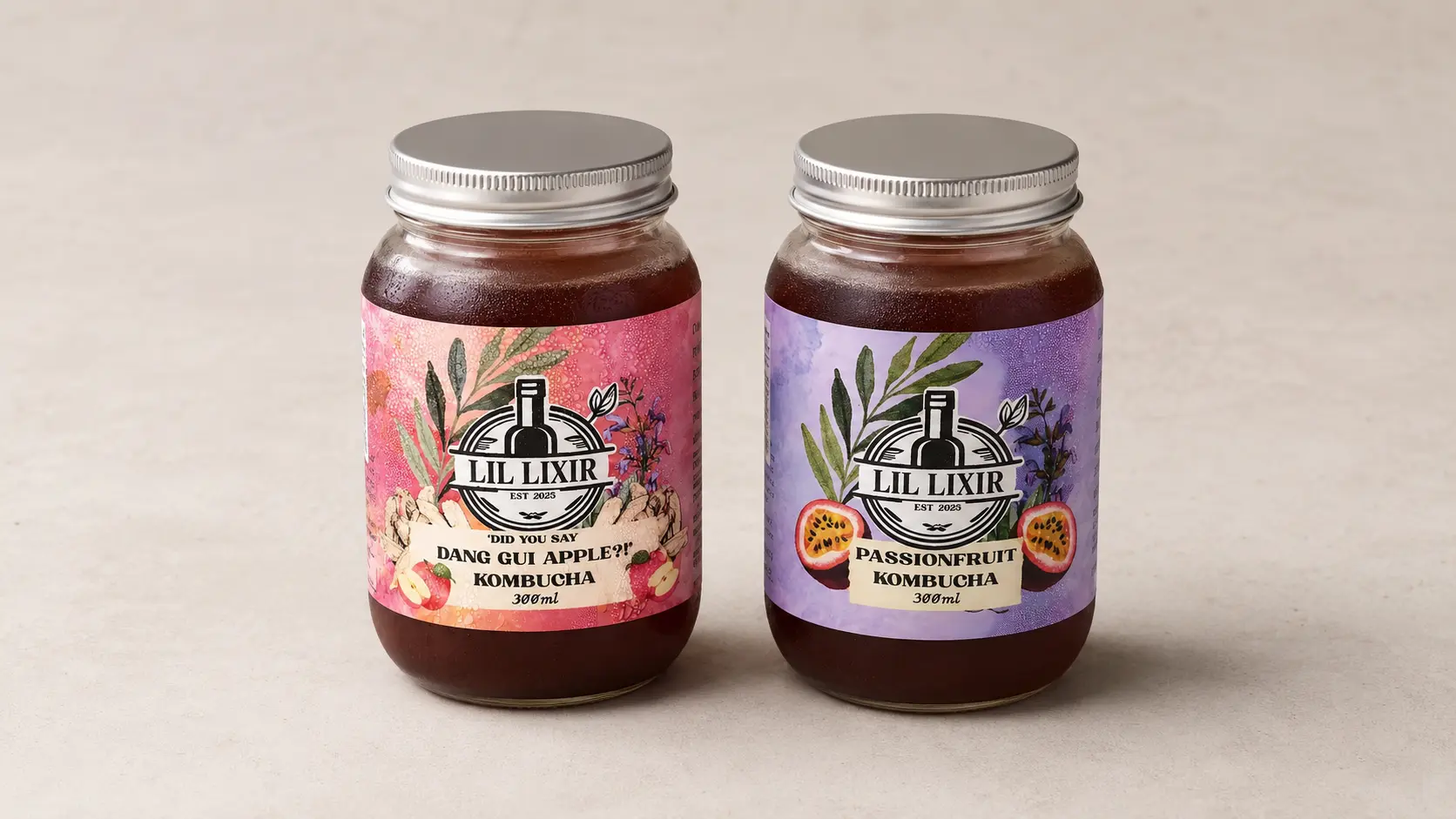
Lil Lixir is a Singapore kombucha brand established in 2025, selling through pop-up markets and its website at lillixir.org. The brand positions itself around two angles: conventional fruit kombucha and a range of TCM-inspired blends that incorporate traditional Chinese medicinal herbs and spices. Products are sold in 300ml glass mason jars with metal lids.
The brand is very new — Est 2025 is declared on all labels reviewed. It operates in Singapore’s pop-up market circuit and describes its kombucha as brewed with premium tea leaves and fermented to support digestion, immunity, and gut health.
On the TCM positioning specifically: the brand markets its herbal blends as wellness products drawing on Traditional Chinese Medicine principles. This claim warrants a factual note. Active compounds in TCM herbs — alkaloids, flavonoids, glycosides — can be degraded or chemically transformed by the acidic fermentation environment of kombucha, which typically reaches a pH of 2.5–3.5. No clinical evidence has been published confirming that TCM herbs retain their traditional therapeutic efficacy when fermented into kombucha. The functional wellness claims associated with the TCM range are not scientifically substantiated in this context. This is noted as an educational observation, not an attack on the brand’s intent.
Front-of-Pack Claims
The following claims are confirmed verbatim from physical bottle labels of both flavours reviewed.
- Product description: “Lil Lixir Kombucha is brewed with premium tea leaves and fermented to support Digestion, Immunity, and Gut health.”
- Live cultures: “Rich in probiotics, antioxidants, and organic acids”
- Raw claim: “This is a raw, natural product—strands of culture may appear, and that’s perfectly normal.”
- Ingredients: “Since we use real fruits and herbs, sweetness and taste may vary slightly from bottle to bottle.”
- Preservatives: “No added preservatives”
- Storage: “Store in the fridge (2–4°C). Enjoy within 3 months. Open gently—don’t shake. Best served chilled.”
- Traceability: “Bottled on:” field present on both labels — left blank on both bottles reviewed. No bottling date is filled in on either physical product.
What’s in the Bottle
All ingredient lists and nutrition data are confirmed verbatim from physical bottle labels.
Two findings from the physical labels that directly affect the scorecard:
1. Erythritol in Cinnajoy. Erythritol is a sugar alcohol used as a zero-calorie sweetener. It is not a whole botanical or fermentation ingredient — it is a processed additive. Its presence in a product described as “natural” using “real fruits and herbs” is inconsistent with that claim. Erythritol is not fermentable by SCOBY cultures and serves purely as a sweetener in the finished product.
2. “Bottled on:” field left blank on both bottles. The label includes a dedicated field for the bottling date, which would allow consumers to track freshness within the stated 3-month shelf life. On both physically reviewed bottles, this field is empty. A product with no bottling date and a 3-month shelf life gives the consumer no way to assess freshness.
Cinnajoy Kombucha ✓ Physical bottle verified
TEA, CANE SUGAR, CINNAMON, NUTMEG, ERYTHRITOL, KOMBUCHA CULTURES.
Sugar: 3.65g / 100ml · Nutri-Grade B (4%) · Energy: 18.22kcal / 100ml · 300ml glass jar
Erythritol is a zero-calorie sugar alcohol sweetener — a processed additive, not a whole spice or botanical. Cinnamon and nutmeg are whole spices and score well on flavouring. The Erythritol entry is the lowest-performing element in the range reviewed and is scored accordingly.
Passionfruit Kombucha ✓ Physical bottle verified
TEA, CANE SUGAR, PASSIONFRUIT, HONEY, KOMBUCHA CULTURES.
Sugar: 7.77g / 100ml · Nutri-Grade C (8%) · Energy: 31.73kcal / 100ml · 300ml glass jar
Ingredient declaration is clean — passionfruit and honey are whole, named ingredients with no artificial additions. The critical issue is sugar: 7.77g per 100ml is well above the KombuchaSG 4g threshold and earns a Nutri-Grade C. This is nearly double what the scorecard permits and is the lowest-performing product in the range on the sugar criterion.
Nutrition Comparison — Physical Labels
| Flavour | Sugar / 100ml | Nutri-Grade | vs 4g Threshold |
|---|---|---|---|
| Cinnajoy | 3.65g | B | ✓ Meets threshold |
| Passionfruit | 7.77g | C | ✗ Fails — nearly double threshold |
Scored on lowest-performing flavour per KombuchaSG multi-flavour scoring rule.
Scorecard Breakdown
| Criteria | Finding | Score |
|---|---|---|
| SCOBY origin & integrity Max 15 pts — Live, documented culture. Not a vinegar shortcut. | “Kombucha Cultures” is declared on both physical labels. The brand describes the product as “raw” and notes that “strands of culture may appear” — consistent with a live culture product. No SCOBY lineage or origin is documented. No explicit “unpasteurised” declaration appears on either physical label. The brand was established in 2025 and has a limited operating history. The tasting note recorded very weak fermentation character across both flavours reviewed, suggesting culture activity may be limited at point of sale. | 8 / 15 |
| Carbonation source Max 15 pts — Natural 2nd fermentation only. No added carbonated or sparkling water. | No carbonated water or sparkling water appears on either physical label reviewed. The product is refrigerated with a 3-month shelf life — consistent with a live product. However, the editor’s tasting note recorded ambiguous carbonation character that was difficult to identify as natural fermentation effervescence. The glass jar format with a metal screw lid, while better than plastic for carbonation retention, does not seal with the same pressure tolerance as a standard kombucha bottle. The criterion scores on declared ingredients — no added carbonated water is present. The tasting observation is noted separately. | 10 / 15 |
| Flavouring method Max 15 pts — Whole fruit or botanicals. No artificial flavours or vague “natural flavouring.” | The Passionfruit variant declares whole, named ingredients — passionfruit and honey — with no artificial flavourings. The Cinnajoy variant includes cinnamon and nutmeg (whole spices) but also erythritol, which is a processed sugar alcohol sweetener and not a whole botanical ingredient. Its presence in a product described as using “real fruits and herbs” is inconsistent with that claim. Scored on Cinnajoy as the lowest-performing flavour on this criterion. | 10 / 15 |
| Live cultures at point of sale Max 15 pts — Lab-verified CFU count or visible culture activity. Not pasteurised. | “Raw, natural product” is declared on both physical labels. “Strands of culture may appear” is stated. Refrigeration is required and shelf life is 3 months — consistent with a living product. No “unpasteurised” declaration appears on either label. No CFU count or Certificate of Analysis is published. The editor’s tasting note found very weak fermentation character across both flavours reviewed — minimal tartness, diluted flavour profile, and ambiguous carbonation — observations consistent with insufficient live culture activity at point of sale. No third-party laboratory verification has been published. | 8 / 15 |
| Sugar content after fermentation Max 15 pts — Under 4g per 100ml. Consumed by SCOBY during fermentation. | Two flavours confirmed from physical nutrition panels. Cinnajoy: 3.65g per 100ml — meets the 4g threshold, Nutri-Grade B. Passionfruit: 7.77g per 100ml — significantly above the 4g threshold, Nutri-Grade C. 7.77g is nearly double the criterion threshold. The scorecard is applied on the lowest-performing flavour. A residual sugar of 7.77g in a fermented product indicates either a short fermentation duration, insufficient SCOBY culture activity to consume the available sugar, or both. This is the most significant scorecard finding in this review. | 0 / 15 |
| Ingredient transparency Max 15 pts — Full disclosure. No vague terms. Every ingredient clearly identified. | Both physical labels declare ingredients clearly and specifically. There are no vague “natural flavouring” entries. The erythritol in Cinnajoy is declared — transparency credit for disclosing it — but its presence alongside a “natural” and “real fruits and herbs” claim is inconsistent. The more significant transparency gap is the “Bottled on:” field, which is present on both labels but left blank on both physically reviewed bottles. A consumer cannot determine when the product was bottled and therefore cannot assess freshness within the 3-month shelf life. No address, no SFA licence number, and no batch identification appear on either label. | 8 / 15 |
| Production integrity Max 10 pts — Small-batch, controlled, traceable. Founder-led or craft production preferred. | Lil Lixir was established in 2025 and operates through pop-up markets — a very early-stage operation. Products are sold in 300ml glass mason jars, which are a functional but non-specialist format for kombucha — the screw-top metal lid does not provide the same pressure-rated seal as a dedicated kombucha bottle. A note on container material for readers: kombucha is an acidic beverage with a typical pH of 2.5–3.5. Acidic liquids stored in plastic containers over time can cause leaching of compounds from the plastic into the drink — a concern well-established in food science. While the bottles reviewed are glass, the brand has also been observed selling kombucha in plastic containers at pop-up markets. Plastic is not a recommended format for acidic fermented beverages intended for refrigerated shelf storage. The “Bottled on:” field is present on both labels but left blank on both bottles reviewed, indicating batch traceability is not yet consistently implemented. No business address, SFA licence number, or founder information appears on either physical label. The TCM wellness claims are made without published scientific substantiation in a fermented context. | 4 / 10 |
| Total Score | 48 / 100 | |
Plain-Language Verdict
Lil Lixir scores Commercial Grade at 48 out of 100. The brand is very new — established in 2025 — and the score reflects a product that is still early in its development across several key dimensions.
The most significant finding is the Passionfruit sugar level: 7.77g per 100ml, earning a Nutri-Grade C. This is nearly double the KombuchaSG threshold of under 4g and is the highest residual sugar recorded in any brand reviewed on this site. A sugar level this high in a fermented product points to either insufficient fermentation duration or insufficient SCOBY culture activity to consume the available sugar. The tasting note’s observation of very weak fermentation character across both flavours reviewed is consistent with this finding.
Erythritol in the Cinnajoy variant is a separate concern. Adding a processed zero-calorie sweetener to a product described as “natural” and made with “real fruits and herbs” is a contradiction the label cannot resolve. The Cinnajoy’s sugar of 3.65g suggests the fermentation is more complete in that variant — but the use of erythritol to supplement sweetness raises questions about why a sweetener is needed at all if fermentation is producing the intended result.
The “Bottled on:” field being blank on both physically reviewed bottles is a straightforward traceability gap. The field exists on the label — it simply is not being filled in. This is fixable immediately and should be. A separate observation on packaging: kombucha is an acidic beverage, typically sitting at pH 2.5–3.5. Acidic liquids stored in plastic containers can cause leaching of compounds from the plastic material over time — a concern recognised in food science. The brand has been observed using plastic containers at pop-up markets alongside the glass jars reviewed here. For a product positioned as a natural health beverage, plastic is not an appropriate format.
The TCM wellness positioning warrants a factual note for readers: active compounds in traditional Chinese medicinal herbs can be degraded or chemically transformed by the acidic fermentation environment of kombucha. No clinical evidence supports the claim that TCM herbs retain their therapeutic efficacy when fermented into kombucha at commercial scale. The functional wellness claims in the TCM range are not scientifically substantiated in this context.
Lil Lixir is a 2025 brand at an early stage of development. The scorecard reflects where the product currently stands against the same criteria applied to every brand on this site. The gaps identified — sugar content, erythritol use, blank bottling dates, and weak fermentation character — are addressable. The score can improve if they are.
Editor’s Tasting Note
This section represents the personal tasting experience of the KombuchaSG editor and is entirely separate from the scorecard assessment above. Tasting notes are subjective and reflect one individual’s experience. Two flavours were tasted: Passionfruit and Cinnajoy.
The fermentation character across both flavours is very weak. There is minimal tartness, minimal vinegar complexity, and a flavour profile that reads as diluted rather than fermented. The brew does not deliver the depth that an active, well-fermented kombucha produces. Both bottles were opened cold and consumed as directed.
Carbonation is present but ambiguous in character — it is difficult to identify as the fine, natural effervescence of a second fermentation. The glass mason jar format with a metal screw lid provides limited carbonation retention compared to a pressure-rated kombucha bottle, which may contribute to the flat quality of the effervescence.
The flavour of both variants does not convincingly deliver on the declared ingredients. Passionfruit in particular — with clean, whole ingredients on the label — did not taste of passionfruit. Cinnajoy’s sweetness read as synthetic rather than spice-derived, consistent with the erythritol in the formula.
The TCM range was also sampled. The dominant experience was bitterness — described accurately as similar to drinking Chinese herbal medicine. Whether that is the intention or a product of insufficient brewing balance is unclear, but it does not read as a pleasurable kombucha experience. The kombucha base disappears entirely behind the herbal bitterness.
After tasting two flavours, the decision was made not to purchase further. The product does not currently deliver on its kombucha claims at point of sale.
| Criterion | What it measures | Score | Max |
|---|---|---|---|
| Fermentation Character | Tartness, depth, live kombucha taste | 1 | 5 |
| Carbonation Feel | Soft and integrated vs sharp and aggressive | 1 | 5 |
| Flavour Honesty | Does it taste like the declared ingredients? | 1 | 5 |
| Overall Impression | Would you drink this again? | 1 | 5 |
| Editor’s Total | 4 | / 20 | |
Where to Buy
Lil Lixir is available through pop-up markets in Singapore and online at lillixir.org. KombuchaSG does not verify current availability, pricing, or pop-up schedules. Check the brand’s website or social media for current locations.
How this score was calculated
Every brand on KombuchaSG is assessed using the same 7-criteria, 100-point scorecard. The criteria are published in full before any brand is reviewed. Read The Standard to understand how every score on this site is calculated.
- → Back to all Singapore kombucha brand reviews
- → The Standard — the full 7-criteria scorecard
- → Real vs Fake Kombucha — the shortcuts explained
- → How to read a kombucha label
KombuchaSG is an independent educational platform. We are not affiliated with any kombucha brand. All ingredient and nutrition data in this review is confirmed from physical 300ml glass jars purchased at a Singapore pop-up market. All criteria are applied identically to every brand reviewed on this site.