TCM kombucha — wellness innovation or marketing claim?
Combining Traditional Chinese Medicine herbs with kombucha is a genuinely interesting idea. But when Chinese herbs are fermented in an acidic environment, do the active compounds survive? The science raises questions that most brands have not answered.
Singapore has a deep and legitimate relationship with Traditional Chinese Medicine. TCM herbs have been used therapeutically for thousands of years, with documented effects on specific compounds in specific conditions. That heritage is real. This article is not questioning it.
What it is questioning is whether those compounds survive the fermentation process that turns sweetened tea into kombucha — and whether the wellness claims attached to TCM kombucha products hold up when you look at the chemistry.
Before we begin — a note on Traditional Chinese Medicine
Traditional Chinese Medicine is a centuries-old system of healing with a significant evidence base for specific herbs, compounds, and applications. The question this article addresses is a narrow scientific one: whether the active compounds in TCM herbs are preserved through kombucha fermentation. This is a chemistry question — not a judgment on TCM as a practice or tradition.
Respecting TCM means holding claims made in its name to the same standard we apply to any other wellness claim. Uncritical acceptance of unverified claims does not honour the tradition — it exploits it.
What TCM kombucha is — and what it claims to be
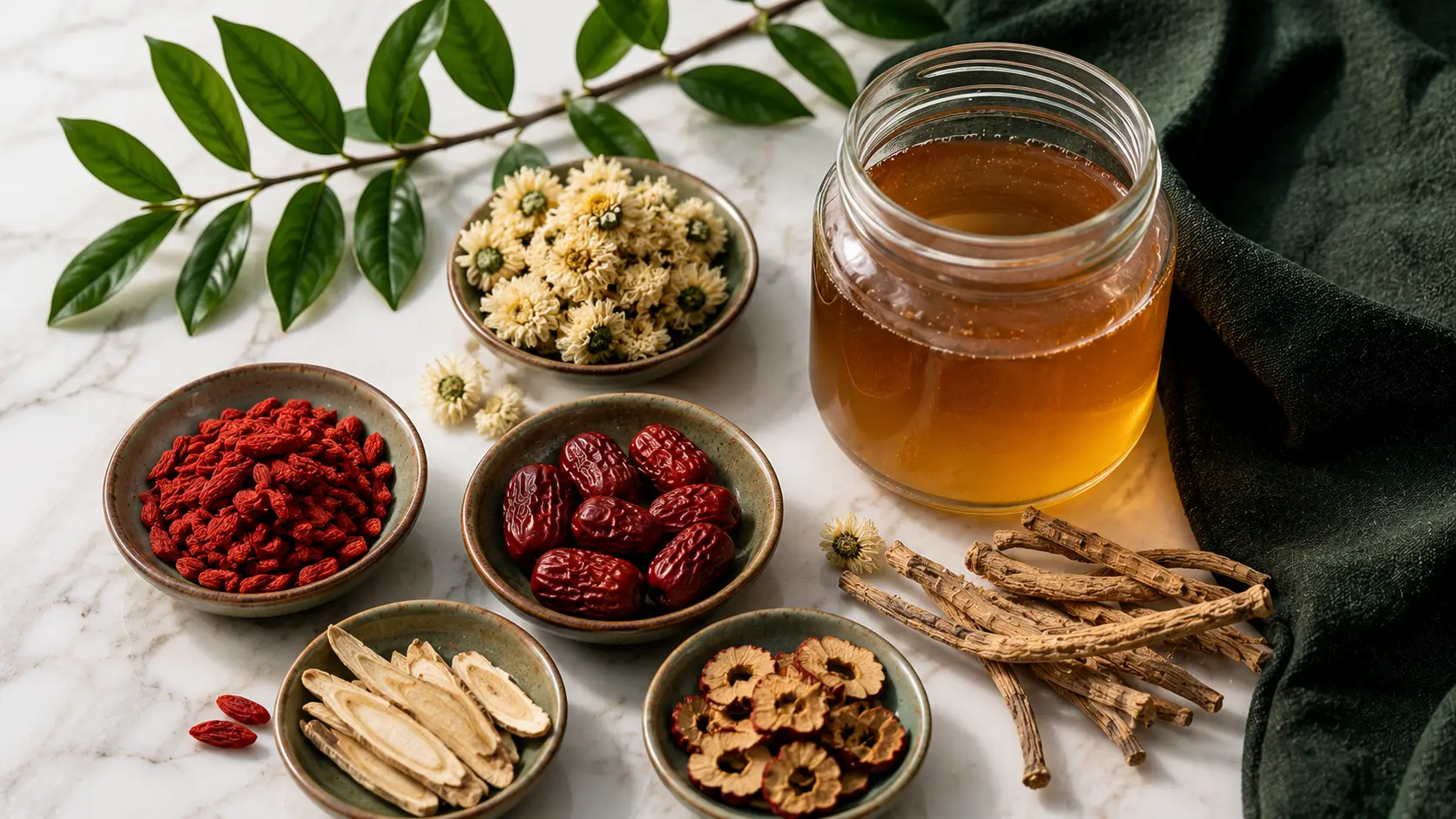
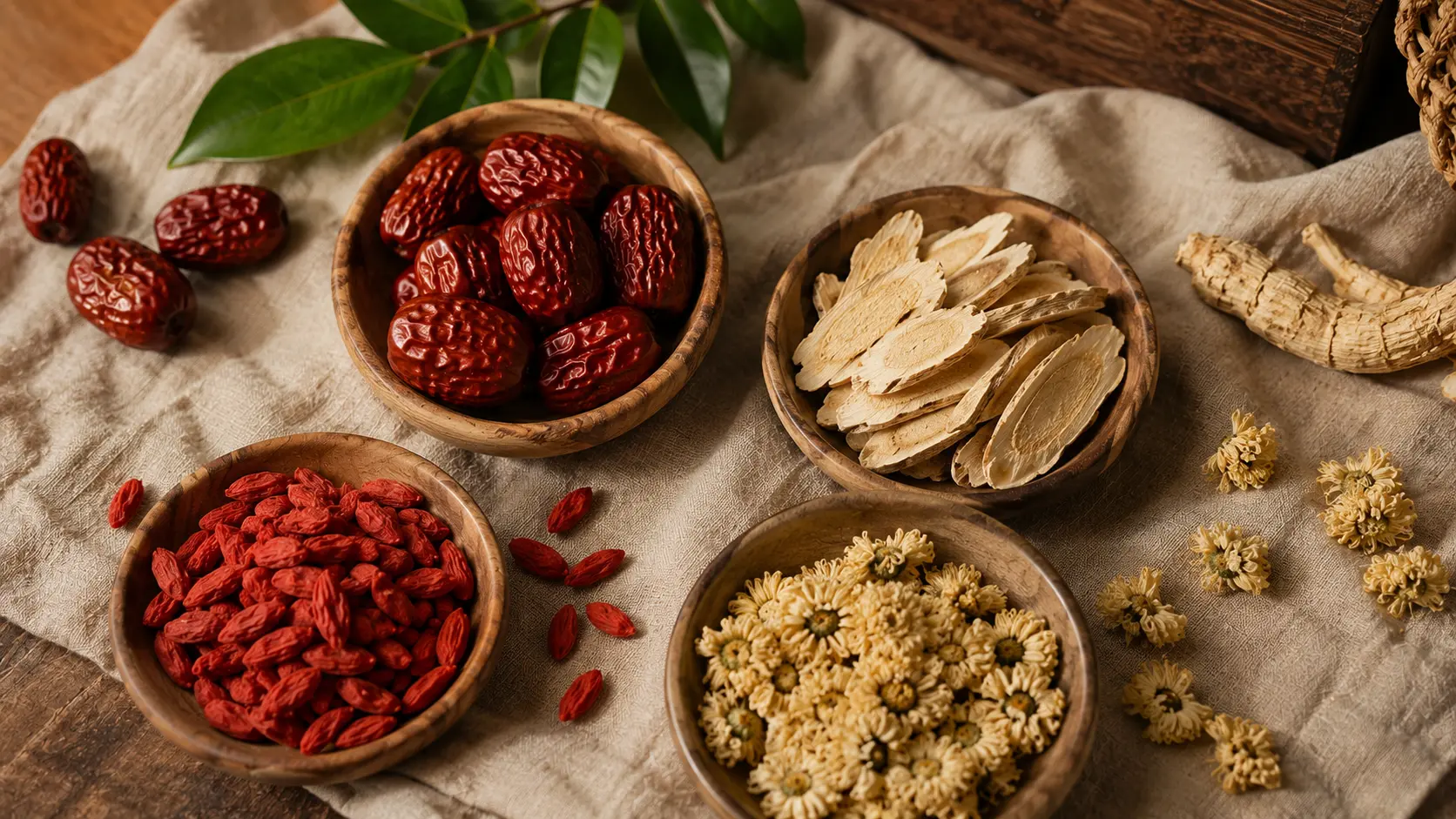
TCM kombucha is a category of product that adds Traditional Chinese Medicine herbs — chrysanthemum, wolfberry, red dates, astragalus, goji berry, and others — to a kombucha fermentation or to the finished kombucha base. The resulting drink is then marketed with the wellness associations of those herbs alongside the gut health positioning of kombucha itself.
The appeal is understandable. Singapore has a large Chinese-heritage population with genuine familiarity and trust in TCM. Kombucha is already positioned as a wellness product. Combining the two creates a product that can speak to both audiences at once.
The commercial logic is clear. The scientific question is whether the resulting product actually delivers the TCM benefits it implies.
TCM is not just ingredients — it is a system of preparation
Before examining what fermentation does to specific TCM compounds, it is worth addressing a more fundamental point that the chemistry alone does not fully capture.
TCM’s therapeutic efficacy is inseparable from its preparation methods. Decoction — prolonged boiling and double-boiling — is not a cooking step. It is the extraction mechanism through which active compounds are made bioavailable in the forms TCM intends. The heat, the duration, the water ratio, the combination of herbs in a specific formula — these are all part of how the medicine works. You cannot separate the herb from the method and expect the same result.
This is the fundamental difference between TCM herbs and the fruits, flowers, and culinary herbs used in conventional kombucha. A strawberry can be eaten raw. Hibiscus can be cold-steeped. Fresh ginger delivers active compounds without boiling. These ingredients are biologically accessible without a specific preparation protocol — which is why they interact meaningfully with fermentation.
TCM herbs were never designed to be consumed cold, unprocessed, or in an acidic fermentation environment. The therapeutic preparation method is not a preference — it is the mechanism.
A telling absence in the historical record
If cold acidic fermentation were an equivalent or superior method for extracting TCM compounds, thousands of years of empirical TCM practice would have discovered it. Fermented foods have existed in Chinese culinary and medical traditions for millennia — vinegar, fermented soybean, rice wine. TCM practitioners were not unfamiliar with fermentation as a concept. Yet fermented preparations of the therapeutic herbs at the heart of TCM pharmacology — astragalus, wolfberry, red dates, chrysanthemum — do not appear as standard TCM delivery formats. The absence is itself a data point.
The chemistry problem: what fermentation does to active TCM compounds
TCM herbs are effective because of specific active compounds they contain — alkaloids, flavonoids, polysaccharides, glycosides, terpenes, and others — each of which exerts its effect through specific biological mechanisms. These compounds are not generic wellness ingredients. They are chemically specific, and their efficacy depends on their intact molecular structure.
Kombucha fermentation creates a challenging environment for many of these compounds:
| Factor | What happens | Likely outcome |
|---|---|---|
| Acidity — pH 2.5 to 3.5 | Many glycosides and alkaloids are sensitive to acid hydrolysis. Acid can cleave glycosidic bonds, transforming compounds into forms with different or reduced biological activity. | Activity altered — unclear |
| Microbial transformation | The SCOBY’s bacteria and yeast metabolise organic compounds. Some TCM-active compounds may be converted into metabolites with different properties. Effects on activity are largely unstudied. | Outcome unknown |
| Heat during brewing | The initial brewing stage involves boiling water. Heat-sensitive compounds — including some flavonoids and volatile aromatics — may be degraded before fermentation begins. | Likely degraded |
| Polysaccharides (goji, wolfberry) | Polysaccharides may be broken down by microbial enzymes during fermentation. Whether resulting fragments retain immunomodulatory or antioxidant activity is not established. | Partial survival possible |
| Some flavonoids (chrysanthemum, red dates) | Certain flavonoids are more acid-stable and may partially survive. Fermentation can also enhance bioavailability of some phenolic compounds by breaking down cell walls. | Partial survival possible |
| Traditional preparation context | In TCM, herbs are prepared as decoctions, tinctures, or powders — methods optimised for compound extraction. Kombucha fermentation was not designed with these compounds in mind. | Context not preserved |
The honest summary is that the science of what happens to specific TCM active compounds during kombucha fermentation is largely unstudied. Some compounds likely survive in altered forms. Others are probably degraded or transformed. The degree to which the resulting fermented liquid delivers the specific therapeutic properties of the original herbs has not been demonstrated.
“TCM herbs have documented effects — in specific preparations, at specific concentrations, in specific forms. Fermentation changes all three.”
The distinction between flavour and therapeutic function
There is an important distinction between using TCM herbs for flavour and using them for therapeutic function. These are not the same claim.
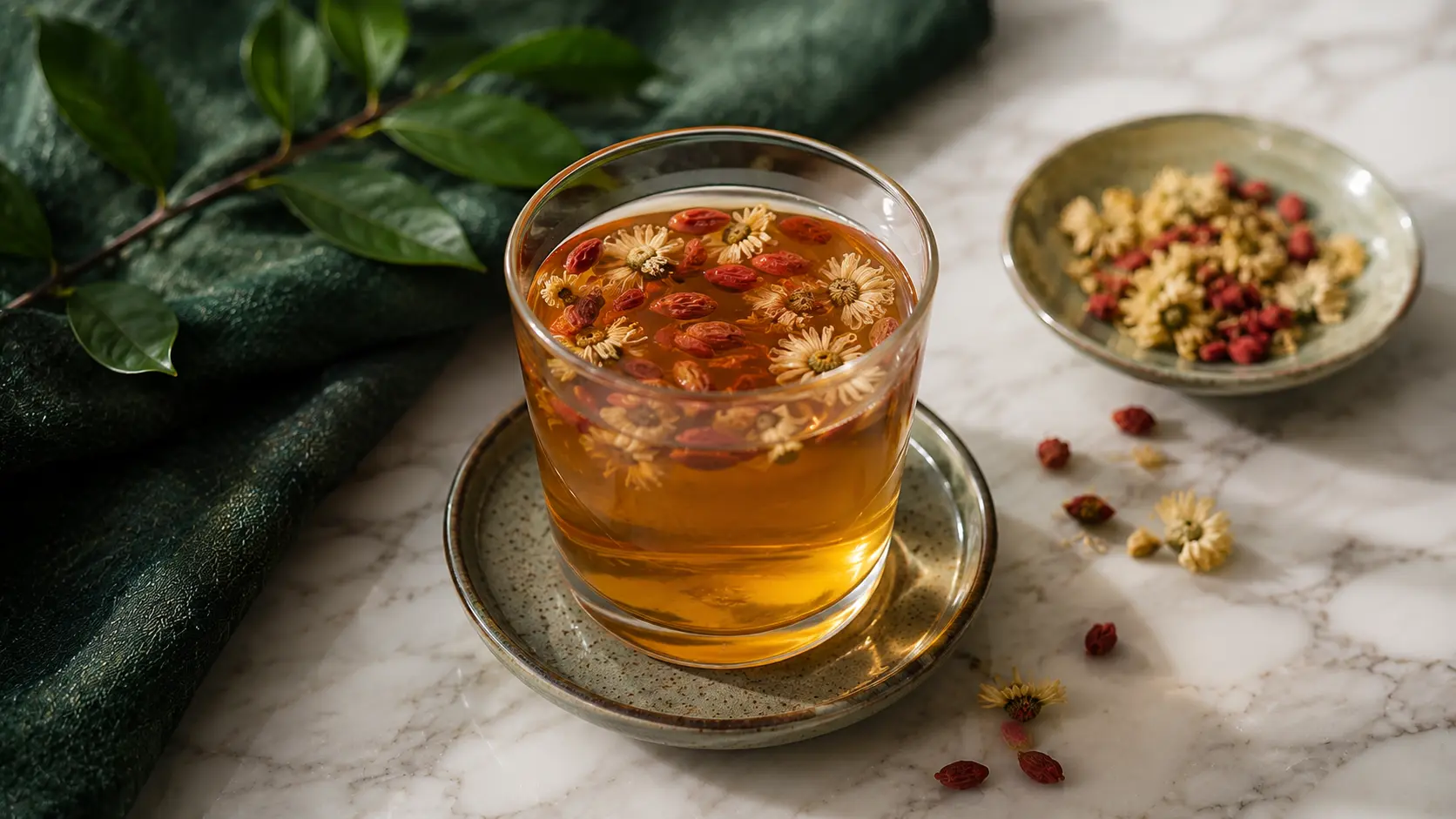
Chrysanthemum, red dates, and wolfberry are genuinely pleasant ingredients. They contribute flavour, aroma, and colour to a kombucha product. A chrysanthemum kombucha with visible petals and a recognisable floral flavour has used real chrysanthemum — and that is a legitimate, real-ingredient claim that scores well on a flavoring authenticity criterion.
The question becomes more complex when a brand moves from “brewed with chrysanthemum” to “supports liver health” or “clears heat” or “boosts immunity” — language borrowed directly from TCM pharmacology. These are therapeutic claims that require the active compounds to be present in efficacious amounts in the finished product. That has not been demonstrated for fermented preparations.
A brand that says “brewed with wolfberry” is making a flavoring claim. A brand that says “TCM-inspired immune support” is making a therapeutic claim. The ingredient list may look identical. The standard of evidence required is very different.
What would change this picture
The questions raised here are not unanswerable. A brand that commissioned independent laboratory analysis of their finished fermented product — testing for the presence and concentration of specific active compounds from the herbs used — and published those results would be in a fundamentally different position. That analysis would not prove therapeutic efficacy, but it would establish whether the active compounds survived fermentation at meaningful levels.
To date, no Singapore TCM kombucha brand has published this kind of third-party compositional analysis for their finished product. Until they do, the therapeutic claims attached to TCM kombucha remain unsubstantiated — not necessarily false, but unverified.
What to look for on TCM kombucha labels
Not all TCM kombucha products make the same claims. Here is how to read the label with appropriate precision:
- Are the TCM herbs listed as actual ingredients? Named specifically — dried chrysanthemum, wolfberry, red dates — or hidden under “natural flavouring”?
- What claims are made? Flavour claims (“brewed with chrysanthemum”) vs therapeutic claims (“supports liver function”, “clears heat”, “boosts immunity”). The former is a statement about ingredients. The latter requires scientific substantiation.
- Is any compositional analysis available? Has the brand tested whether active compounds survive in the finished product? If so, are results published?
- What is the fermentation integrity like otherwise? A TCM kombucha that also uses carbonated water, natural flavoring, and high residual sugar has prioritised marketing positioning over fermentation quality in ways that go beyond the TCM question.
The bottom line
TCM kombucha is an interesting creative direction — combining two traditions with genuine individual credibility. The herbs used often have real documented properties. Kombucha fermentation produces a genuinely functional beverage. The combination is not inherently dishonest.
The problem is the leap from interesting combination to specific therapeutic claims — claims that require the active TCM compounds to survive fermentation intact and in sufficient concentration. That has not been demonstrated, and both the chemistry and the logic of TCM preparation give reason to question whether it occurs.
TCM works because of how it is prepared — not just what it contains. A decoction of astragalus is not interchangeable with astragalus steeped in acidic kombucha, for the same reason that a raw wolfberry is not interchangeable with a wolfberry that has been double-boiled for forty minutes. The method is the medicine.
A TCM kombucha brand that says “brewed with wolfberry, chrysanthemum, and red dates” is making a flavoring and ingredient claim — one that can be evaluated against the ingredient list. A brand that says those same herbs “support immunity, clear heat, and strengthen the liver” is making a therapeutic claim — one that requires evidence the product does not currently provide.
The distinction matters. The tradition of TCM deserves to be applied with the same rigour it has always demanded — not borrowed as a wellness aesthetic.
Ingredient transparency and flavoring method are both scored on the KombuchaSG Authenticity Scorecard.
Every Singapore kombucha brand reviewed on this site — including TCM-positioned brands — is assessed on whether their ingredient claims are specific and verifiable, and whether their front-of-pack positioning is supported by what is actually in the bottle.
→ Read The Standard — the full 7-criteria scorecard
Frequently asked questions
Is TCM kombucha safe to drink?
For most healthy adults, yes. The TCM herbs commonly used in Singapore kombucha products — chrysanthemum, wolfberry, red dates, goji berry — are food-grade ingredients with long histories of safe consumption. The concern this article raises is not about safety but about whether the therapeutic properties of these herbs survive fermentation. Drinking TCM kombucha is unlikely to cause harm. Whether it delivers the specific TCM benefits claimed is a separate question.
Why does TCM use boiling and double-boiling instead of cold preparation?
Decoction is the primary extraction method in TCM because many of the active compounds in TCM herbs — polysaccharides, alkaloids, glycosides — require sustained heat to be released from the plant matrix and converted into bioavailable forms. Double-boiling in particular is used for herbs where prolonged gentle heat extracts compounds more completely without degrading them. These methods were refined empirically over centuries. Cold-steeping, fermentation, or raw consumption of the same herbs does not produce the same compound profile — which is why TCM prescriptions specify preparation method as carefully as they specify ingredients.
Are there any TCM herbs that might genuinely survive kombucha fermentation?
Possibly. Some flavonoid-rich herbs — including chrysanthemum — contain compounds that are relatively acid-stable and may partially survive the fermentation environment. Fermentation can also enhance the bioavailability of certain phenolic compounds by breaking down plant cell walls. The honest answer is that this is largely unstudied for most specific TCM herb-fermentation combinations. The presence of a compound is not the same as therapeutic efficacy — that requires the compound to be present at a concentration sufficient to exert a measurable biological effect in the form TCM intends, which has not been demonstrated in finished TCM kombucha products.
How is TCM kombucha different from regular herbal tea?
In traditional herbal tea preparation, TCM herbs are steeped in hot water — a method developed to extract specific active compounds in forms that are bioavailable and effective. The temperature, duration, and preparation method are part of the therapeutic protocol. In kombucha, the herbs are introduced into an acidic, live-culture fermentation environment not designed for TCM compound preservation. The flavour may be similar. The compound profile — and therefore any therapeutic equivalence — is likely very different. A cup of chrysanthemum tea and a bottle of chrysanthemum kombucha are different products in terms of what they contain, regardless of how similar they may taste.
What should I look for if I want to buy TCM kombucha in Singapore?
Look for brands that name their TCM herbs specifically in the ingredient list rather than hiding them under “natural flavouring”. Evaluate whether the brand makes flavoring claims (“brewed with wolfberry”) or therapeutic claims (“boosts immunity”) — and apply appropriate scepticism to the latter. Check the overall fermentation quality using the standard checklist: no carbonated water, low residual sugar, unpasteurised, refrigerated. A TCM kombucha that is otherwise well-made and uses real named herbs is a more credible product than one that combines TCM positioning with multiple fermentation shortcuts. The herbs are a flavouring and ingredient choice — the fermentation quality is the foundation.
- → The Standard — our 7-criteria authenticity scorecard
- → Real vs Fake Kombucha — the shortcuts explained
- → How to read a kombucha label
- → Browse all Singapore kombucha brand reviews
KombuchaSG is an independent educational platform. We are not affiliated with any kombucha brand. Content is published for educational purposes only and does not constitute medical or nutritional advice. This article addresses the scientific question of compound preservation during fermentation and does not constitute a judgment on Traditional Chinese Medicine as a practice or system of healing.