
Why the bottle your kombucha comes in matters more than you think
Glass or plastic? The container is not just a packaging choice — it affects carbonation retention, flavour integrity, and what it signals about how the kombucha inside was made.
Most consumers do not think twice about the bottle. They look at the label, check the price, and reach for a product. But for a living beverage like kombucha — naturally carbonated, acidic, and containing live cultures — the packaging choice matters in ways that are not visible on the outside.
Here is what the difference actually means.
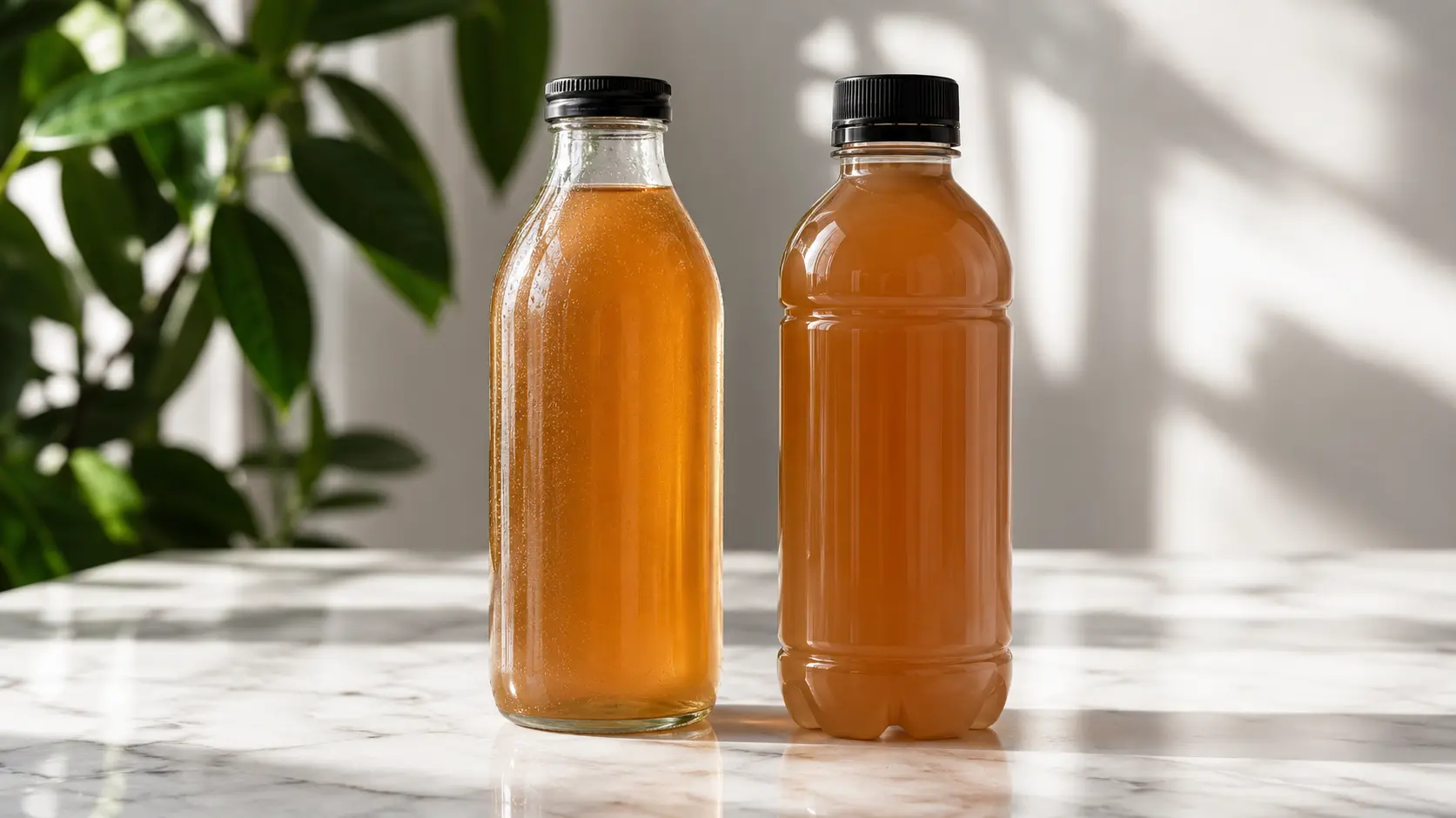
Why packaging matters for a live fermented beverage
Kombucha is acidic — typically with a pH between 2.5 and 3.5. It is naturally carbonated, containing dissolved CO₂ produced during fermentation. And in an unpasteurised product, it contains live cultures that continue to slowly ferment the residual sugars in the bottle after sealing.
These three characteristics — acidity, carbonation, and live biological activity — interact with the container in ways that affect what you drink. Not every container type handles all three equally well.
- Non-porous — CO₂ cannot escape through the walls
- Chemically inert — does not react with acidic contents
- No leaching of compounds into the liquid
- Preserves natural carbonation over time
- Maintains flavour profile from bottling to consumption
- Recyclable and reusable
- Standard for craft and authentic kombucha globally
- Permeable to CO₂ — natural carbonation escapes over time
- Reactive with acidic liquids at a molecular level
- Risk of leaching BPA, phthalates, or other compounds
- Fizz diminishes faster — particularly in a naturally carbonated product
- May affect flavour over time, especially in warm conditions
- Lower production cost — commercial advantage
- More common in mass-market products
The CO₂ permeability problem
This is the most practically significant difference between glass and plastic for naturally carbonated kombucha. Plastic — including PET plastic, the most common type used in beverage bottles — is permeable to CO₂. Dissolved carbon dioxide slowly migrates through the plastic walls and escapes into the surrounding air.
For a naturally carbonated kombucha — where the fizz was produced by live cultures during second fermentation — this means the carbonation that took days to develop inside a sealed bottle is gradually lost through the container walls. A plastic bottle of naturally carbonated kombucha stored for several weeks will be noticeably flatter than it was when first sealed.
Glass is non-porous. CO₂ cannot escape through glass walls. The carbonation stays in the bottle until you open it — exactly as the brewer intended.
For a product that uses injected carbonated water rather than natural fermentation, CO₂ permeability in plastic is still a concern but less central to the authenticity question — the carbonation was never a result of fermentation to begin with.
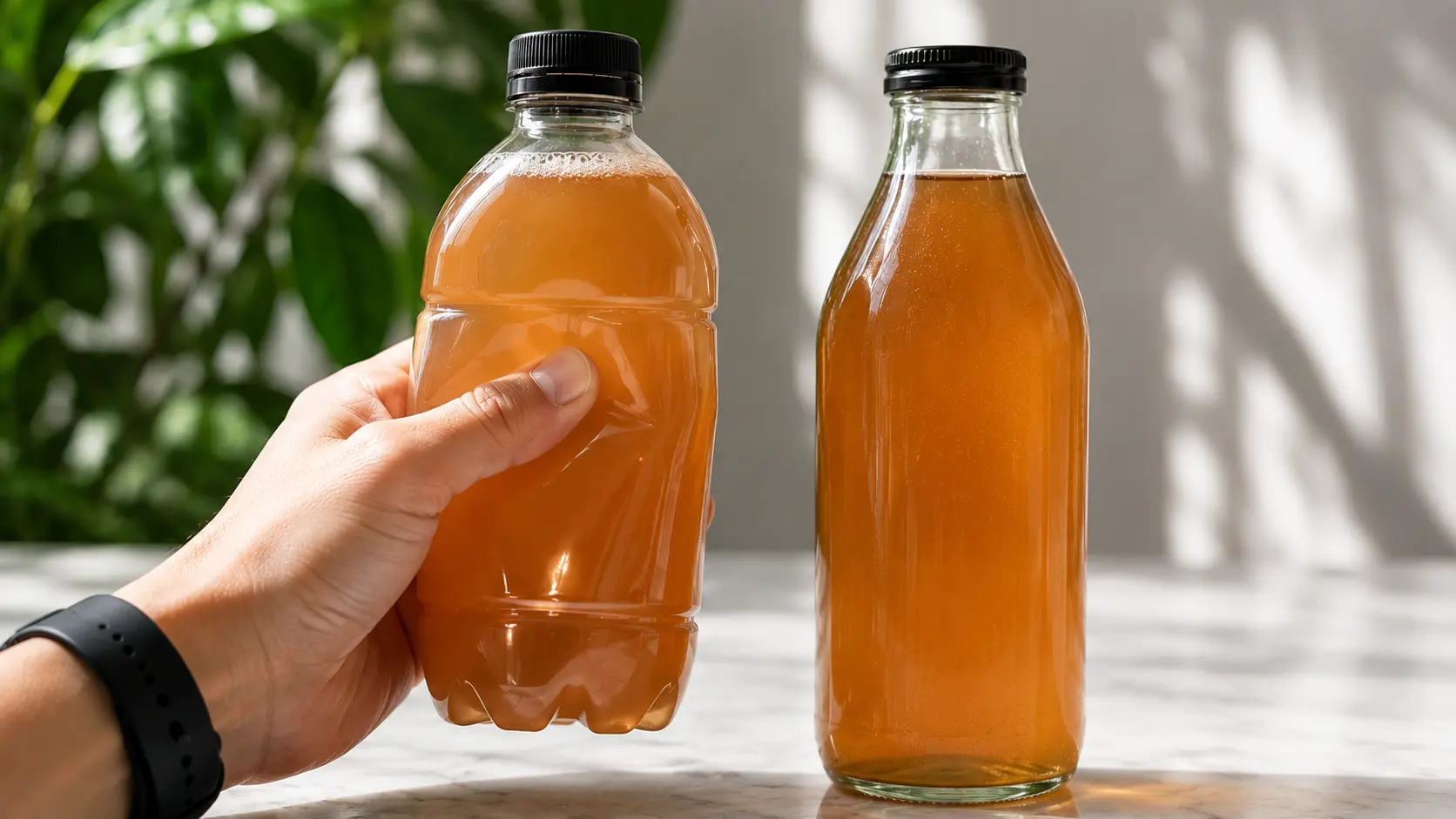
Acidity and plastic — what happens to your drink
Kombucha’s acidity is not just a flavour characteristic — it is a chemical environment that interacts with its container. Glass is chemically inert: it does not react with acidic liquids and adds nothing to the flavour or composition of the kombucha inside.
Plastic is not chemically inert. The acidity of kombucha can accelerate the migration of compounds from plastic into the liquid — a process known as leaching. The compounds of concern include:
- BPA (Bisphenol A) — a chemical used in some plastics, associated with hormonal disruption. Many modern bottles are labelled BPA-free, but BPA-free plastics sometimes use alternative bisphenols with similar concerns.
- Phthalates — plasticisers used to make plastic flexible. Can leach into acidic liquids over time and with heat exposure.
- Antimony — a catalyst used in PET plastic production. Can leach into beverages, particularly when exposed to heat.
Singapore’s climate — warm year-round, with significant temperature variation between air-conditioned retail environments and outdoor transport — increases the risk of temperature-related leaching during distribution and storage.
The evidence on the health significance of leaching at typical beverage consumption levels is mixed and still developing. But for a product positioned around health and gut wellness, the choice to use plastic packaging introduces concerns that glass simply does not.
“A genuinely craft-brewed kombucha deserves a container that protects what was built through days of careful fermentation. Glass does that. Plastic compromises it.”
What packaging signals about the product
Beyond the functional differences, the choice of packaging is a signal — about production values, cost structure, and how seriously a brand takes the integrity of its product.
| Factor | Glass | Plastic |
|---|---|---|
| CO₂ retention | Excellent — non-porous | Poor — CO₂ escapes over time |
| Chemical reactivity | None — fully inert | Acidic liquid may leach compounds |
| Flavour preservation | Unchanged from bottling | May be affected over time |
| Production cost | Higher | Lower |
| Weight and shipping | Heavier — higher freight cost | Lighter — cheaper to ship |
| Environmental impact | Recyclable, reusable | Single-use, slower to degrade |
| Signal to consumer | Craft, quality-first | Cost-efficiency prioritised |
A note on Singapore’s climate
Singapore’s year-round warmth and humidity create conditions where plastic-bottled kombucha faces greater risk than in cooler climates. Heat accelerates CO₂ loss through plastic walls, increases the rate of potential leaching, and — if the cold chain is broken during distribution — can allow live cultures to over-ferment inside a plastic bottle that cannot handle the pressure build-up as safely as glass.
Always check that plastic-bottled kombucha has been kept refrigerated throughout the retail environment. If the cold chain has been broken, a plastic bottle under pressure from over-fermentation gives less reliable warning signs than a glass bottle, where pressure build-up is more immediately obvious.

The bottom line
Glass is the appropriate container for genuinely fermented, naturally carbonated, unpasteurised kombucha. It preserves what fermentation produces — the carbonation, the flavour, the live culture activity — without introducing variables that compromise the product. The higher cost of glass relative to plastic reflects a real production decision: a brand that chooses glass is choosing to protect the quality of what is inside.
Plastic is not automatically disqualifying. Some brands producing good-quality kombucha use plastic for cost or logistics reasons. But the combination of plastic packaging with other shortcuts — added carbonated water, natural flavoring extracts, high residual sugar — tells a coherent story about the priority a brand places on authenticity versus efficiency.
Packaging is one piece of the picture. Read it alongside everything else on the label.
Sterilisation — the problem plastic does not advertise
There is a further consideration that rarely appears on packaging but matters for anyone thinking seriously about what goes into a live fermented beverage: plastic is significantly harder to sterilise than glass.
Glass can withstand high-temperature sterilisation — boiling, steam, autoclaving — without degrading. Most plastic bottles cannot. At temperatures effective for deep sterilisation, plastic warps or breaks down, which means producers working with plastic are limited to chemical sanitisers. These are less reliable, particularly for reaching every surface.
The issue is compounded by surface microstructure. Even food-grade plastic develops microscopic scratches and pitting over time — from handling, cleaning, and the acidity of kombucha itself. These micro-abrasions harbour bacteria, yeast, and mould spores in recesses that sanitising solutions cannot fully penetrate. Glass has a harder, smoother surface that resists this kind of micro-damage and cleans more completely.
Plastic is also slightly porous at a molecular level — the same property that allows CO₂ to escape through the walls allows surface contamination to penetrate beyond what rinsing or wiping can remove.
The practical consequence is visible in the market. Mould growth on the interior surface or along the wall and cap seal of a plastic kombucha bottle is a known occurrence — the warm, moist, nutrient-rich environment inside a kombucha bottle is exactly the condition mould thrives in when sterilisation is incomplete. This is not a universal outcome, but it is a risk that glass packaging substantially reduces.
Production integrity — including packaging choices — is assessed on the KombuchaSG Authenticity Scorecard.
Every Singapore kombucha brand reviewed on this site is evaluated on the full picture of production quality. Packaging is one signal among many. See how local brands score.
Frequently asked questions
Is it safe to drink kombucha from a plastic bottle?
For most people, yes — the risk from occasional consumption of beverages in plastic bottles is low. The concern is not immediate harm but cumulative exposure to compounds that may leach from plastic into acidic liquids over time, particularly in warm conditions. In Singapore’s climate, where beverages can experience significant temperature variation during transport and storage, the risk is higher than in cooler environments. For a product specifically positioned around health and gut wellness, glass is simply the more appropriate container.
Why do some kombucha brands use plastic if glass is better?
Cost and logistics. Plastic is cheaper to produce, lighter to ship, and less breakable during transit. For a brand producing at scale or trying to minimise per-unit cost, plastic offers significant commercial advantages. The tradeoff is that the container compromises the product in ways that glass does not. It is a legitimate business decision — but it is a decision that prioritises production efficiency over product integrity, and that is worth knowing when you are choosing what to buy.
Does the colour of glass matter for kombucha?
Slightly. Amber or dark-coloured glass provides some UV protection, which can help preserve light-sensitive compounds — particularly the polyphenols from tea. Clear glass offers no UV protection but allows you to see the product, including any sediment or culture activity inside. Both are significantly better than plastic for all the reasons outlined above. For most Singapore retail environments, where bottles are stored in refrigerated units away from direct light, the difference between amber and clear glass is minimal.
Can I tell if a plastic kombucha bottle has lost its carbonation before opening?
To some extent. Gently squeeze the bottle — a well-carbonated plastic bottle will feel firm and resist pressure. A bottle that has lost significant carbonation through the walls or over-fermented will feel softer or unusually pressurised respectively. This is one of the practical limitations of plastic compared to glass: the container itself gives you less reliable information about what has happened to the product inside.
- → The Standard — our 7-criteria authenticity scorecard
- → Real vs Fake Kombucha — the shortcuts explained
- → 5 things to check before buying kombucha in Singapore
- → Browse all Singapore kombucha brand reviews
KombuchaSG is an independent educational platform. We are not affiliated with any kombucha brand. Content is published for educational purposes only and does not constitute medical or nutritional advice.