ROK Kombucha — Review & Authenticity Score
Reviewed using the KombuchaSG 7-criteria authenticity scorecard. Same format, same criteria as every other brand on this site. ROK stands for Raw Organic Kombucha — a Margaret River brand available at NTUC FairPrice Singapore.
Brand Overview
ROK Kombucha is a raw organic kombucha brand founded in 2015 by husband-and-wife team Trent and Amanda Carroll in Margaret River, Western Australia. The name is an acronym — Raw Organic Kombucha — and the brand’s production philosophy is built around that commitment. Trent Carroll is a qualified winemaker and former professional AFL footballer who discovered kombucha in 2015 while researching natural remedies for chronic back pain from his playing career. His winemaking background — understanding single-origin ingredients, fermentation complexity, and flavour precision — shapes the product directly.
ROK uses a white and green tea base rather than the black tea used by most commercial kombucha producers. White and green teas are less oxidised and higher in certain antioxidant compounds. The brand sources single-origin organic tea, uses filtered Margaret River water, and declares cold-pressed juices as its flavouring method. No artificial flavours and no preservatives are declared anywhere in the range. The brand publicly advocates for kombucha industry standards, positioning itself as an educator as much as a producer.
ROK is available in Singapore at NTUC FairPrice in 330ml glass bottles, imported by Hu Lee Impex Pte Ltd. The brand carries certified organic certification, confirmed on the physical label.
Front-of-Pack Claims
The following claims are confirmed from the physical Passionfruit Rap bottle label, supplemented by brand materials from rokkombucha.com.au.
- Name: ROK = Raw Organic Kombucha — declared on label: “rok is raw organic kombucha”
- Tea: “Single origin white & green teas” — confirmed on physical label
- Water: “Pure Margaret River Water” — confirmed on physical label
- Flavouring: “Raw Cold Pressed Juices” — confirmed on physical label
- Brewing: “Brewed by an experienced wine maker” — confirmed on physical label
- Product description: “Handcrafted Authentic Kombucha” — confirmed on physical label
- Live cultures: “Naturally full of antioxidants, B vitamins, organic acids and live cultures” — confirmed on physical label
- Live culture visible: “See my floaty bits? They’re proof I’m alive!” — confirmed on physical label
- Tagline: “Bubbles with benefits” — confirmed on physical label
- Certification: Certified Organic — confirmed on physical label
- Sugar: 2.7g per 100ml — confirmed from physical label nutrition panel
- Storage: “Keep below 4°C at all times. Consume within 5 days of opening.” — confirmed on physical label
- Carbonation: “Naturally carbonated” — stated in brand materials. Physical label declares “carbon dioxide bubbles” as a separate ingredient — see scorecard.
What’s in the Bottle
Ingredient list quoted verbatim from the physical Passionfruit Rap bottle label (330ml). Additional flavour data from NTUC FairPrice Singapore listing and Australian retail sources.
Carbon dioxide declared as a separate ingredient: The physical label ingredient list ends with “carbon dioxide bubbles” as a distinct entry outside the kombucha sub-declaration. This means carbonation is added externally — it is not solely the result of natural second fermentation. The brand’s website and marketing materials describe the product as “naturally carbonated.” The physical label does not support this claim for the Singapore-market Passionfruit Rap. This directly affects the carbonation scorecard criterion.
Passionfruit Rap ✓ Physical label verified
100% Kombucha (Margaret River water, white* and green tea*, evaporated cane juice*, cold-pressed passionfruit & mango, strawberry gum, wild kombucha culture), carbon dioxide bubbles. *certified organic.
Physical label verified. Sugar: 2.7g per 100ml. Energy: 49 kJ per 100ml. Flavour subtitle on front label: “Cold-pressed Passionfruit + Mango · Strawberry [gum]”. Strawberry gum is a native Australian botanical (Eucalyptus olida) used as a flavouring — a distinctive and specific whole-botanical ingredient. “Wild kombucha culture” is a more specific culture declaration than the generic “kombucha cultures” used by most Singapore brands reviewed. Carbon dioxide bubbles declared as a separate ingredient outside the kombucha sub-declaration.
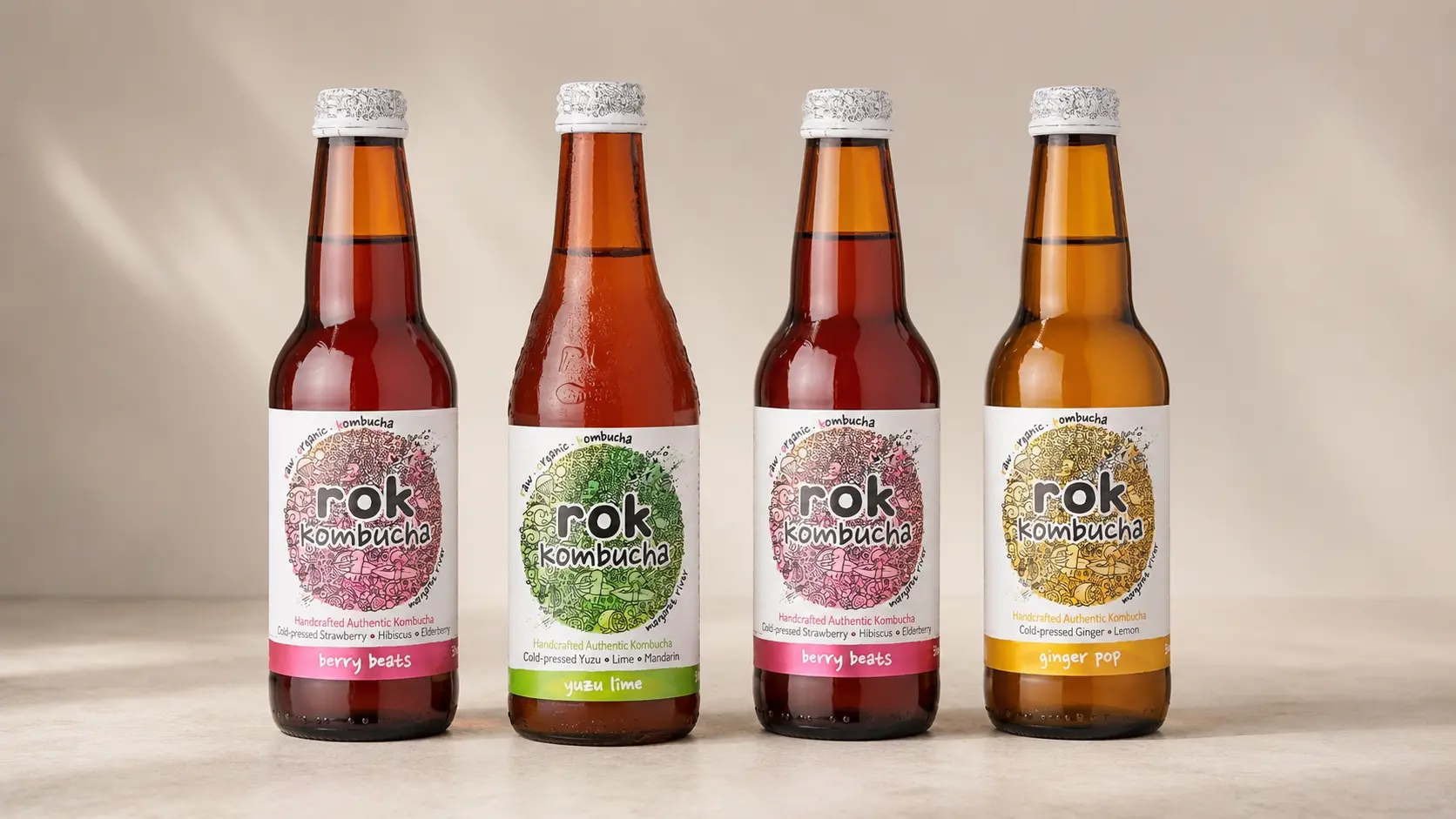
Berry Beats ✓ Singapore FairPrice listing confirmed
Filtered pure Margaret River water, white and green tea, certified organic raw sugar, certified organic cold-pressed strawberries, certified organic hibiscus, certified organic elderberries, kombucha culture.
Confirmed from Singapore NTUC FairPrice product listing. Every flavouring ingredient is certified organic and whole. No carbon dioxide entry visible in this listing — physical label verification pending to confirm whether this variant also declares added CO₂.
Classic Booch
Filtered pure Margaret River water, certified organic white and green tea, certified organic raw sugar, kombucha culture. [Source: Australian retail — pending Singapore label verification.]
Unflavoured base product.
Ginger Pop
Filtered pure Margaret River water, certified organic white and green tea, certified organic raw sugar, certified organic cold-pressed ginger juice, kombucha culture. [Source: Australian retail — pending Singapore label verification.]
Cold-pressed ginger juice as the sole flavouring — whole ingredient, organically certified.
Scorecard Breakdown
| Criteria | Finding | Score |
|---|---|---|
| SCOBY origin & integrity Max 15 pts — Live, documented culture. Not a vinegar shortcut. | “Wild kombucha culture” is declared as a named ingredient in the physical label — a more specific culture declaration than the generic “kombucha cultures” used by most Singapore brands reviewed. “Naturally full of antioxidants, B vitamins, organic acids and live cultures” is confirmed on the physical label. “See my floaty bits? They’re proof I’m alive!” is a direct reference to visible SCOBY culture activity in the bottle. The brand has brewed consistently since 2015 using a fermentation process informed by Trent Carroll’s professional winemaking background. No specific SCOBY lineage or origin documentation is published. | 13 / 15 |
| Carbonation source Max 15 pts — Natural 2nd fermentation only. No added carbonated or sparkling water. | The physical Passionfruit Rap label declares “carbon dioxide bubbles” as a distinct ingredient entry outside the kombucha sub-declaration. This means carbonation is added externally and is not solely the product of natural second fermentation. The brand’s website and marketing materials describe the product as “naturally carbonated” — a claim the physical label does not support. The criterion requires natural second fermentation carbonation only. Added CO₂ does not meet this criterion regardless of whether the kombucha base itself is also naturally carbonated to some degree. The criterion is not met. | 0 / 15 |
| Flavouring method Max 15 pts — Whole fruit or botanicals. No artificial flavours or vague “natural flavouring.” | Cold-pressed passionfruit and mango juices are declared as whole-produce flavourings in the physical label. Strawberry gum (Eucalyptus olida) is a native Australian botanical used as a flavouring — a specific, identifiable whole-botanical ingredient. The Berry Beats FairPrice listing declares certified organic cold-pressed strawberries, hibiscus, and elderberries — each individually certified. No artificial flavourings and no vague “natural flavouring” entries appear in any verified ingredient list. The brand’s stated flavouring philosophy — “the only flavouring we use is raw cold pressed juices” — is consistent with the physical label findings. One point deducted for the inability to verify the full range from physical Singapore labels. | 13 / 15 |
| Live cultures at point of sale Max 15 pts — Lab-verified CFU count or visible culture activity. Not pasteurised. | “Live cultures” confirmed on physical label. “See my floaty bits? They’re proof I’m alive!” is a direct on-label claim of visible culture activity. “Wild kombucha culture” declared in the ingredient list. Refrigeration required — “keep below 4°C at all times” confirmed on label. Consume within 5 days of opening — consistent with a genuinely active live culture product. As an imported product, cold chain during transit to Singapore is a relevant consideration not independently verifiable. No specific CFU count published. No explicit “unpasteurised” declaration confirmed from the physical label — “raw” is declared in brand name and website but not sighted verbatim on the physical label reviewed. | 13 / 15 |
| Sugar content after fermentation Max 15 pts — Under 4g per 100ml. Consumed by SCOBY during fermentation. | Physical label nutrition panel confirms sugars at 2.7g per 100ml for Passionfruit Rap — well under the 4g threshold. No artificial sweeteners appear in any ingredient list reviewed. All residual sugar is from evaporated cane juice fermented by the wild kombucha culture — no post-process sweetener substitution. At 2.7g per 100ml, ROK’s sugar content is among the lowest in the KombuchaSG review directory. The criterion is fully met. | 15 / 15 |
| Ingredient transparency Max 15 pts — Full disclosure. No vague terms. Every ingredient clearly identified. | The physical label ingredient list is specific and complete — every ingredient named, cold-pressed juices and botanicals identified individually, organic certification marked with an asterisk throughout. “Wild kombucha culture” is more transparent than the generic “kombucha cultures” used by most brands reviewed. Strawberry gum is named as a specific botanical rather than a vague flavouring entry. Nutrition panel confirmed on physical label. No Nutri-Grade panel is present — ROK is an Australian product imported to Singapore and may not yet carry the Singapore Nutri-Grade declaration. The ingredient sub-declaration format (100% Kombucha (…), carbon dioxide bubbles) is transparent about the added CO₂. One point deducted for the missing Nutri-Grade and inability to verify the full range from physical labels. | 13 / 15 |
| Production integrity Max 10 pts — Small-batch, controlled, traceable. Founder-led or craft production preferred. | Husband-and-wife founded, Margaret River, 2015. Trent Carroll’s professional winemaking background is a genuinely unusual production credential for a kombucha brand — directly relevant to fermentation quality and ingredient sourcing decisions. Single-origin organic tea confirmed on physical label. Cold-pressed juices as the sole flavouring method. Certified Organic confirmed on physical label. Brand publicly advocates for kombucha industry standards and consumer education. Glass 330ml bottles. Imported to Singapore — cold chain applies. No batch traceability information on physical label reviewed. | 9 / 10 |
| Total Score | 76 / 100 | |
Plain-Language Verdict
ROK’s score of 76 reflects a genuine contradiction between the brand’s stated identity and what the physical label declares. The name — Raw Organic Kombucha — and the marketing claim of “naturally carbonated” set a clear expectation. The physical Passionfruit Rap label then declares “carbon dioxide bubbles” as a distinct ingredient. That is added CO₂. The carbonation criterion is scored on what the label says, not on what the brand’s website claims.
Everything else about ROK’s credentials is strong. The sugar content of 2.7g per 100ml is among the lowest in the directory — achieved through genuine fermentation, not artificial sweetener substitution. The cold-pressed juice flavouring philosophy is confirmed on the physical label and is consistent across the range. The wild kombucha culture declaration, the certified organic certification, and the winemaker’s background are all genuine differentiators. The flavouring and ingredient transparency are among the best of the imported brands reviewed on this site.
The carbonation finding is the one that matters for the scorecard. A brand that builds its entire identity around being raw, organic, and authentic — and that positions itself as a consumer educator on kombucha quality — should not be adding carbon dioxide externally while describing its product as naturally carbonated. Readers who understand what authentic kombucha carbonation looks like will notice.
If the added CO₂ were removed and carbonation came solely from natural second fermentation, ROK’s score would move to 91 and into the Authentic band.
Editor’s Tasting Note
This section represents the personal tasting experience of the KombuchaSG editor and is entirely separate from the scorecard assessment above.
The label says raw organic kombucha. The glass delivered something closer to sparkling water with flavouring. The carbonation is immediate and aggressive — the sharp, artificial effervescence of added CO₂, not the soft integrated fizziness of natural second fermentation. One sip was enough to identify it. The bottle was put down.
The passionfruit character is the more telling problem. Cold-pressed passionfruit juice is declared on the label. What arrived in the glass bore no meaningful resemblance to the fruit. There was a faint tropical note somewhere in the background, but it was thin, unconvincing, and detached from the liquid — the character of flavouring rather than real cold-pressed fruit integrated through fermentation. Anyone familiar with what fresh passionfruit tastes like will find the gap significant.
There is almost no fermentation character to speak of. The tartness, the depth, the slight vinegary complexity that marks a well-developed kombucha base — none of it is present in any meaningful way. What is in the bottle is carbonated, vaguely fruit-flavoured liquid. A can of cola, for all its faults, at least delivers exactly what it promises. This does not.
ROK’s ingredients list and brand philosophy set a high bar. The drinking experience does not clear it.
| Criterion | What it measures | Score | Max |
|---|---|---|---|
| Fermentation Character | Tartness, depth, live kombucha taste | 1 | 5 |
| Carbonation Feel | Soft and integrated vs sharp and aggressive | 1 | 5 |
| Flavour Honesty | Does it taste like the declared ingredients? | 1 | 5 |
| Overall Impression | Would you drink this again? | 1 | 5 |
| Editor’s Total | 4 | / 20 | |
Where to Buy
ROK Kombucha is available at NTUC FairPrice Singapore in 330ml glass bottles. Imported by Hu Lee Impex Pte Ltd. KombuchaSG does not verify current stock availability or pricing. Check NTUC FairPrice online or in store for current listings.
How this score was calculated
Every brand on KombuchaSG is assessed using the same 7-criteria, 100-point scorecard. The criteria are published in full before any brand is reviewed. Read The Standard to understand how every score on this site is calculated.
- → Back to all Singapore kombucha brand reviews
- → The Standard — the full 7-criteria scorecard
- → Real vs Fake Kombucha — the shortcuts explained
- → How to read a kombucha label
KombuchaSG is an independent educational platform. We are not affiliated with any kombucha brand. This review is based on a physical Passionfruit Rap 330ml bottle obtained from NTUC FairPrice Singapore, verified June 2026, supplemented by Singapore FairPrice product listings and rokkombucha.com.au. All criteria are applied identically to every brand reviewed on this site.