Remedy Kombucha — Review & Authenticity Score
Reviewed using the KombuchaSG 7-criteria authenticity scorecard. Same format, same criteria as every other brand on this site. All data confirmed from a physical 330ml Remedy Passionfruit bottle purchased at Singapore retail.
Brand Overview
Remedy Kombucha is an Australian brand founded in Melbourne in 2012, now one of the best-selling kombucha brands in Australia and among the most widely distributed in Singapore — available at NTUC FairPrice, Cold Storage, and other major retailers. The brand is built on three core claims: organic, no sugar, and live cultured. It brews its kombucha in small batches over 30 days, using organic black and green tea with a wild kombucha culture, and holds Australian Certified Organic (ACO) status.
Two of those three claims hold up under scrutiny. The organic certification is genuine and independently verified. The live culture claim is supported by a published CFU count on the physical label — 100 million live cultures per 100ml — one of the very few brands in the KombuchaSG review directory to declare a specific CFU count on packaging.
The “no sugar” claim requires more careful reading. Remedy ferments out all available sugar during its 30-day brew — this is genuinely achieved through fermentation. However, after fermentation, erythritol and steviol glycosides (stevia) are added to restore sweetness to the finished product. These are non-caloric sweeteners that do not register as “sugar” in nutrition panels. The result is a product that is legally, technically, and genuinely sugar-free — but whose sweetness comes from post-fermentation sweetener additions, not from the natural character of a well-fermented kombucha. The “no sugar” message on the front label is accurate. What it does not tell you is why.
The Singapore-market bottles reviewed are Australian domestic labels imported without Singapore-specific labelling. No Nutri-Grade declaration appears on the physical bottle. The label carries the Australian container deposit scheme marking (10c refund), confirming it is an Australian domestic product label sold in Singapore without local label adaptation.
Front-of-Pack Claims
Confirmed verbatim from the physical 330ml Remedy Passionfruit bottle label.
- Product: “Organic Kombucha — No Sugar”
- Fermentation: “Delicately brewed for 30 days”
- Production: “Our kombucha is handcrafted in Melbourne”
- Raw: “Our kombucha is RAW & VEGAN”
- Live cultures: “Live Cultured” — declared on front label
- Culture activity: “Strands of the kombucha may appear. These are signs of a natural, healthy and raw kombucha.” — confirmed on label
- Carbonation: “Sparkling” — declared on label. Physical ingredient list confirms sparkling water in base.
- Calories: “Just 9 Calories per serve” — confirmed on front label
- Organic: ACO Certified Organic — cert. no. 11964 — confirmed on back label
- Nutri-Grade: Not present on physical bottle — Australian domestic label
- Storage: “Best served chilled” — not “must be refrigerated.” Remedy is shelf-stable.
What’s in the Bottle
All data confirmed verbatim from the physical 330ml Remedy Passionfruit bottle label purchased at Singapore retail.
Two ingredient findings that directly affect the scorecard:
1. Sparkling water is inside the kombucha base. The ingredient list reads: “Certified organic raw kombucha (sparkling water, wild kombucha culture*, black tea*, green tea*).” Sparkling water is declared as a component of the fermented base — not as a separate addition. The carbonation in the finished product comes from added sparkling water, not solely from natural second fermentation activity. This directly affects the Carbonation Source criterion.
2. “Natural passionfruit flavour” and “natural lemongrass flavour” — not whole fruit. The passionfruit flavour is delivered by a natural flavour extract, not whole passionfruit or passionfruit juice. Lemongrass flavour similarly. Lemon juice is the only whole ingredient in this flavour’s formula. These are vague flavour extract declarations that do not meet the scorecard’s whole-ingredient standard.
Passionfruit ✓ Physical bottle confirmed
Certified organic raw kombucha (sparkling water, wild kombucha culture*, black tea*, green tea*), plant-based sweeteners (erythritol* and steviol glycosides*), natural passionfruit flavour, lemon juice*, natural lemongrass flavour. *Certified organic ingredients.
Sugar: 0.0g / 100ml · Live Cultures: 100 million CFU / 100ml · Acetic Acid: 0.2g / 100ml · Energy: 12 kJ (3 Cal) / 100ml · Best Before: 20/11/26
Physical 330ml bottle purchased at Singapore retail. Australian domestic label — no Nutri-Grade. Importer: Wholesome Harvest Pte Ltd, 629 Aljunied Road #06-13, Singapore 389838.
Additional flavours — Singapore market
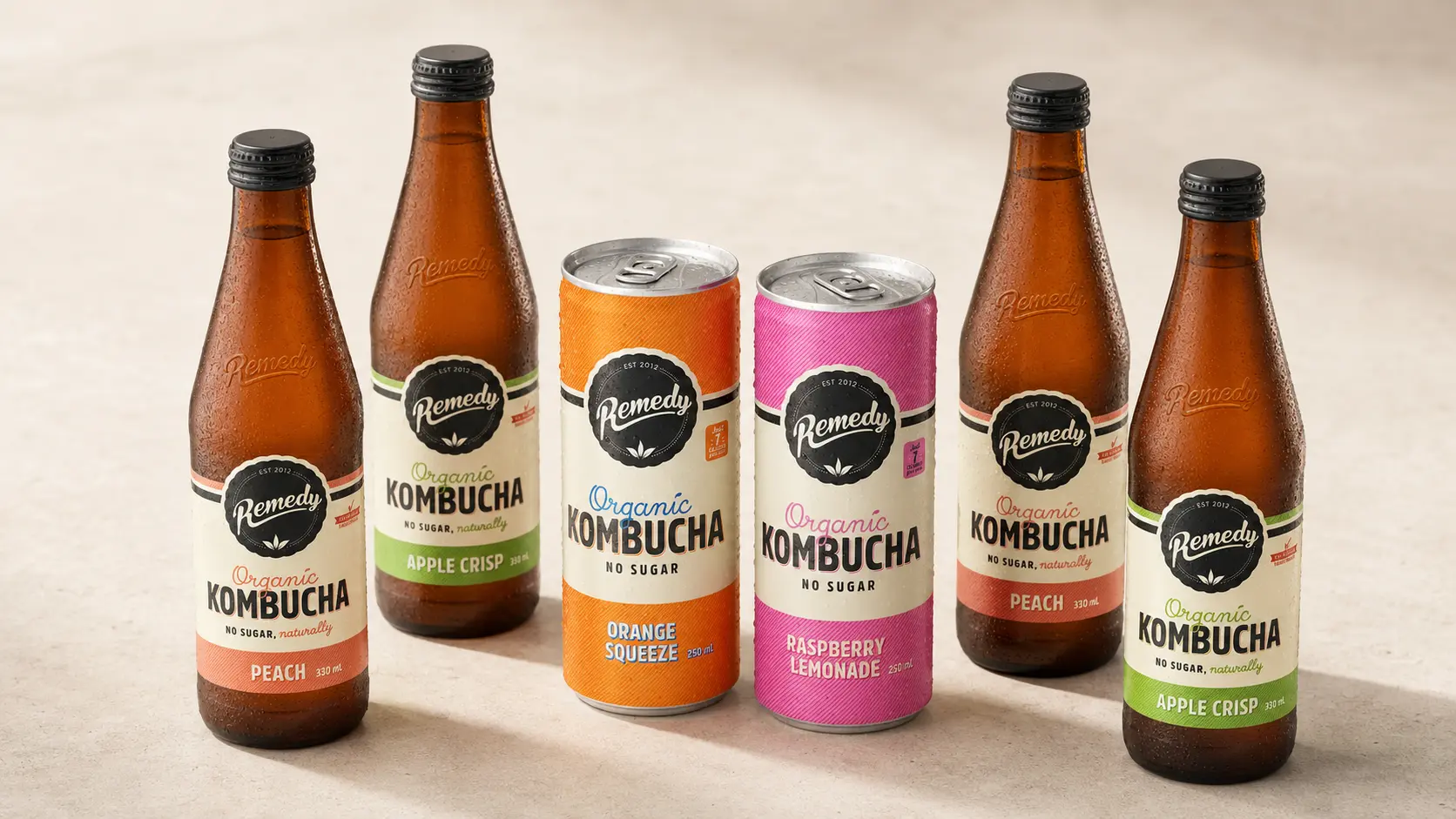
Ginger Lemon · Lemon Lime & Mint · Mango Passion · Orange Squeeze · Raspberry Lemonade · Wild Berry · and others. Individual ingredient lists available at remedydrinks.com. All flavours reviewed use the same base structure: sparkling water in the kombucha base, erythritol and stevia, and natural flavour extract declarations throughout.
The Passionfruit label is representative of the full range. Sparkling water, erythritol, stevia, and natural flavour extracts appear consistently across all Remedy Kombucha products reviewed.
Nutrition — Confirmed from Physical Label (per 100ml)
| Nutrient | Per 100ml | vs KombuchaSG threshold |
|---|---|---|
| Energy | 12 kJ (3 Cal) | — |
| Sugar | 0.0g | ✓ Under 4g threshold |
| Live Cultures (CFU) | 100 million | ✓ Published on label |
| Tea Polyphenols | 25mg | — |
| Organic Acid (Acetic) | 0.2g | — |
| Sodium | Less than 5mg | — |
CFU footnote on physical label: “Remedy natural live cultures are a result of our long-aged fermentation.” No separately added probiotics declared.
Scorecard Breakdown
| Criteria | Finding | Score |
|---|---|---|
| SCOBY origin & integrity Max 15 pts — Live, documented culture. Not a vinegar shortcut. | “Wild kombucha culture” is declared as a named ingredient. The label footnote explicitly states: “Remedy natural live cultures are a result of our long-aged fermentation” — confirming cultures are not added separately post-fermentation. 30-day fermentation duration. “Strands of the kombucha may appear — these are signs of a natural, healthy and raw kombucha” is declared on the physical label, consistent with genuine SCOBY culture activity. The brand has brewed consistently since 2012. No SCOBY lineage or origin is documented. | 12 / 15 |
| Carbonation source Max 15 pts — Natural 2nd fermentation only. No added carbonated or sparkling water. | Sparkling water is explicitly declared as the first ingredient inside the kombucha base bracket: “Certified organic raw kombucha (sparkling water, wild kombucha culture*, black tea*, green tea*).” This is confirmed from the physical bottle label. The criterion requires natural second fermentation as the sole carbonation source, with no added carbonated or sparkling water. Sparkling water is present in the base. The criterion is not met. The front label declares “Sparkling” — this is accurate, but the source of that sparkling character is confirmed to include added sparkling water, not natural fermentation alone. | 0 / 15 |
| Flavouring method Max 15 pts — Whole fruit or botanicals. No artificial flavours or vague “natural flavouring.” | “Natural passionfruit flavour” and “natural lemongrass flavour” are both flavour extract declarations — not whole passionfruit, not whole lemongrass root or stalks. Lemon juice is the only whole ingredient in this flavour. Across the range, all Remedy flavours use “natural [fruit] flavour” declarations — no whole fruit, no real botanicals. This is the same vague flavouring pattern penalised consistently across the KombuchaSG review directory. The organic certification covers the base ingredients but not the flavouring declarations, which are extract-based throughout. | 5 / 15 |
| Live cultures at point of sale Max 15 pts — Lab-verified CFU count or visible culture activity. Not pasteurised. | Remedy publishes a CFU count on the physical label: 100 million live cultures per 100ml (330 million per 330ml bottle). The footnote confirms: “Remedy natural live cultures are a result of our long-aged fermentation” — not added separately. “RAW & VEGAN” is declared on the label. “Strands of the kombucha may appear” is stated as evidence of live culture activity. Two factors create uncertainty: the product is shelf-stable (can be stored outside the fridge — “best served chilled” rather than “must be kept refrigerated”), and the sugar content is 0.0g — meaning there is no remaining fermentable substrate to support ongoing culture activity. Imported from Australia, so cold chain considerations apply. | 12 / 15 |
| Sugar content after fermentation Max 15 pts — Under 4g per 100ml. Consumed by SCOBY during fermentation. | Sugar: 0.0g per 100ml — confirmed from the physical nutrition panel. This is the result of a genuine 30-day fermentation process that converts all available cane sugar into organic acids. The scorecard criterion is fully met: sugar is under 4g per 100ml. The reader should be aware that the sweetness experienced when drinking Remedy does not come from residual fermented sugar — it comes from erythritol and steviol glycosides added post-fermentation. These are non-caloric sweeteners that do not register as sugar in nutrition panels. The “no sugar” claim is technically accurate. The sweetness in the glass is from sweetener additions. | 15 / 15 |
| Ingredient transparency Max 15 pts — Full disclosure. No vague terms. Every ingredient clearly identified. | Remedy publishes a CFU count (100 million per 100ml), organic acid content (0.2g acetic acid per 100ml), and tea polyphenol content (25mg per 100ml) on the physical label — a level of nutritional transparency not offered by most other brands in this directory. Erythritol and steviol glycosides are declared clearly. The deductions come from the vague “natural [fruit] flavour” declarations throughout the range, and from the Singapore-market bottles carrying Australian domestic labels without Nutri-Grade compliance. A consumer in Singapore buying Remedy has no Nutri-Grade reference on the bottle, though the nutrition panel is present and detailed. | 10 / 15 |
| Production integrity Max 10 pts — Small-batch, controlled, traceable. Founder-led or craft production preferred. | Founded 2012, Melbourne. “Handcrafted in Melbourne” declared on label. Small batch 30-day fermentation. ACO Certified Organic. The brand has scaled significantly since founding and is now one of Australia’s largest kombucha producers, widely distributed across supermarket chains in multiple countries. “Small batch” language remains on the label — this describes the vessel methodology rather than the operational scale. Imported to Singapore on Australian domestic labels without local label adaptation — the bottle carries the Australian container deposit scheme mark (10c refund) and no Singapore-specific regulatory labelling. Score reflects the genuine production credentials alongside the scale and import considerations. | 7 / 10 |
| Total Score | 61 / 100 | |
Plain-Language Verdict
Remedy’s score of 61 reflects a product of two halves. The fermentation process is genuine: 30 days, wild kombucha culture, organic certification, and a published CFU count on the label that most other brands in this directory do not offer. The 0.0g sugar result is real — the SCOBY consumes all available sugar during fermentation. These are meaningful credentials that the scorecard recognises.
The carbonation criterion scores zero. Sparkling water is declared explicitly inside the kombucha base on the physical label — “certified organic raw kombucha (sparkling water, wild kombucha culture*, black tea*, green tea*).” The carbonation in this product comes from added sparkling water, not solely from natural fermentation activity. This is not an inference or an editorial opinion. It is what the label says.
The flavouring is entirely extract-based. “Natural passionfruit flavour” and “natural lemongrass flavour” are flavour compounds, not whole fruit or whole botanicals. No actual passionfruit appears in this passionfruit kombucha. The word “natural” in these declarations is not a regulated term in Singapore — it tells the reader nothing about whether real fruit was involved in producing the flavour extract.
On the “no sugar” claim: readers should understand what this means and what it does not mean. The 0.0g sugar is genuine — fermentation genuinely converts all available cane sugar into organic acids. However, Remedy then adds erythritol and steviol glycosides to restore sweetness. These are non-caloric sweeteners that do not register as “sugar” in nutrition panels. The product is legally, technically, and genuinely sugar-free. The sweetness you taste is from sweetener additions, not from the fermentation character. A consumer who reads “no sugar, naturally” and expects a product free of sweetener additions should read the ingredient list before purchasing.
Remedy is a legitimate, organic-certified product with real fermentation credentials. It is not a fake kombucha. But the sparkling water base, the extract-based flavourings, and the sweetener additions make it a commercially optimised product first and a craft fermented beverage second. Singapore readers looking for authentic kombucha character in the glass will find it elsewhere in this directory.
Editor’s Tasting Note
This section represents the personal tasting experience of the KombuchaSG editor and is entirely separate from the scorecard assessment above. The Passionfruit flavour was tasted from a cold physical bottle purchased at Singapore retail.
The experience is immediate and unambiguous: this tastes like sparkling water. Not like kombucha, not like fermented tea, not like passionfruit — like carbonated water with a flavour additive. The fermentation character that defines genuine kombucha — the tartness, the vinegar depth, the slight complexity that comes from an active live culture process — is absent.
The carbonation is aggressive and sharp. The sparkling water declared in the ingredient list is the dominant sensory character in the bottle. The natural passionfruit flavour extract produces a generic sweetened fruit note without any of the tang, acidity, or tropical depth that real passionfruit delivers. Lemongrass is not detectable as a distinct flavour — it blurs into the general sweetness.
The sweetness itself is notable. The product declares 0.0g sugar — but the erythritol and stevia produce a persistent sweetness that is the dominant aftertaste. This is a characteristic quality of these sweeteners: they produce sweetness without the quick fade that natural sugar provides, leaving a flat, chemical sweetness on the tongue that lingers after swallowing. This aftertaste was consistent with the lingering chemical sensation observed across several other brands reviewed in this directory.
A product that is organic, 30-day fermented, and live-cultured should taste like something. This tastes like sweetened sparkling water. For a consumer who has not yet experienced genuine, well-fermented kombucha, Remedy could create the impression that this is what kombucha is supposed to taste like. It is not. Brands like this, sold at premium health-beverage prices in mainstream supermarkets, do a disservice to the category they represent.
| Criterion | What it measures | Score | Max |
|---|---|---|---|
| Fermentation Character | Tartness, depth, live kombucha taste | 1 | 5 |
| Carbonation Feel | Soft and integrated vs sharp and aggressive | 1 | 5 |
| Flavour Honesty | Does it taste like the declared ingredients? | 1 | 5 |
| Overall Impression | Would you drink this again? | 1 | 5 |
| Editor’s Total | 4 | / 20 | |
Where to Buy
Remedy Kombucha is available at NTUC FairPrice, Cold Storage, and other major Singapore retailers. Imported by Wholesome Harvest Pte Ltd, 629 Aljunied Road #06-13, Singapore 389838. KombuchaSG does not verify current stock, pricing, or availability. Check NTUC FairPrice or Cold Storage online for current listings.
How this score was calculated
Every brand on KombuchaSG is assessed using the same 7-criteria, 100-point scorecard. The criteria are published in full before any brand is reviewed. Read The Standard to understand how every score on this site is calculated.
- → Back to all Singapore kombucha brand reviews
- → The Standard — the full 7-criteria scorecard
- → Real vs Fake Kombucha — the shortcuts explained
- → How to read a kombucha label
KombuchaSG is an independent educational platform. We are not affiliated with any kombucha brand. All ingredient and nutrition data in this review is confirmed from a physical 330ml Remedy Passionfruit bottle purchased at Singapore retail. The bottle carries an Australian domestic label without Singapore-specific regulatory labelling. All criteria are applied identically to every brand reviewed on this site.