Craft & Culture Kombucha — Review & Authenticity Score
Reviewed using the KombuchaSG 7-criteria authenticity scorecard. Same format, same criteria as every other brand on this site.
Brand Overview
Craft & Culture is one of Singapore’s longest-running artisan kombucha brands, founded in 2015 by Winnie and Zhiwei — a women-owned business built on genuine, deep fermentation experience. Winnie’s kombucha practice began in 2002 while studying in the United States, where she turned to fermented foods to manage chronic allergy and eczema issues after years on prescription steroids. Zhiwei came to fermentation through milk kefir, seeking a natural approach to her daughter’s eczema and food allergies. When they met on a business trip and discovered their shared passion, they started Craft & Culture immediately on returning to Singapore.
Between them, the founders bring over 20 years of fermentation experience. Their approach is rooted in function first — kombucha as a genuinely health-beneficial food rather than a lifestyle drink. The brand explicitly rejects the commercial industry norm of short fermentation and extended shelf life. Craft & Culture’s kombucha undergoes an extremely slow first fermentation of one to three months — significantly longer than the 7–14 days typical in the industry — which the brand credits with producing layers of flavour and beneficial compounds including glucosamine.
The brand’s products are sold flat — intentionally so. Craft & Culture’s kombucha is prepared fresh and unfizzy, with a shelf life of four to six weeks. Some natural carbonation may develop in the bottle over time. Customers who specifically want sparkling kombucha are directed to the brand’s separately carbonated products. This is an uncommon but principled position, and the brand is transparent about it.
Craft & Culture also produces milk kefir, probiotic skincare, and a Chinese tea kombucha range alongside its main black tea range. The brand operates online at craftculturesg.com with local delivery.
Front-of-Pack Claims
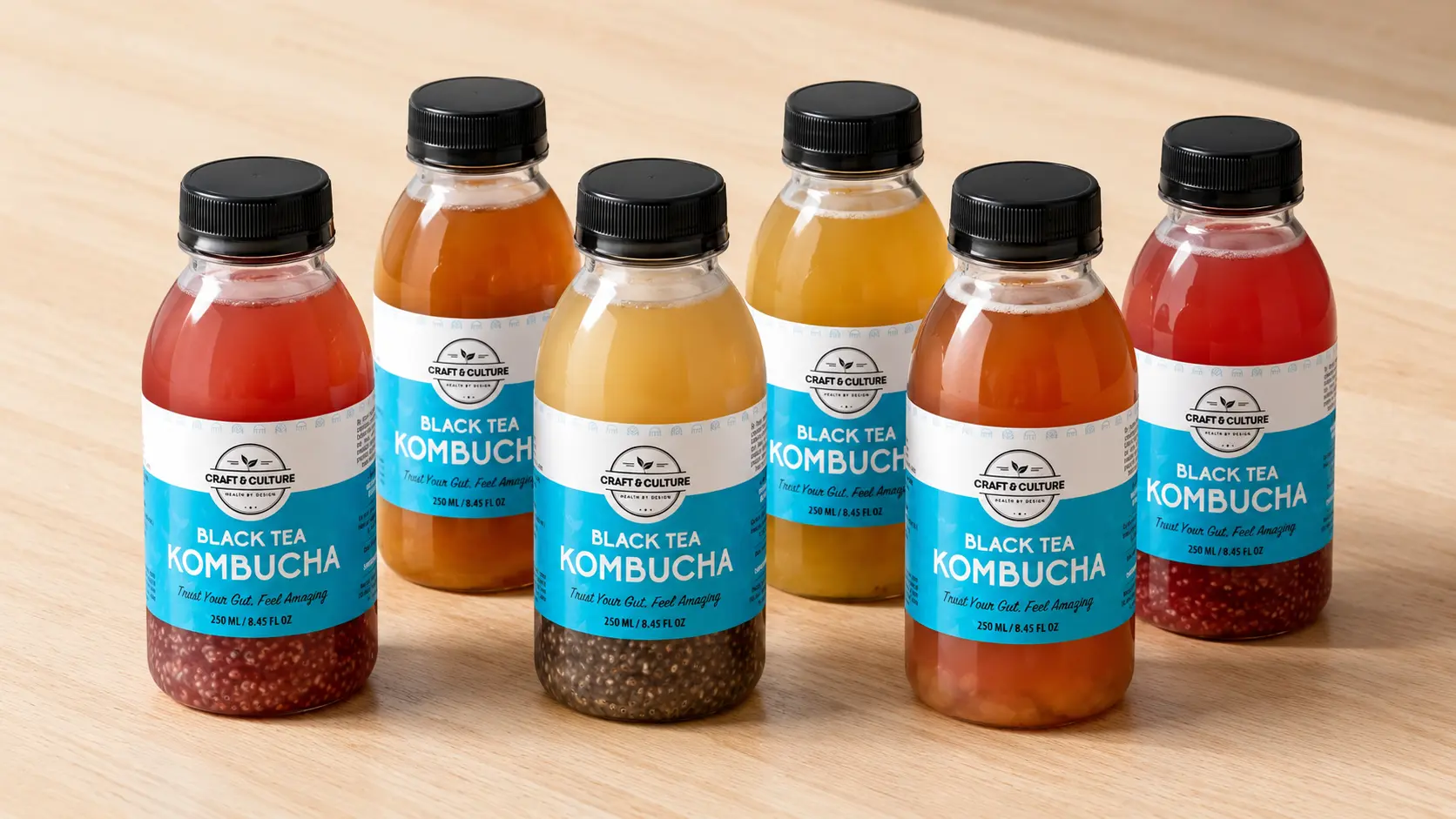
The following claims are taken directly from the physical bottle label.
- Tagline: “Trust Your Gut. Feel Amazing”
- Production: “Freshly fermenting products that are raw, unpasteurized & in small batches”
- Fermentation: “Artisanal Kombuchas are undiluted, lightly sweetened to feed our live probiotic bacteria”
- Alcohol: Non Alcoholic: <0.5% ABV
- Experimental Benefits (as printed): Boosts natural immunity · Promotes glowing skin health · Maintains gut health & reduces bloating · Increases efficiency of liver detoxification · Helps with the relief of allergy symptoms · Glucosamine is excellent for gout, arthritis & joints
- Probiotics declared: Bacillus Coagulans GBI-30 6086: 500 million · S. Boulardii: 500 million
- Organic acids declared: L-Theanine 50mg · Glucuronic Acid 5mg · Lactic Acid 25mg · Acetic Acid 15mg
- Sugar (Original): 10g per 250ml bottle (4g per 100ml) — Nutri-Grade: B
- Calories (Original): 40 per 250ml serving
What’s in the Bottle
Ingredient list quoted verbatim from the physical bottle label (Original / Black Tea, 250ml).
Black Tea Kombucha (all flavours — physical label)
Water, Cane Sugar, Black Tea, Kombucha cultures, indicated flavours.
Physical label verified. The label uses a single ingredient list for the entire range with “indicated flavours” as the flavouring declaration — covering Original, Ginger-Chia, Rose-Chia, Lychee, and other variants. Per-flavour calorie and sugar figures are listed separately on the label: Original (Cal 40, sugar 4%), Ginger-Chia (Cal 86, sugar 4.8%), Rose-Chia (Cal 90, sugar 4.8%), Lychee (Cal 50, sugar 4.8%), Other (sugar 4.5–5%).
Note on “indicated flavours”: The physical label uses the single declaration “indicated flavours” to cover all flavoured variants in the range. This is less specific than the per-flavour “Flavours (x)” declarations shown on the brand’s website (e.g. “Flavours (Citrus Blend)”, “Flavours (Rose)”). In Singapore food labelling, neither “Flavours” nor “indicated flavours” distinguishes between natural and artificial flavouring compounds or confirms the use of whole fruit or botanical ingredients. This declaration affects two scorecard criteria.
Note on ingredient order: On the physical label, Cane Sugar is listed second — before Black Tea. Under Singapore food labelling regulations, ingredients are listed in descending order by weight. This places sugar as the second most abundant ingredient by weight in the product, after water.
Scorecard Breakdown
| Criteria | Finding | Score |
|---|---|---|
| SCOBY origin & integrity Max 15 pts — Live, documented culture. Not a vinegar shortcut. | “Kombucha cultures” is declared as an ingredient on the physical label. The brand’s About page describes a SCOBY-based fermentation process and explicitly references organic acids, vitamins, and amino acids produced through fermentation — consistent with a genuine live culture process. Winnie has been brewing kombucha since 2002 and Zhiwei since before 2015, giving the brand over 20 years of combined active fermentation practice. A 1–3 month first fermentation duration significantly exceeds industry standard. No SCOBY lineage or origin documentation is published. | 11 / 15 |
| Carbonation source Max 15 pts — Natural 2nd fermentation only. No added carbonated or sparkling water. | No carbonated water or sparkling water appears in the physical label ingredient list. Craft & Culture’s kombucha is intentionally sold flat — the brand explicitly states its brews are “intentionally prepared fresh and flat.” The brand notes that natural carbonation may develop in the bottle over time due to active cultures. No added CO₂ or sparkling water is declared or implied anywhere in brand materials or on the physical label. The criterion is met. | 15 / 15 |
| Flavouring method Max 15 pts — Whole fruit or botanicals. No artificial flavours or vague “natural flavouring.” | The physical label uses “indicated flavours” as a single declaration covering all flavoured variants in the range. This is the most ambiguous flavouring declaration encountered in the Singapore kombucha market. It does not identify the flavouring compounds used, does not distinguish between natural and artificial, and does not confirm the use of whole fruit or botanical ingredients. The Original Black Tea, which carries no flavouring, is the only product in the range that would meet this criterion in full. Scored on the lowest-performing flavoured product. | 5 / 15 |
| Live cultures at point of sale Max 15 pts — Lab-verified CFU count or visible culture activity. Not pasteurised. | The physical label explicitly declares two named probiotic strains with stated counts: Bacillus Coagulans GBI-30 6086 at 500 million and S. Boulardii at 500 million. Organic acids are also declared by name and amount: L-Theanine 50mg, Glucuronic Acid 5mg, Lactic Acid 25mg, Acetic Acid 15mg. The label states the product is “raw, unpasteurized.” The short shelf life of 4–6 weeks and the brand’s note that natural carbonation may develop in the bottle are consistent with active, living cultures. The named strains and declared counts represent a higher standard of transparency than most Singapore kombucha brands. No third-party lab certification is published, and Bacillus Coagulans and S. Boulardii are added probiotics rather than strains native to traditional SCOBY-driven kombucha fermentation — a distinction worth noting for informed readers. | 13 / 15 |
| Sugar content after fermentation Max 15 pts — Under 4g per 100ml. Consumed by SCOBY during fermentation. | The physical label Nutrition Facts panel declares Sugars as 10g per 250ml serving — equivalent to 4g per 100ml. The criterion requires under 4g per 100ml. At exactly 4g per 100ml for the Original variant, the product sits at the threshold but does not go below it. Flavoured variants declare higher sugar levels: Ginger-Chia and Rose-Chia at 4.8%, Lychee at 4.8%, and other variants at 4.5–5%. The scorecard criterion is applied uniformly: under 4g per 100ml. The declared level does not meet this threshold. | 0 / 15 |
| Ingredient transparency Max 15 pts — Full disclosure. No vague terms. Every ingredient clearly identified. | The base ingredients — water, cane sugar, black tea, kombucha cultures — are clearly declared. The probiotic strains and organic acid content are declared by name and quantity, which is a meaningful level of transparency. However, two issues reduce the score. First, “indicated flavours” is the least specific flavouring declaration found in the Singapore kombucha market and provides no information about what the flavouring compounds are. Second, cane sugar appears second in the ingredient order — ahead of black tea — indicating it is the second-largest ingredient by weight. This is consistent with the brand’s stated position that residual sugar feeds the probiotic culture, but it is a labelling reality that readers should be aware of. | 6 / 15 |
| Production integrity Max 10 pts — Small-batch, controlled, traceable. Founder-led or craft production preferred. | Women-founded and owner-operated since 2015. Winnie and Zhiwei bring over 20 years of combined fermentation experience. Small-batch, handmade production is declared consistently across brand materials and on the physical label. The 1–3 month first fermentation duration reflects a serious, controlled process significantly beyond industry standard. The four to six week shelf life confirms the product is not stabilised for commercial distribution. Manufacturing address confirmed on physical label: 183 Jalan Pelikat, B1-113, Singapore 537643. | 8 / 10 |
| Total Score | 58 / 100 | |
Plain-Language Verdict
Craft & Culture is one of Singapore’s most genuine fermentation businesses by background. Winnie and Zhiwei are the real thing — two women who came to kombucha through personal health need, built serious brewing knowledge over decades, and have been producing craft kombucha in Singapore since 2015. Their 1–3 month slow fermentation is not marketing language; it is a deliberate process choice that puts them well outside commercial norms. Their product is sold flat, fresh, and with a short shelf life — none of which is typical of brands optimising for convenience and scale.
The Partially Authentic score reflects two specific labelling choices, not the brand’s character. The first is the “indicated flavours” declaration used across the flavoured range on the physical label — the most ambiguous flavouring declaration encountered in the Singapore kombucha market. The brand may well be using natural, high-quality flavour compounds, but the label does not confirm this, and the scorecard can only score what is declared.
The second is sugar content. The Original variant sits at exactly 4g per 100ml — right at the scorecard threshold, not below it. Flavoured variants rise to 4.8–5%. The brand openly defends this as a principled brewing choice based on the belief that residual sugar is necessary for a genuinely probiotic-active culture. This is a legitimate position in the fermentation world. The KombuchaSG scorecard applies the same 4g criterion to every brand.
One genuinely positive finding from the physical label: the explicit declaration of named probiotic strains with stated counts is a higher standard of transparency than most Singapore kombucha brands provide. A reader who prioritises live culture potency and genuine small-batch craft may find Craft & Culture a compelling choice. The scorecard is one framework. It does not capture everything.
Editor’s Tasting Note
This section represents the personal tasting experience of the KombuchaSG editor and is entirely separate from the scorecard assessment above. Tasting notes are subjective and reflect one person’s experience with a single bottle on one occasion.
As one of Singapore’s kombucha pioneers — with significant media coverage across YouTube, newspapers, and lifestyle press — Craft & Culture carries the weight of expectation that comes with being first. That context made this tasting more disappointing than it might otherwise have been.
The first thing that stood out before a single sip was the packaging. Craft & Culture uses plastic bottles. For a brand that positions itself on raw, living fermentation and genuine craft brewing principles, this is a fundamental contradiction. Plastic is porous and not inert — it is unsuitable for a raw, active fermented product that continues to develop in the bottle. Glass is the standard for a reason, and any brewer serious about their product’s integrity will know this. It is a basic that a brand of this experience and standing should not be getting wrong.
The liquid itself compounded the disappointment. Despite the label declaring two named probiotic strains at 500 million CFU each, and organic acids including lactic acid and acetic acid — the chemical signatures of genuine fermentation — the drink delivered almost none of the fermentation character you would expect. The tartness, the depth, the slight funk that marks a well-fermented kombucha: all of it was either absent or so faint as to be undetectable. It read more like lightly sweetened tea than kombucha. Whether this is a result of under-fermentation, significant dilution with water, or the long fermentation time producing a different profile from what the label implies — it is difficult to say. What is clear is that the drinking experience did not match the label’s promises.
The one saving grace: no fake carbonation, no sparkling water, no artificial fizz. The flatness is exactly what the brand declares, and that much is honest.
| Criterion | What it measures | Score | Max |
|---|---|---|---|
| Fermentation Character | Tartness, depth, live kombucha taste | 1 | 5 |
| Carbonation Feel | Soft and integrated vs sharp and aggressive | 3 | 5 |
| Flavour Honesty | Does it taste like the declared ingredients? | 2 | 5 |
| Overall Impression | Would you drink this again? | 1 | 5 |
| Editor’s Total | 7 | / 20 | |
Where to Buy
Craft & Culture is available online at craftculturesg.com. KombuchaSG does not verify current stock availability, pricing, or delivery areas. Check the brand website directly for the most up-to-date information.
How this score was calculated
Every brand on KombuchaSG is assessed using the same 7-criteria, 100-point scorecard. The criteria are published in full before any brand is reviewed. Read The Standard to understand how every score on this site is calculated.
- → Back to all Singapore kombucha brand reviews
- → The Standard — the full 7-criteria scorecard
- → Real vs Fake Kombucha — the shortcuts explained
- → How to read a kombucha label
KombuchaSG is an independent educational platform. We are not affiliated with any kombucha brand. Scorecard findings are based on physical bottle label verification and publicly available brand materials. All criteria are applied identically to every brand reviewed on this site.